
- Trump’s rejection of Iran’s proposal sours risk sentiment in Asia
- US payrolls beat while Canada unexpectedly shed jobs in April
- Geopolitics and sentiment outweigh relative rate pricing
- Bullish engulfing pattern warns USD/CAD rebound may extend further
Iran Optimism Fades Again
USD/CAD may face additional upside risks this week after Donald Trump rejected Iran’s latest counterproposal for peace talks, posting on Truth Social late Sunday: “I don’t like it - TOTALLY UNACCEPTABLE.” The remarks have seen risk sentiment sour in early Asian trade on Monday, adding to an already supportive backdrop for the pair following divergent economic data alongside improving technicals.
Economic Divergence Widens
Friday’s labour market reports reinforced the divergent economic signals coming from the United States and Canada, with US payrolls growth rising by 115,000 in April, near doubling expectations, while Canada unexpectedly shed 17,700 jobs outright. While the underlying details of the US report were softer than the headline suggested, including a 0.2 percentage point drop in participation to 61.4% and another decline in household employment, it still contrasted sharply against the deterioration seen north of the border where full-time employment plunged by 46,700 and the unemployment rate climbed to 6.9%, the highest level in six months.
Source: Bloomberg
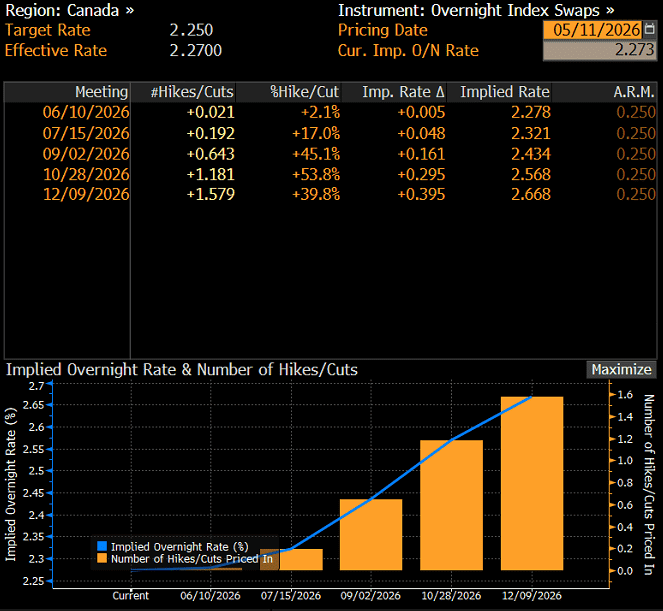
The Canadian data saw markets push back the expected timing of the first rate hike from the Bank of Canada well into the second half of the year. Based on overnight index swap pricing, September is now viewed as the first genuinely live meeting for a hike with implied odds sitting around 64%, while a full 25 basis point move is now seen by October. By contrast, the stronger US payrolls report generated little reaction in front-end Fed pricing, with futures traders continuing to price no movement in the Fed funds rate through 2026.
Trump-Xi Meeting Adds Event Risk
While the US calendar remains busy this week with inflation and retail sales data due for release, Friday’s payrolls report again highlighted how difficult it may be for economic data alone to dominate broader market direction in the current environment unless it materially shifts the interest rate outlook. With little of significance scheduled on the Canadian calendar, geopolitics, sentiment and technicals may remain the more influential forces for USD/CAD.
The other event traders should be mindful of this week will be talks between Trump and Xi Jinping on May 14 and 15. Given prior form, there is a risk the US administration attempts to bolster sentiment through more optimistic rhetoric surrounding either trade relations with China or prospects for de-escalation in the Iran conflict ahead of the meeting. Should that occur, it may help stabilise broader risk sentiment and cap USD/CAD upside at the margin, especially after the sharp reversal already seen from last week’s lows.
Bullish Signals Building
Technicals arguably carry greater sway in USD/CAD right now than other currency pairs given both the United States and Canada are major energy exporters with freely floating currencies, helping it avoid some of the more binary moves seen elsewhere during geopolitical shocks.

Source: TradingView
From a technical perspective, the directional call made last Monday proved accurate, with USD/CAD extending its rebound despite risk appetite remaining broadly supported through much of last week. The pair broke the downtrend running from the April highs before kissing resistance at 1.3710 ahead of Friday’s close.
The weekly chart shown in the insert in the bottom left reveals a clear bullish engulfing candle that warns the corrective bounce may extend further this week, especially with other recent reversal patterns delivering accurate signals. That leaves 1.3710 as the immediate resistance level overhead to watch alongside the confluence of the 50 and 100-day moving averages located only 10 pips above.
Should the pair establish a foothold above the moving average zone, 1.3750 and 1.3800 stand out as possible upside targets before attention shifts towards the 200-day moving average and 1.3860 resistance beyond. On the downside, there’s little in the way of meaningful support beneath current levels until the May 1 swing low at 1.3550, although bids may emerge on dips back towards 1.3600.
While still neutral in the overall message, RSI (14) and MACD are beginning to hint at shifting directional risks, with the former trending higher and back near the neutral 50 level while the latter has crossed the signal line from below despite remaining in negative territory. Momentum had firmly favoured the bears previously, but that no longer appears the case, placing greater emphasis on price action when assessing setups from here.