Oil prices initially opened higher following weekend reports that Iran had once again moved to restrict activity through the Strait of Hormuz. However, that early strength quickly faded, with crude retreating towards levels seen at the end of last week. At the time of writing, WTI crude was down around 2.5%, hovering near intraday lows. Part of the weakness reflects the fact that the strait was not completely shut, despite shipping data showing a notable decline in vessel traffic. More importantly, investors have responded positively to diplomatic developments in the region. The first round of talks between Washington and Tehran concluded with what Iranian Foreign Minister Abbas Araghchi described as “major progress” while securing a ceasefire in Lebanon also appeared to advance. With efforts towards a lasting peace ongoing, this could put further pressure on crude oil forecast in the near-term. That said, the scope for a deeper sell-off may be limited given that much of the geopolitical premium has already been removed from prices and underlying demand remains resilient.
Inventory rebuilding could help stabilise the market
For now, the market’s immediate direction still appears tilted to the downside as tensions in the Middle East ease. Crude has already surrendered most of the gains accumulated during the conflict period. Oil prices are now approaching the range that prevailed before disruptions intensified, suggesting that most of the war-related premium has been priced out. Prior to the war, WTI was trading in the $65-$66 per barrel region, an area that could provide meaningful support if prices continue to retreat.
However, the disruptions affecting the Strait of Hormuz over recent months has created a significant imbalance between supply and demand, tightening global markets and reducing available inventories. So, even if WTI were to return to pre-war levels, don’t expect it to continue heading south.
For one thing, releases from strategic reserves, which helped offset some of the supply shortfall experienced during the disruption, will need to be replenished. As prices retreat, many countries will likely look to rebuild inventories that were drawn down during the period of heightened uncertainty. Major consumers including China, Japan and the United States may take advantage of lower prices to replenish reserves. Such buying activity could provide an important source of support for the crude oil forecast over the coming weeks.
That said, stronger demand may be partly offset by rising output from producers including Iran and Venezuela. Unless geopolitical tensions flare up again, additional supply could cap any meaningful upside in prices.
Another factor worth watching is the US dollar. A stronger greenback typically weighs on dollar-denominated commodities, creating an additional headwind for both oil and precious metals.
Why a sharp collapse still looks unlikely
While further near-term downside cannot be ruled out, the conditions for a dramatic collapse in oil prices do not appear to be in place.
The direction of the crude oil forecast from here will largely depend on how supply growth balances against demand trends. On the consumption side, several supportive factors remain intact.
Strategic reserve replenishment programmes are likely to generate fresh demand, while the US summer driving season should continue to underpin fuel consumption. Seasonal strength in gasoline demand could help keep inventories relatively tight, even as OPEC members and Iran gradually increase production.
As a result, any additional weakness in crude may prove more measured than aggressive, particularly if demand remains robust through the third quarter, or if the return to pre-war production levels prove to be more difficult than expected.
WTI technical outlook
From a technical perspective, WTI has been trending lower for several weeks, leaving momentum indicators increasingly stretched to the downside.
That raises the possibility of a corrective rebound on oil prices, particularly if geopolitical tensions re-emerge and threaten supply routes through the Strait of Hormuz or other strategically important areas.
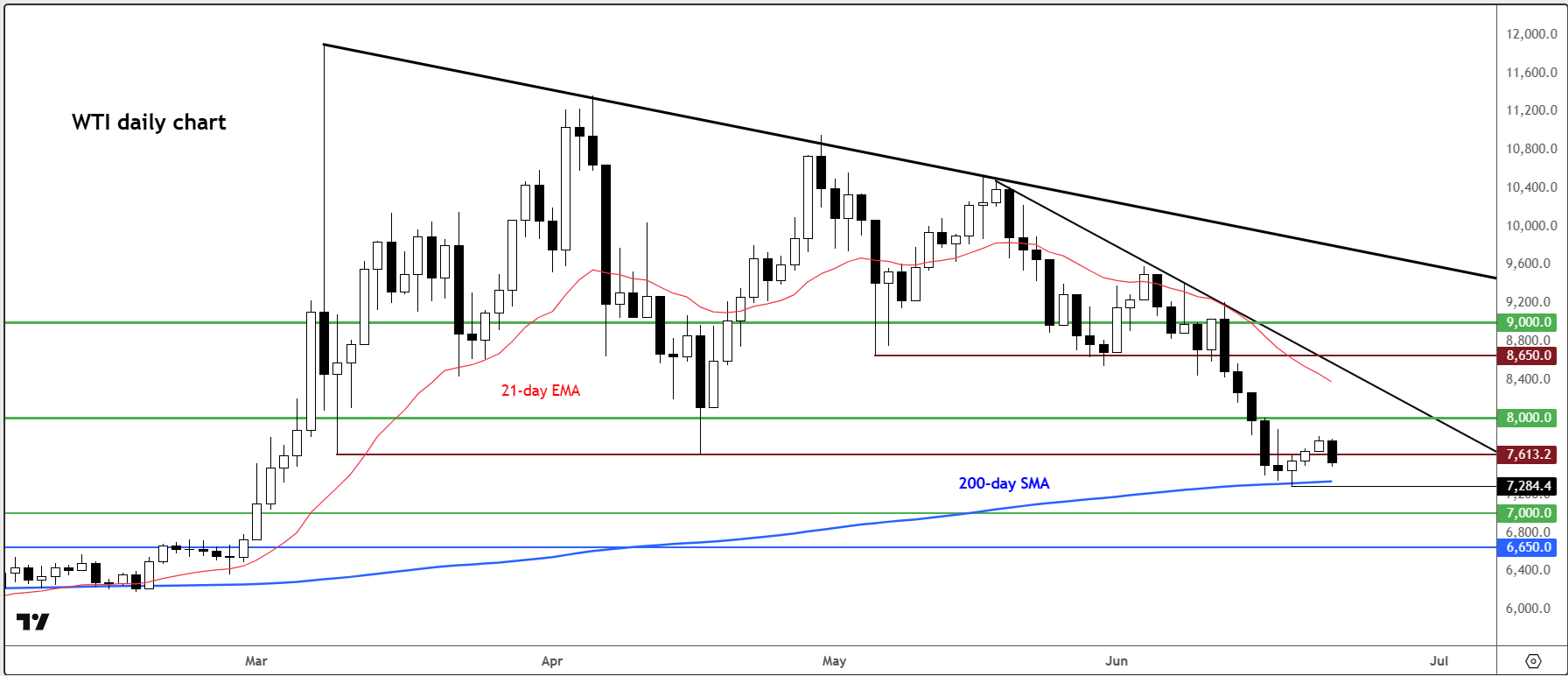
WTI was testing the $73-$74 per barrel region at the time of writing. This area represents a support zone as prices managed to hold above here during the final sessions of last week, while the 200-day moving average is also located nearby, reinforcing its significance.
Should that support fail, attention would likely shift towards the psychologically important $70 level. Below that, traders may focus on the pre-conflict trading range near $66-67 per barrel.
On the upside, the first key resistance level comes in around $76.10. This area acted as support earlier in the year before eventually giving way, and recent price action suggests it is now functioning as resistance.
A move above $76.10 would improve the short-term technical outlook and could open the door to a recovery towards $80 per barrel. In the event of a significant resurgence in Middle East tensions, a move into the $85-$86 region cannot be ruled out.

-- Written by Fawad Razaqzada, Market Analyst
Follow Fawad on Twitter @Trader_F_R