- Crude oil outlook dominated by geopolitics, not fundamentals
- Strait of Hormuz disruptions could send prices soaring
- Traders may wish to stay nimble amid crude volatility
It is all about the oil market right now, and the volatility there is creating side effects on nearly everything else: stock indices, FX majors and even cryptos. In short, when oil goes up, it is risk off. When it eases back down, risk assets stage corrective bounces. But the risks to the energy market remain tilted to the upside as the whole world awaits Iran’s response to the weekend US air strikes. Ahead of Iran’s potential response, oil prices began the week jolting higher at the Asian open as traders digested the weekend’s US airstrikes and fresh rocket exchanges between Israel and Iran. That early jump, however, proved short-lived. Prices soon retreated, closing the weekend gap and even falling lower than Friday’s finish. Still, the crude oil outlook remains firmly tilted to the upside in the short-term, courtesy of geopolitical uncertainty. For now, oil’s rally has little to do with tightening fundamentals. Quite the opposite: global demand is looking soggy, and OPEC+ appears happy to keep increasing supplies. But with the spectre of Iranian retaliation and the US now actively involved, traders are buying risk insurance, not barrels.
Iran’s response awaited
All eyes are on Tehran’s response now. Thus far, Iran’s has not responded in a meaningful way, but that could shift at any moment. Should Iran escalate—whether through direct strikes on US assets, attacks by proxies like Hezbollah, or sabotage of oil infrastructure in the Gulf—the market will react swiftly.
The Strait of Hormuz is the wildcard. Roughly 20% of the world’s oil passes through this narrow choke point daily. Iran’s parliament has signalled its intent to close the strait in response to US actions, though the final decision rests with the national security council. A full blockade would hurt Iran as well, given its dependency on crude exports to Asia—but asymmetric attacks on ships or terminals remain a very real possibility.
The current price moves, then, are best seen as a risk premium. There’s been no disruption to supply—yet. But the market knows all too well how quickly that could change.

Crude oil outlook: Fundamentals take a backseat
From a macroeconomic lens, the crude oil outlook appears uninspiring. Demand growth is anaemic, particularly across Europe, where fresh PMI data paints a picture of economic stagnation. The Eurozone’s manufacturing PMI remains stuck below 50, and the services sector barely eked out expansion in June.
Moreover, with OPEC+ supply edging higher, one might reasonably expect downward pressure on prices. Yet the geopolitical premium remains in firm control, keeping the downside limited for now.
Trading strategy: Stay light, stay flexible
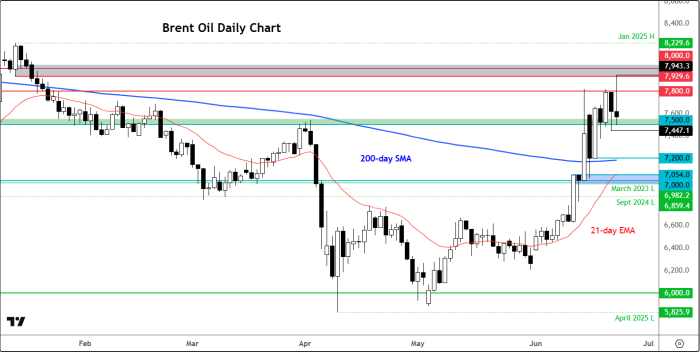
In such an environment, the best approach is one of caution and agility. With market moves driven more by headlines than fundamentals, traders should keep their positioning nimble. If tensions escalate, Brent could make a clean break above the $78 mark and press on towards $80—a level both psychologically significant and technically meaningful.
Source: TradingView.com
On the downside, initial support lies at $76, with a firmer floor around $75. A sustained break below there could bring the low $70s back into view—particularly if diplomacy takes centre stage and tempers cool.
In short, the crude oil outlook is a geopolitical guessing game, with fundamentals playing second fiddle. Stay sharp, trade light, and prepare to pivot as events unfold.
-- Written by Fawad Razaqzada, Market Analyst
Follow Fawad on Twitter @Trader_F_R