

Over the past four trading sessions, WTI crude has shown price fluctuations of less than 1%, reflecting a steady neutral bias that has persisted in recent sessions. Concerns about a potential market oversupply have kept short-term indecision intact, and as long as there is no clear signal regarding the OPEC+ production strategy, it is likely that the lack of direction will continue to limit oil’s movements, keeping prices within a neutral range over the coming days.

What’s Happening with Oil Supply?
Concerns about global oil supply remain, especially following the latest OPEC+ meeting, where members decided to increase daily production by 137,000 barrels starting in December of this year. In addition, U.S. output continues to reach record levels, with production exceeding 13.2 million barrels per day, according to recent EIA data.
This situation has limited the potential for a sustained recovery in oil prices, despite the initial positive expectations for demand at the start of the week, driven by hopes that an end to the U.S. government shutdown could partially stimulate economic activity toward year-end. However, fears of oversupply persist, as the market anticipates a potential production surplus in early 2026, fueled by both rising U.S. output and OPEC+ production increases, which are expected to be discussed in the group’s next meeting scheduled for early December.
For now, medium-term forecasts do not point to a significant price rebound. According to EIA STO projections, crude futures are expected to remain around $60 per barrel during the final months of 2025 and the early part of 2026, while spot prices could drop below $50 per barrel. This reinforces a neutral outlook, where the main source of pressure stems from the sustained growth in global supply, particularly from the U.S. and OPEC+ countries.
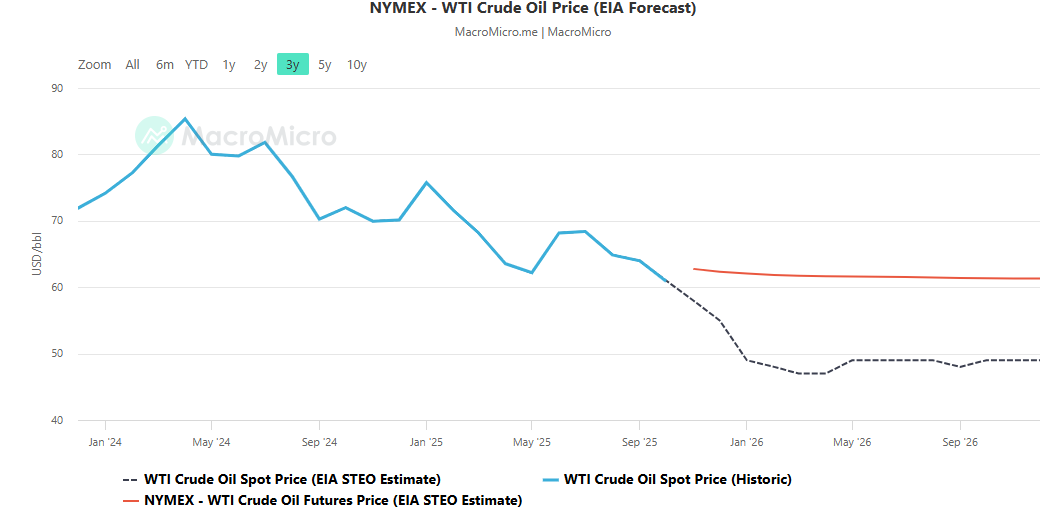
Source: MacroMicro
As a result, although WTI has recently attempted to recover amid slightly improved demand expectations, the dominant factor remains the risk of oversupply. If production rates continue to rise toward the end of the year, the resulting imbalance between supply and demand could intensify selling pressure, making it difficult for crude oil to achieve a sustained recovery in the short term.
WTI Technical Outlook
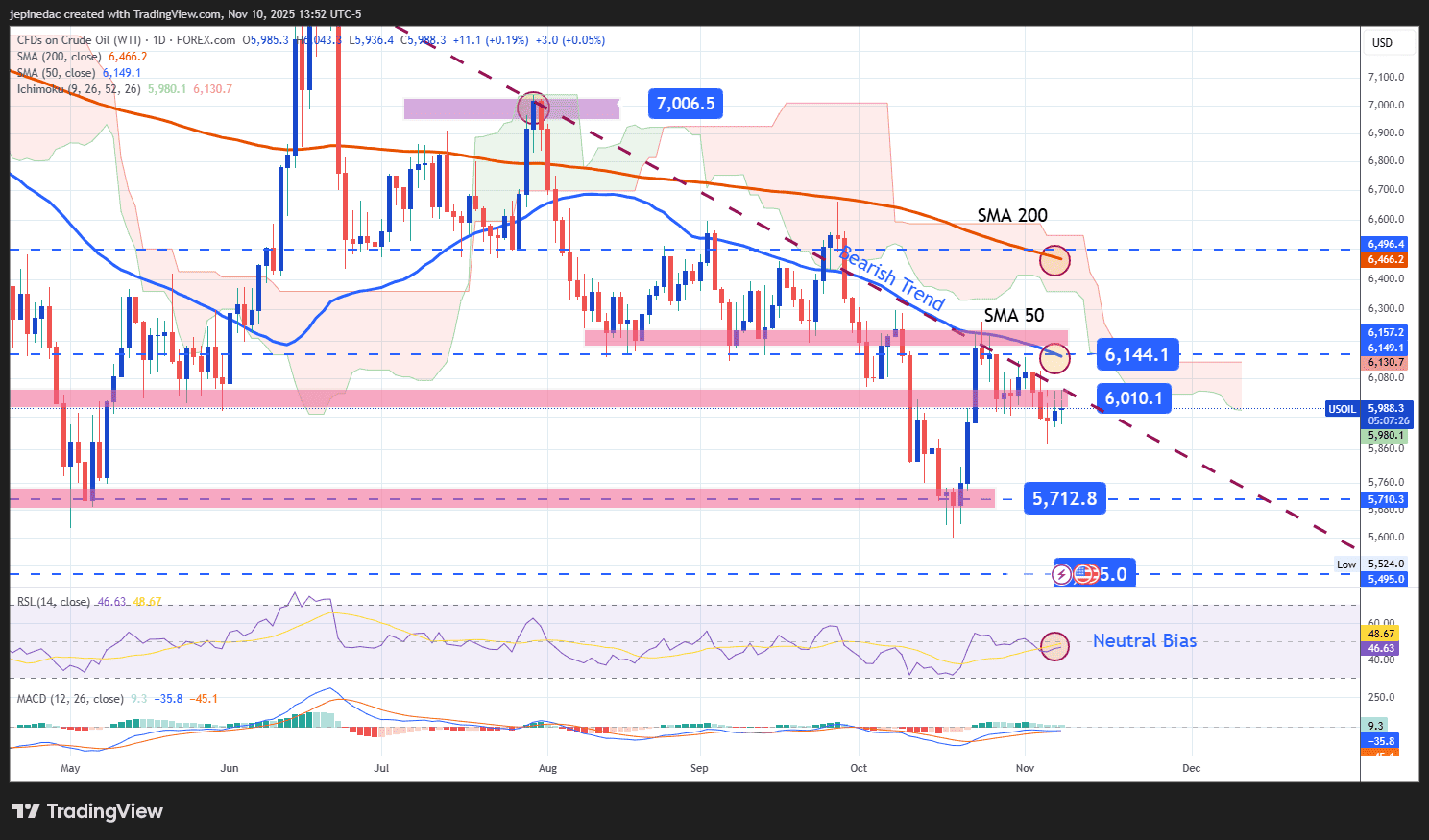
Source: StoneX, Tradingview
- Downtrend remains intact: Recent WTI movements continue to reflect a consistent downward trend, aligned with a descending trendline that still defines price direction. The dominant bias remains bearish, and as long as prices stay below the 50-period moving average, the downtrend is likely to remain active in the coming weeks. The absence of sustained bullish corrections reinforces this technical structure, which remains the most relevant pattern to monitor in the short term.
- RSI: The RSI line continues to move near the neutral 50 level, indicating that the average momentum over the past 14 sessions reflects a neutral bias. If this behavior continues, a period of price indecision could persist in the oil market over the next few sessions.
- MACD: The MACD indicator shows a similar behavior, with its histogram oscillating around the zero line, confirming the lack of a clear directional trend. This pattern suggests that the neutral bias could remain dominant unless a new bullish or bearish catalyst emerges.
Key Levels to Watch:
- $62 – Major Resistance: This level coincides with the 50-period moving average and an important retracement zone observed in recent months. A sustained breakout above this level could weaken the current downtrend and trigger a short-term bullish bias.
- $60 – Psychological Barrier: This area represents a key short-term psychological level. While prices fluctuate around this point, the market is likely to remain range-bound, though continued weakness could lead to renewed downward pressure if no bullish catalyst appears.
- $57 – Key Support: This marks the annual low zone. A break below this level could reactivate dominant bearish pressure, reinforcing the downward trend and potentially leading to a new bearish leg in the coming sessions.
Written by Julian Pineda, CFA, CMT – Market Analyst
Follow him on: @julianpineda25