
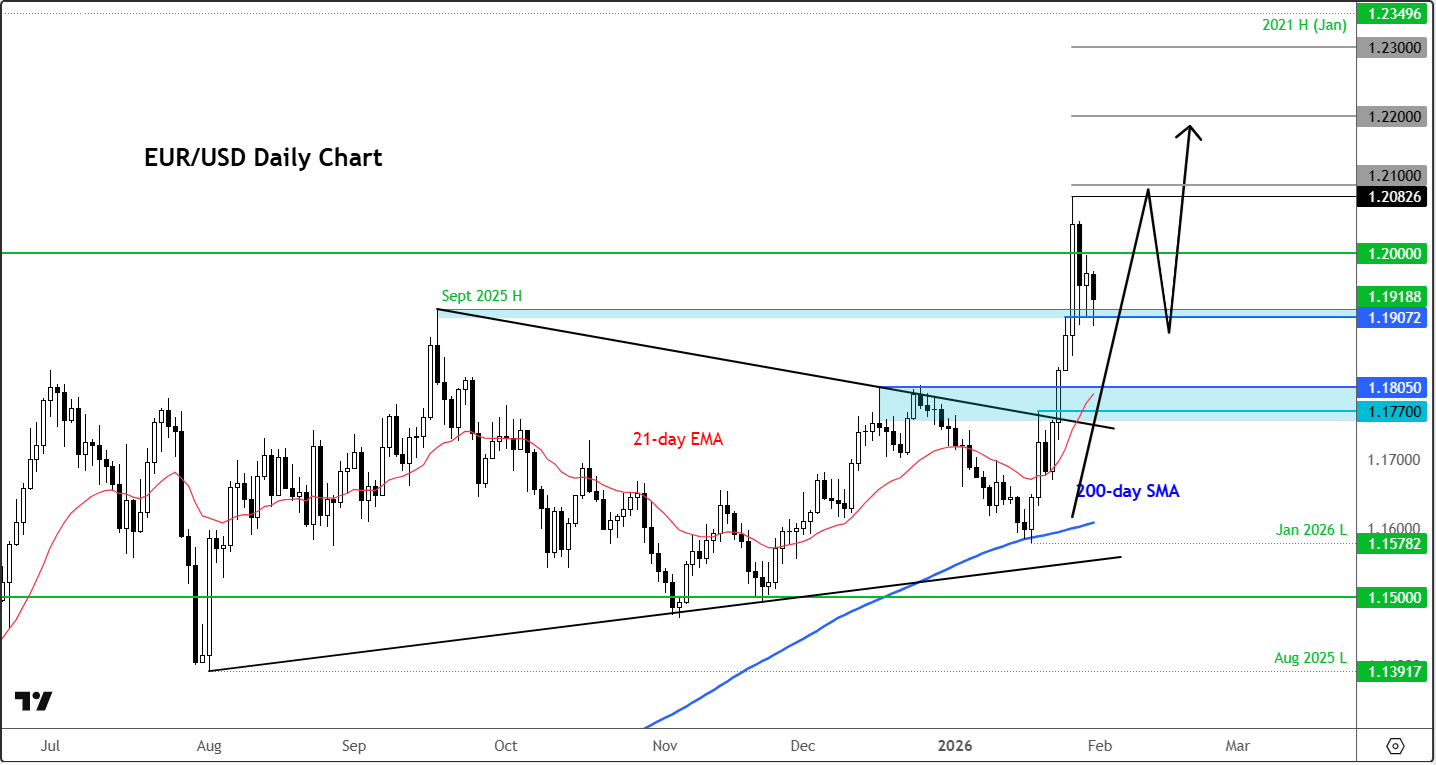
The EUR/USD was bouncing off its earlier lows at the time of writing, after the pair fell along with other majors as the US dollar rallied. Eurozone growth data beat expectations, helping the single currency a little. But elevated risks of Iran being hit by the US at the weekend meant traders remained on the edge. Looking ahead, we have US PPI coming up, before a big week for US data next week. Warsh’s nomination to replace Powell at the Fed has – for now – caused a bit of support for the dollar, though the risks still remain titled to the upside for the EUR/USD forecast as the pair coils inside a bullish continuation pattern above 1.19 handle.
Dollar finds mild support as Powell picks Warsh
The US dollar managed to extend its recovery overnight against certain currencies, and we saw big falls in precious metals. The dollar gains certainty seems to have been first on expectations and then confirmation that Trump would nominate Kevin Warsh as the new Fed Chair. Most currency strategists would argue that his nomination may be good news for the dollar, which can price out some risks of a more dovish pick. The dollar has also stopped falling against the yen after the US government denied the possibility of intervening the USD/JPY recently. However, for as long as policy uncertainty hangs over the US economy with Trump’s tariff theatrics, the dollar debasement narrative is likely to hold back the greenback from making a meaningful comeback.
Eurozone economy grew a tad better than expected in Q4
Eurozone GDP grew by 0.3% in the final quarter of 2025, rounding off the year on a fairly solid note despite the backdrop of ongoing uncertainty and economic tension. All things considered, that’s not a bad place to be. Looking into 2026, the mood is starting to brighten a little, with investment plans pointing towards a modest cyclical pickup. That said, structural challenges across the bloc haven’t gone away, so there’s still plenty to keep an eye on.
Growth held steady at 0.3% quarter-on-quarter in Q4, which was slightly better than markets had been expecting. Sentiment indicators towards the end of the year were fairly gloomy, so this outcome came as a mild positive surprise.
At a country level, Spain stood out with a robust 0.8% expansion, while Germany finally managed to escape stagnation with 0.3% growth. That in itself feels quite significant after a long period of flatlining. A cyclical rebound does seem to be taking shape, but it’s clear that more is needed if Germany is to really lift its long-term growth potential. With the effects of last year’s sizeable stimulus package likely to feed through this year, the outlook for the German economy remains cautiously optimistic. Stronger momentum in Spain and, to a lesser degree in Germany, helped offset the softer performance in France.
Strong euro vs. rebounding oil and their impact on EUR/USD forecast
Meanwhile, an improving Eurozone economy could keep the euro supported on the dips, even if the recent uptick in the exchange rate is going to increase calls for rate cuts from the ECB. This is because a rising currency will reduce imported inflation, raising the risks that CPI could fall below the ECB’s target. However, this is also slightly outweighing the impact of the pickup in crude oil, priced in US dollars. Concerns over Iran being attacked by the US is helping Brent trade near $70 per barrel. All told, however, I continue to see limited downside risks to the EUR/USD forecast and, if anything, expect modest further gains in the pair following the recent consolidation. Indeed, a new catalyst may be needed in the coming days to cause a trend reversal in the pair.
Looking ahead
Geopolitics could easily steal the spotlight again. There’s always the risk of the US striking Iran over the weekend, which would be negative for risk sentiment and could weigh on EUR/USD, potentially even leading to a gap at the open next week. Before that, we’ve got US PPI later today, though it’s unlikely to move the dial too much. The real focus on the macro picture comes next week, with a heavy run of data as the new month begins — ISM surveys first, then attention shifts to the labour market with ADP and, ultimately, the all-important payrolls report, next Friday.

-- Written by Fawad Razaqzada, Market Analyst
Follow Fawad on Twitter @Trader_F_R