
The big news regarding the attacks on Iran and its retaliatory strikes means the oil market is almost certainly going to gap higher. And gold too. That should mean bad news for oil importing regions like the eurozone. The EUR/USD could therefore gap lower, but the downside is likely to be limited owing to the current bearish trend for the US dollar. That said, much will now depend on how the Middle Situation evolves, which will have implications for global markets, especially gold and oil, and by extension the dollar (positive) and currencies of the oil importing regions (negative). This makes the near-term EUR/USD outlook quite difficult to predict, but we do expect an initial negative response. Come the end of the week, we will have the US jobs report to provide the next directional move for the forex markets.
Iran closes Strait of Hormuz
Following the Israeli-US attacks on Iran at the weekend, Tehran officially declared the closure of the Strait of Hormuz as one of its primary retaliatory measures. With no passage allowed through the narrow strait, which carries about 20% of world oil daily, as well as other energy products like LNG, this has the potential to cause a big upsurge on oil prices that could remain high until the situation cools down. It could send oil to even above $100 per barrel if the situation gets worse. That in turn should send prices of petrol and diesel, surging higher for big importers such as India, China and Japan. Europe will also be affected which is not great news for the euro. But that’s the worst case scenario. Hopefully things will calm down fairly quickly and the focus will shift back to data.
Week Ahead: Key Data to Watch
ISM Manufacturing PMI – Monday, 2 March (15:00)
The February ISM Manufacturing PMI kicks off the week, followed by services data on Wednesday. As one of the earliest indicators of US business activity, the PMI provides insight into expansion or contraction across key sectors. Markets will be watching closely for signals on growth momentum, supply-chain pressures and, crucially, any implications for Federal Reserve policy. But given that the manufacturing PMI lands early in the week, markets might look past it as the focus will pretty much be on the Middle East situation.
Eurozone CPI – Tuesday, 3 March (10:00 GMT)
German CPI came in sharply lower at +0.2% m/m against expectations of +0.5% on Friday. The eurozone CPI is therefore also likely to come in weaker on Tuesday, but this will be priced in and therefore offer little imputing in shaping expectations for investors trying to figure out the European Central Bank’s next rate move. A reading in line with forecasts would likely reinforce the ECB’s cautious stance. Any meaningful surprise, however, could shift rate expectations a little, particularly given crude oil and Middle East situation.
US Non-Farm Payrolls – Friday, 6 March (13:30 GMT)
Friday’s US employment report is the headline event for the week ahead. Non-farm payrolls, the unemployment rate and average hourly earnings together provide the most comprehensive snapshot of the labour market. In the current environment, that means direct implications for the Fed’s next move on interest rates.
EUR/USD outlook in a nutshell
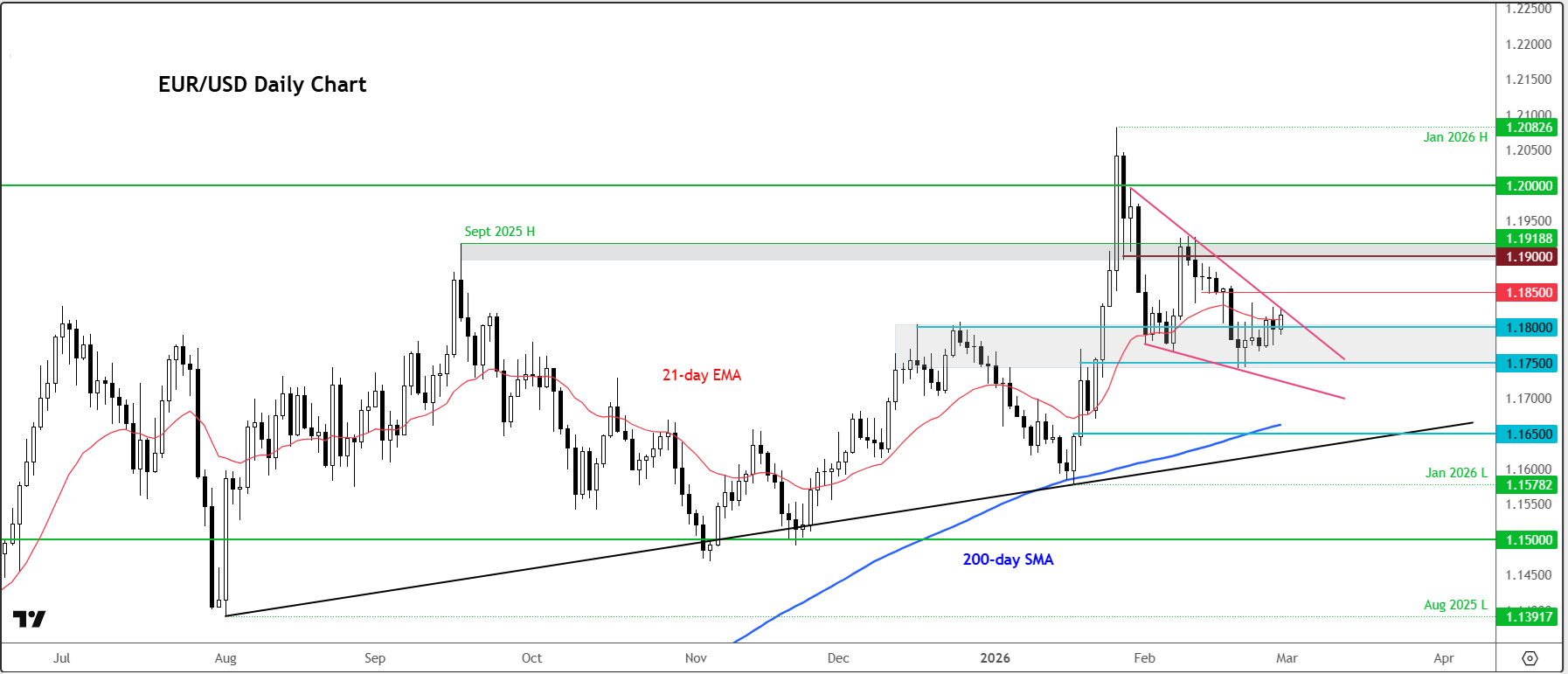
All told, it’s a week where macro data could play second fiddle to geopolitics, which could further fuel an already jittery backdrop with the ‘AI scare’ trade hitting Wall Street last week. This could mean short-term weakness for the EUR/USD. But as long as those long term higher highs and higher lows remain intact, the bulls will be happy with a relatively small short-term drop. Key support comes in around 1.1650 where the 200-day and a rising trend line converge. This area will need to hold, should we get there, to keep the bulls still interested.

-- Written by Fawad Razaqzada, Market Analyst
Follow Fawad on Twitter @Trader_F_R