
The EUR/USD pair has accumulated a streak of eight consecutive bullish sessions, gaining more than 1% from recent lows. Buying pressure has intensified following the release of new U.S. employment data, which reinforces expectations of lower interest rates in next week’s Federal Reserve decision. If this lower-rate outlook persists, combined with a neutral stance from the European Central Bank (ECB), buying momentum may continue to dominate the pair’s short-term movements.

New Employment Data Arrives
Today, the ADP Employment Change report was released, an indicator that measures variations in private-sector employment in the United States. A modest increase of 5,000 jobs had been expected for this month, but the official reading showed a decline of -32,000, highlighting a slowdown that has persisted throughout the year. This result suggests that the stability of the U.S. labor market may be weakening in the short term, raising new concerns about the country’s economic outlook.

Source: FxStreet
The significance of this data lies in the fact that markets were already expecting a rate cut from the Federal Reserve, mainly to ease economic pressures. With weaker labor figures, this perception has grown stronger: a month ago, the probability of a 0.25% cut stood at 66.79%, but with the latest employment data, it has now risen to 89% for the December 10 decision — the highest level recorded in the past month.
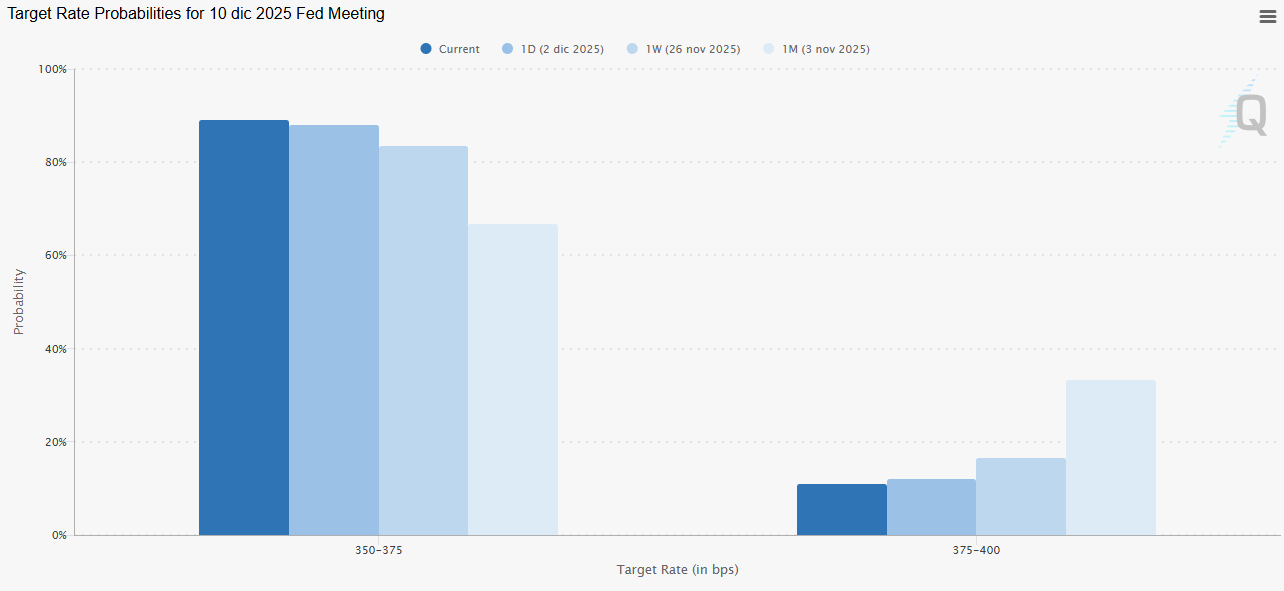
Source: CMEGROUP
As markets price in lower rates from the Federal Reserve, Treasury yields are also expected to decline, reducing foreign demand for U.S. dollars. This dynamic could allow the euro to continue gaining ground in the short term, supporting consistent buying pressure on EUR/USD.
The European Central Bank Remains in Neutral Territory
In contrast to the Federal Reserve, the outlook for the European Central Bank remains stable. The market currently assigns a 94.2% probability that the deposit rate will remain at 2.00% for the December 16 policy meeting.
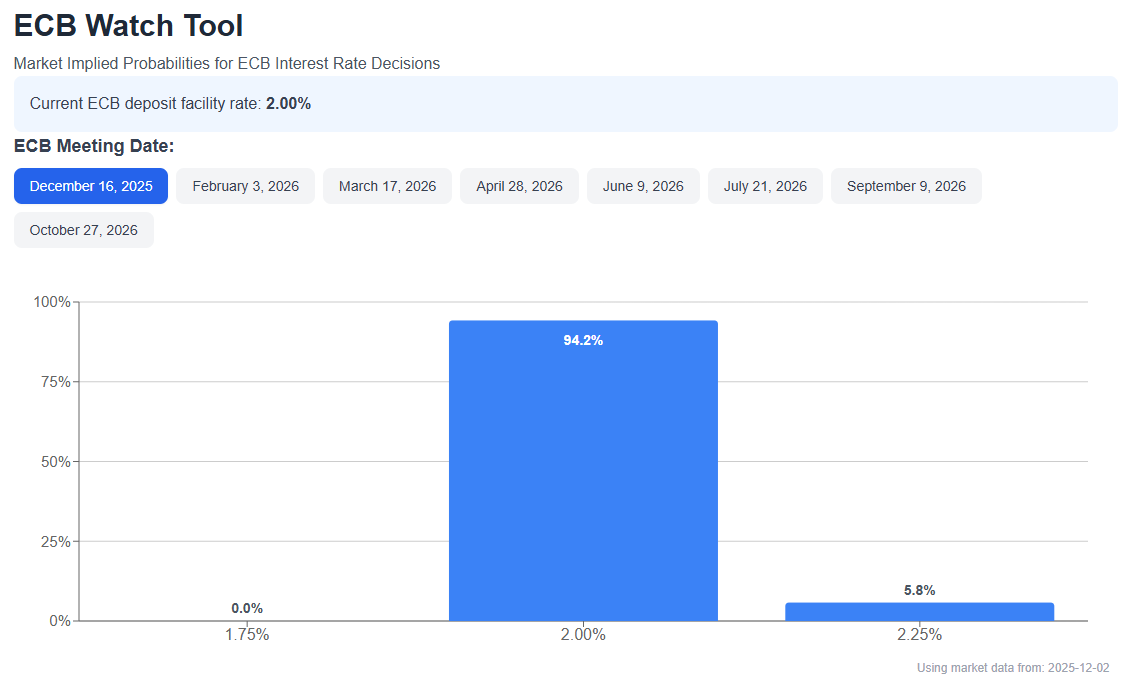
Source: ECBWATCH
A more neutral stance from the ECB may be providing short-term stability to the euro, especially as the dollar exhibits greater volatility ahead of next week’s U.S. interest-rate decision. This scenario creates the perception that the euro is a relatively more stable currency, supporting steady demand in recent sessions.
EUR/USD Technical Outlook

Source: StoneX, Tradingview
- The Downtrend Comes to an End: Since mid-September, the EUR/USD pair had remained within a consistent downward trendline that dominated price movements for nearly two months. However, the recent recovery has broken that trend, supported by sustained buying pressure. If price continues to hold above key resistance levels, a new bullish bias may develop, potentially giving rise to a fresh short-term uptrend.
- RSI: The RSI shows steady growth above the neutral 50 level, indicating dominant bullish momentum. However, it is now nearing the 70 zone, which would signal overbought conditions and could lead to bearish corrections if buying pressure becomes excessive.
- MACD: The MACD also maintains a steadily rising histogram above 0, showing that short-term moving-average strength remains in bullish territory. If this behavior continues, the dominant bias heading into year-end may remain bullish.
Key Levels to Watch:
- 1.16835 – Key Resistance: This level corresponds to the mid-range neutrality zone within the wide lateral channel observed since June. A breakout above this area could lead to the formation of a new short-term uptrend.
- 1.16121 – Nearby Barrier: This immediate support zone aligns with the 50-period simple moving average. If the price retraces to this level, a new period of neutrality and indecision could emerge, forming a short-term range.
- 1.15252 – Final Support: This level corresponds to the most recent lows reached during the previous downtrend. A break below this zone could reactivate a stronger bearish bias, restoring downward dominance in the short term.
Written by Julian Pineda, CFA, CMT – Market Analyst
Follow him at: @julianpineda25