
US indices, led by Nasdaq, surged higher, pushing up global markets as well as gold in the first half of Monday’s session following a bruising last week. Initially, it was a series of support measures from Asian authorities that helped to trigger an oversold and short-covering bounce. Then came out news that Nvidia had reinstated Jensen Huang as CEO, president and board member. The further boosted the rally, sending Nasdaq 100 +5.5% higher by the time Wall Street opened, as Nvidia shares surged higher.
The key question is whether gold’s recovery will hold in what still is a dollar-positive environment. Before today’s recovery, gold had fallen in eight of the previous nine sessions. Even the one session in which it managed to post a gain was virtually flat. Clearly, selling pressure has been intense, leaving the metal severely oversold.
What next for gold and what to watch this week?
Gold has already suffered a substantial correction and is now down by roughly 35% from its January peak. But that does not necessarily mean the selling is over. Markets can remain under pressure for longer than many investors expect, particularly when a strong preceding rally gives way to an aggressive liquidation phase.
For a more convincing recovery to take hold, however, markets would probably need some reassurance that the Federal Reserve is not about to become significantly more aggressive. US Treasury Secretary Scott Bessent offered a carefully worded hint of concern over the weekend, suggesting that many believe the Fed could make a policy mistake by overtightening.
The problem is that the inflation backdrop is not yet offering much encouragement. Wednesday’s release of October core PCE inflation is expected to reinforce concerns about persistent price pressures, potentially keeping the prospect of further monetary tightening into 2027 firmly on the table. That makes it difficult to build a convincing bearish dollar case at this stage. Against that backdrop, the dollar’s downside and gold’s upside could be limited.
Gold technical analysis
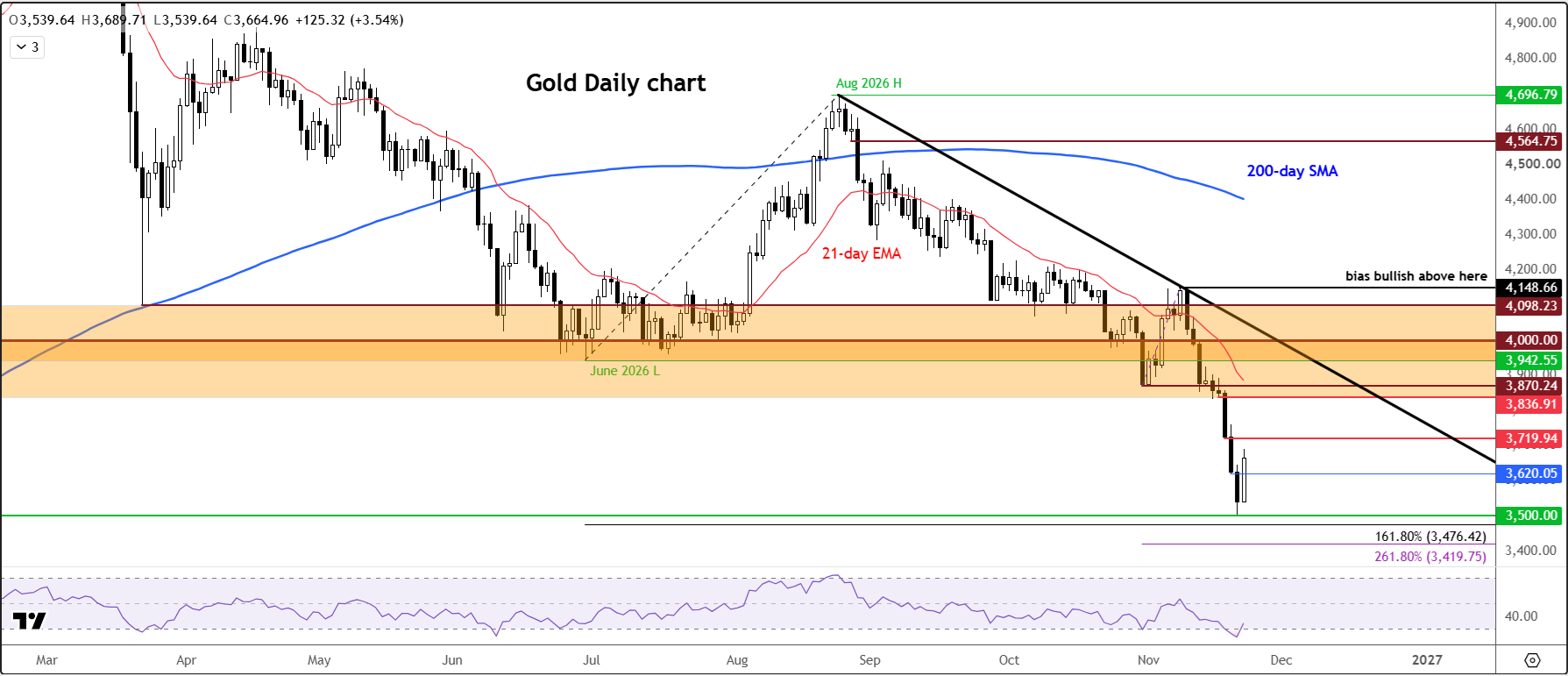
Today’s rebound can be viewed as an oversold recovery from a key psychological level around $3,500, which gold came close to testing on Friday. While this recovery could extend a little further, the broader trend remains firmly bearish. I would still be looking for resistance levels to hold and support levels to give way. After all, momentum is quite weak and there are no major signs of an imminent reversal. What’s more, bullish conviction has taken a big hit in both gold and silver, with the two metals having broken key support levels (of $4,000 and $50, respectively). Thus, the dip-buying mentality is now a lot different than it used to be, while short sellers are continuing to grow in confidence having gains so much ground in recent months.
Key resistance levels to watch
There is a short-term resistance level that has now come into view following today’s gold price rebound. It is around the $3,720 area, which provided some short-term support before giving way during last week’s sell-off. Beyond this level, there is a much more significant band of resistance between approximately $3,835 and $4,100.
This zone will be important in determining whether the broader bearish trend remains intact. As long as gold trades below it, the path of least resistance should remain to the downside, regardless of any short-term recovery attempts such as the one we are seeing today.
There are several technical factors converging within this region. It previously acted as support on multiple occasions during the preceding bull market, most recently in June 2026, when gold found buyers around $3,940 following a period of consolidation.
Prices returned to this area towards the end of October and initially attempted to recover. That move briefly created what looked like a trend reversal. However, the recovery failed to gain traction and the buyers were again trapped.
Once selling pressure returned, investors rushed for the exits, triggering the sharp liquidation that has continued over the past several sessions.
The $3,835–$4,100 region is therefore likely to represent a formidable resistance zone. Within it, we also have the 21-day exponential moving average converging with former support and a short-term bearish trendline. The confluence of these technical factors makes this an important area to watch.
Whether gold can even recover towards those levels following last week’s sizeable sell-off remains an open question. For now, I would not be rushing to buy into short-term strength. I would prefer to see either further weakness followed by a convincing reversal pattern at lower levels, or a more meaningful improvement in the technical picture before considering a bullish position.
Where could gold head to next, if the selling resumes?
Turning to the downside,$3,620 is the initial support now, which was Thursday’s low. Gold broke below this level on Friday, but today it has been reclaimed.
the next obvious area of interest is the liquidity resting beneath last week’s low.
Gold fell by almost 9% last week, and there are likely to be plenty of stop-loss orders sitting just below the $3,500 mark, particularly from traders who attempted to buy the dip during the sell-off.
If selling pressure returns and today’s recovery starts to lose momentum, we could see another sharp move lower as those stops are triggered. I would expect that liquidity to be tested sooner or later if the broader bearish trend remains intact.
There are also a couple of Fibonacci extension levels worth monitoring below $3,500. The 161.8% extension of the June-to-August upswing comes in around $3,476. Meanwhile, the 261.8% extension of the smaller upswing seen in early November, which ended on the 10th of the month, sits around $3,420.
Beyond these technical levels, there are relatively few obvious areas of support until we reach the next major psychological handles at $3,400 and $3,300. The $3,000 mark would then become the next major psychological level, particularly now that gold has moved decisively below $4,000.
For now, I would treat today’s rebound as a potential relief rally within a broader bearish trend, rather than evidence that a durable low is in place.