Oil prices rebounded after its massive drop the day before, and this kept equity markets in a holding pattern. Reports suggested that the Strait of Hormuz remained largely blocked, which was in retaliation to Israel’s attacks on Lebanon yesterday. There were serious doubts about whether the ceasefire agreement would hold, and this kept investors largely on the sidelines. US index futures drifted a bit lower as crude oil rebounded, while in the FX markets, the yen came under some pressure too. But there was still a sense of optimism that the worst case scenario is to be avoided and with the White House saying the US will hold direct talks with Iran, hopefully things will calm down further. But Israel’s ongoing fighting in Lebanon remained a major stumbling block to negotiations. Still, the Nasdaq 100 forecast looks a lot better than it did last week.
Keep an eye on rebounding oil prices
As before, nothing else seems to matter for stock markets right now, so let’s get straight to the point.
After a barrage of attacks from Israel on Lebanon on Wednesday, Iran's Deputy Foreign Minister Saeed Khatibzadeh said this was a "grave violation" of the US-Iran ceasefire agreement. Accordingly, Iran has refused to re-open the Strait of Hormuz, which is applying renewed pressure on energy markets ahead of direct talks between Iran and the USA over the weekend in Islamabad.
US Vice President JD Vance, special envoy Steve Witkoff and Jared Kushner will go to Islamabad for talks set to start on Saturday. However, we could hear something before that as Tehran’s delegation are set to arrive in the Pakistan’s capital later today, meaning indirect talks will be ongoing.
For now, oil prices have stopped falling, reversing a chunk of Wednesday’s drop. The June Brent oil contract traded around $98 a barrel earlier today, after slumping from around $110 to a low of around $90 on Wednesday on the ceasefire announcement.
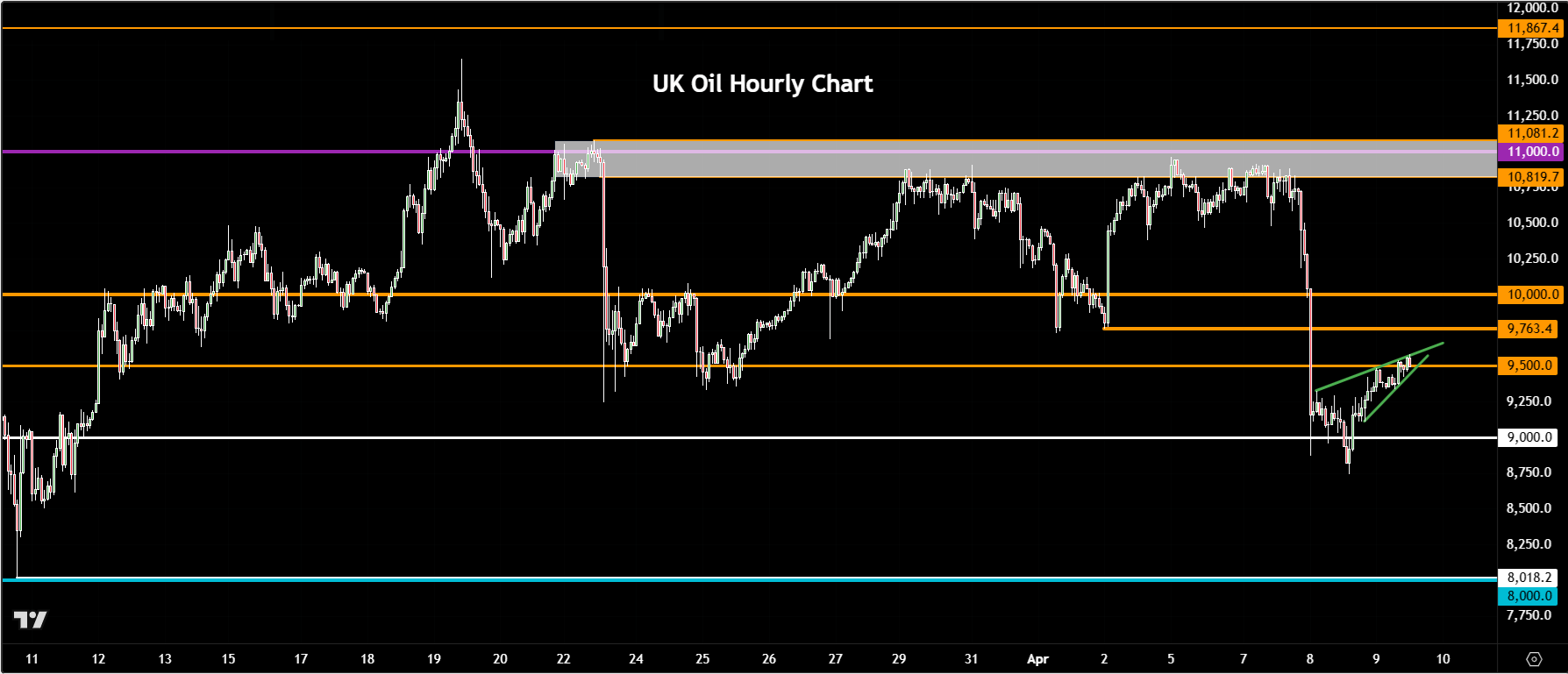
The best-case scenario is for flows through the Hormuz strait to start picking up this weekend, followed by a gradual, one-month recovery in Persian Gulf exports to pre-war levels. If that happens, oil prices should drift lower towards $80 and then eventually $70 per barrel as the supply pressure eases.
However, if the ceasefire completely breaks down, then oil could easily spike back to pre-ceasefire levels and in that scenario, we would very likely see renewed falls in stock markets.
Nasdaq 100 forecast: Technical analysis
The Nasdaq 100 futures have broken their previous trendline after forming a couple of higher lows, before surging higher on Wednesday on the back of the ceasefire agreement.
This move has pushed the index back above both its 21-day exponential moving average and the 200-day moving average, providing objective technical signals that the bearish trend may now be over, at least in the near term.
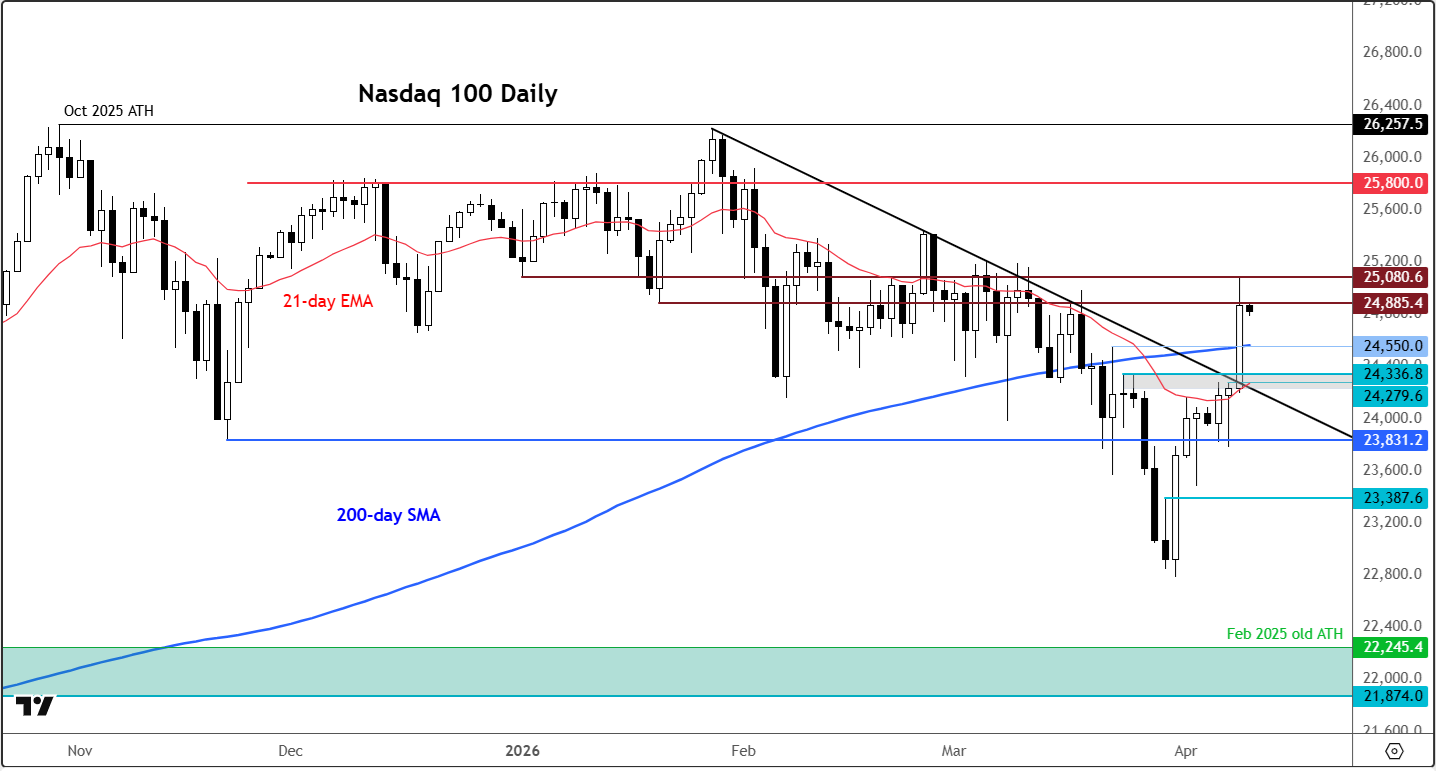
With this improved technical backdrop, the path of least resistance appears to be to the upside for our US Tech 100 chart once again, which is derived from the underlying Nasdaq 100 futures. The market is now starting to resemble a “buy-the-dip” environment, given the price structure that has developed over the past couple of weeks.
Key levels and scenarios to watch
The turning point came when the index successfully reclaimed the 23,830 level, which marked the low from November 2025. Recovering this level was the first indication that the worst of the selling pressure might be behind us.
Following that, we saw three to four days of consolidation above this level before the ceasefire news triggered a sharp move higher.
In terms of levels to watch, on the downside, the key support zone now lies between 24,280 and 24,340 — essentially the base of the recent breakout. This area is likely to be critical on any short-term pullbacks.
Just above that, the 24,550 region marks the now reclaimed 200-day average and is another important level to monitor.
From a bullish perspective, the ideal scenario would be a period of consolidation or a modest pullback, allowing the market to digest recent gains before attempting another breakout higher.
On the upside, initial resistance comes in at around 25,000 — a key psychological level — followed by 25,400.
A sustained break above these levels would open the door toward 25,800, an area where the index previously struggled and where more meaningful resistance may emerge.
Overall, the market is no longer looking as bearish as it did previously. As long as the ceasefire agreement holds, dips are likely to be supported, and buyers may continue to step in on any weakness, keeping the Nasdaq 100 forecast tilted to the upside.

-- Written by Fawad Razaqzada, Market Analyst
Follow Fawad on Twitter @Trader_F_R