
US futures
Dow futures -1%, S&P futures -1% & Nasdaq futures -1.25%
In Europe
FTSE -0.35% & DAX 1.45%
- US stocks fall and oil rises despite Trump’s 10-day extension
- TACO trade is failing & Treasury yields are rising
- Headlines continue to drive risk sentiment
- Oil rises but is set to fall across the week

US stocks fall to 7-month lows despite Trump’s extension
US stocks are falling, extending losses from yesterday and heading lower for the week as markets remain on edge amid another volatile stretch of headlines from the Middle East.
President Trump has extended the deadline for striking Iran’s energy facilities by 10 days, reportedly at Tehran’s request. However, Iran has denied making such a request, highlighting the fragility of any possible diplomatic progress and offering conflicting accounts of where negotiations stand.
The Pentagon is also reportedly considering sending an additional 10,000 troops to the region, dimming hopes of a near-term end to the conflict.
Oil prices remain elevated, keeping inflation concerns alive. The yield on the 10-year Treasury has climbed to its highest level since July, as Trump’s extension of the deadline has failed to reassure energy markets.
The 10-year Treasury yield is now around 4.46%, up 4 basis points on the day and roughly 50 basis points since the start of the conflict.
Meanwhile, hopes of a renewed “TACO trade” are fading as investors realise the situation involves far more stakeholders and risks than a simple diplomatic headline can resolve.
Markets remain highly headline-driven, and only clearer signs of progress or tangible evidence of de-escalation are likely to improve sentiment.
Corporate news
Carnival Corp is falling despite Q1 results beating Wall Street expectations. The cruise operator reported EPS of $0.20 per share, ahead of the $0.18 expected, on revenue of $6.2 billion, above the $6.13 billion forecast. However, shares are under pressure as investors continue to weigh the impact of higher fuel costs on the company’s outlook.
Crypto-related stocks are also falling as Bitcoin drops to $68K, marking a two-day decline of more than 6%. Strategy is down 2%, while Coinbase is lower by 3%.
S&P 500 – technical analysis
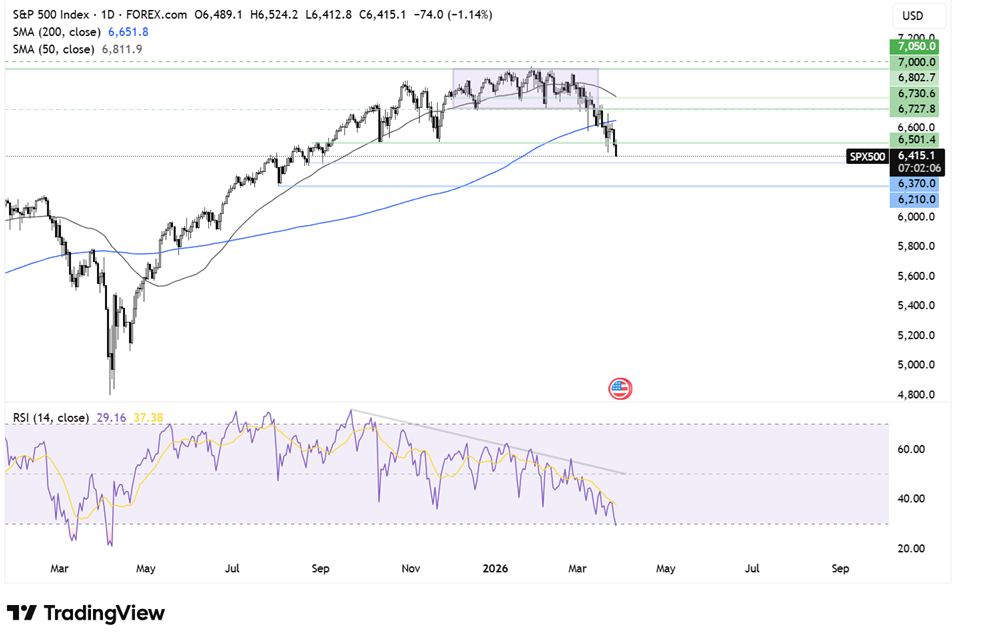
The S&P 500 has broken below 6,730, slipping out of its recent consolidation range and falling to a low of 6,420.
With the RSI holding below 50, momentum remains tilted to the downside. Sellers will be looking for a break below 6,370 — the September low. A move below this level could open the door to 6,210, the August low.
On the upside, any recovery would first need to reclaim 6,500, an area that broadly aligns with the October and November lows. A move above this could bring the 200-day SMA near 6,650 back into focus.
A sustained rise above that level would improve the near-term outlook and bring 6,730 back into play.
FX markets – USD rises, GBP/USD falls
The US dollar is rising on safe-haven demand as uncertainty around the Iran conflict persists and Trump’s extension fails to reassure markets. The dollar is on track to rise 2.4% in March, which would mark its strongest monthly gain since July 2025, when it rose 3.4%.
EUR/USD is falling against the stronger dollar, even as data showed hotter-than-expected inflation in Spain. Spanish CPI rose to 3.3% year-on-year in March from 2.3% in February, reflecting rising price pressures linked to the conflict and higher energy costs.
GBP/USD is also falling after UK retail sales declined for the first time in three months. Sales fell 0.4% month-on-month in February, indicating that consumers were already reining in spending even before the Iran conflict intensified.
Separately, GfK consumer confidence fell in March to its lowest level in over a year.
Oil rises but is set to fall on the day
Oil prices are rising on Friday but are still on track for their first weekly decline since early February, after President Trump extended the pause on attacks against Iran’s energy infrastructure by another 10 days.
Brent is still up around 53% since the start of the conflict but is down 1.3% on the week. WTI is up around 45% since the war began and is lower by roughly 1.5% this week.
Despite recent talk of de-escalation, there are still no concrete signs of progress, with the Strait of Hormuz remaining effectively closed.
That means supply concerns remain firmly in place and oil is likely to stay highly sensitive to any fresh geopolitical headlines.