

Key Events
- Rising Volatility Risk: Market volatility is expected to build into Wednesday amid ongoing tariff rhetoric and an anticipated Trump speech at the World Economic Forum.
- Canadian CPI Softens: Canadian CPI readings fell below expectations, to levels last seen in January 2025, reinforcing near-term USD strength versus CAD, despite ongoing tariff-related uncertainty.
- Pressure on Dollar Pairs: Dollar pairs face near-term drawdown risks as geopolitical uncertainty revives concerns reminiscent of early-2025 volatility.
- Haven Demand: Demand across gold and silver is expected to remain supported as geopolitical headlines continue to shape risk sentiment into 2026.
USDCAD gains remain capped alongside risk assets amid tariff escalation risks between the U.S. and the EU over Greenland, despite the latest downside surprise in Canadian inflation data. CPI m/m and trimmed CPI fell to 0.2% and 2.7%, respectively — levels last seen in January 2025.
Last year, tariff threats pressured dollar pairs, pushing the DXY down toward a 17-year support near 96, while major pairs including USDCAD reached historical levels near 1.4790. A similarly fragile backdrop is emerging, with USDCAD rejecting the 1.39 resistance twice, as the dollar struggles to hold above the 100 mark and both the Fed and BoC are expected to remain on hold.
Key Levels and Scenarios in Focus
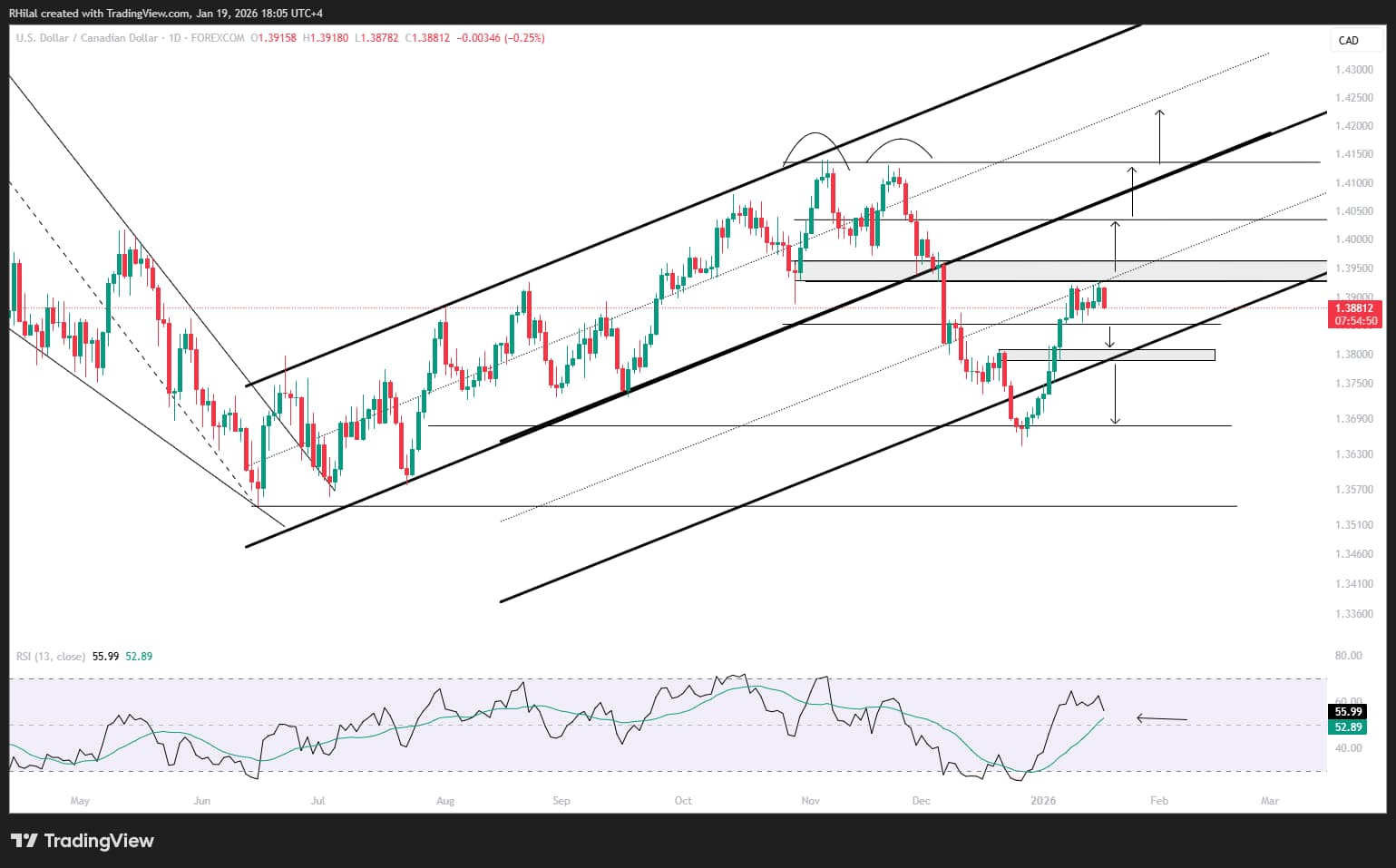
USDCAD Daily Time Frame – Log Scale
Source: Trading view
In line with the major double-top formation traced on the USDCAD chart in November 2025, a smaller double-top potential is developing below the neckline of the initial pattern at 1.39.
A clean hold above 1.39 would be expected to extend gains toward 1.4040 and 1.4140, aligning with Fibonacci extension levels derived from the June 2025 low, November 2025 high, and December 2025 low.
As long as these levels are respected and Fibonacci extensions continue to align with price action, the near-term bias remains constructive. However, short-term drawdowns may unfold should the smaller double-top pattern materialize, with key support levels at 1.3850, followed by 1.3790 and 1.3680, before shifting the bias back to the downside.
Downside headwinds across major dollar pairs may also emerge — notably USDJPY, given stretched momentum conditions and resurfacing tariff risks — keeping key technical levels in focus to confirm any shift in the broader bullish dollar narrative.
Written by Razan Hilal, CMT
Follow on Rh_waves