

USD
The US Dollar recovered from an early-week sell-off following the announcement of a criminal inquiry into Fed Chair Jerome Powell. In last week’s video, I said don’t be surprised to here President Trump try to coax the USD lower; and while sourcing of that criminal inquiry can be argued, it seems another effort to inject influence in the Federal Reserve with the aim of getting lower rates and faster rate cuts.
The pullback in the USD was short-lived, however, as buyers showed support at prior resistance and then rallied the currency up to yet another fresh high, and that enthusiasm largely remained into the end of the week.
The current weekly bar shows one of recovery, with wide underside wick illustrating that reversal. This also highlights where the big fight is, around the 100-handle in DXY, the same level that held bulls at bay multiple times in the second-half of last year.
US Dollar Weekly Chart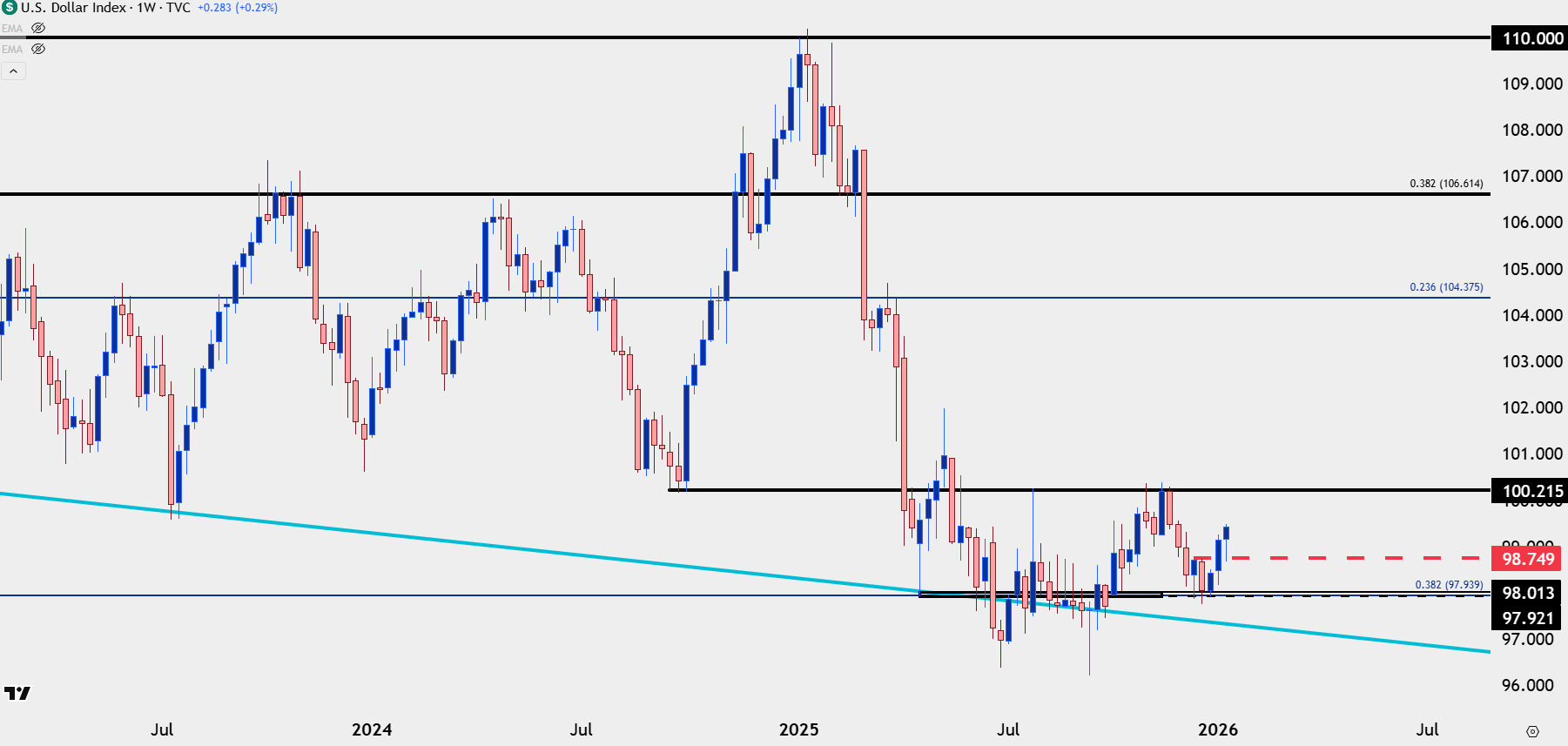
Chart prepared by James Stanley; data derived from Tradingview
While USD has been range-bound on the weekly chart for the past six-and-a-half months, the daily chart shows a few different trends along the way, and we’re currently in a bullish trend that started from around Christmas Eve. Perhaps more impressively is that this has built even with markets holding the expectation for more rate cuts out of the FOMC for next year.
Of course, given that DXY is merely a basket of underlying currencies, it’s the relative weakness in the Euro and Japanese Yen that have done some of the heavy lifting here. But, at this point, it’s a bullish short-term trend and this sets the stage for a possible re-test of that big picture resistance looked at above around the 100-100.22 level.
US Dollar Daily Chart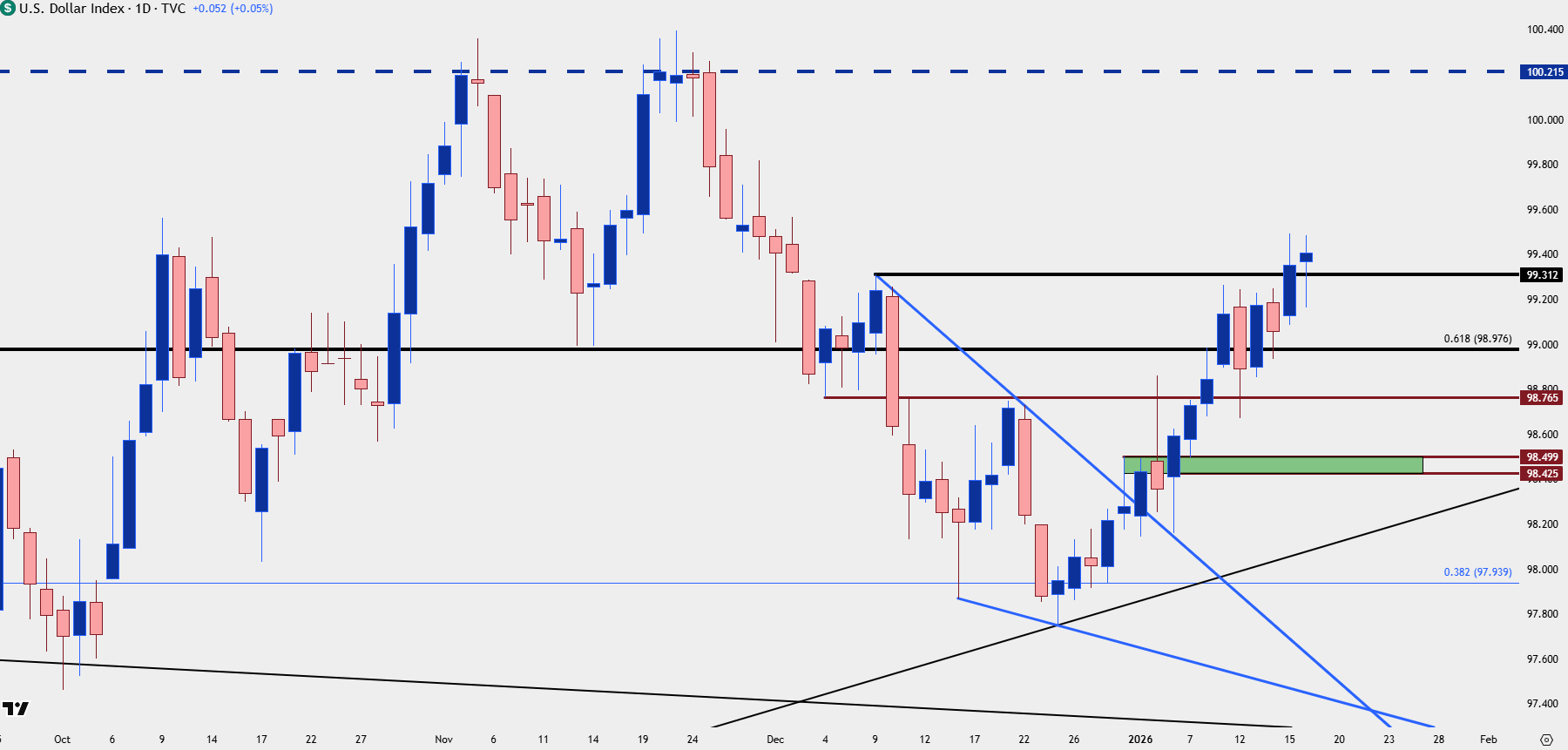
Chart prepared by James Stanley; data derived from Tradingview

EUR/USD
At this point, EUR/USD is grasping on to Fibonacci support at 1.1593 which came into play a couple of different times last week, but the response from sellers has been clear as each bounce has so far been faded.
Like the 100-level in DXY above, there’s a big line in the sand on long-term charts for EUR/USD around the 1.1500 level. But, for now, the trend remains fairly clear on shorter-term charts, and this sets up for resistance at 1.1616, 1.1656 and then 1.1686.
EUR/USD Four-Hour Chart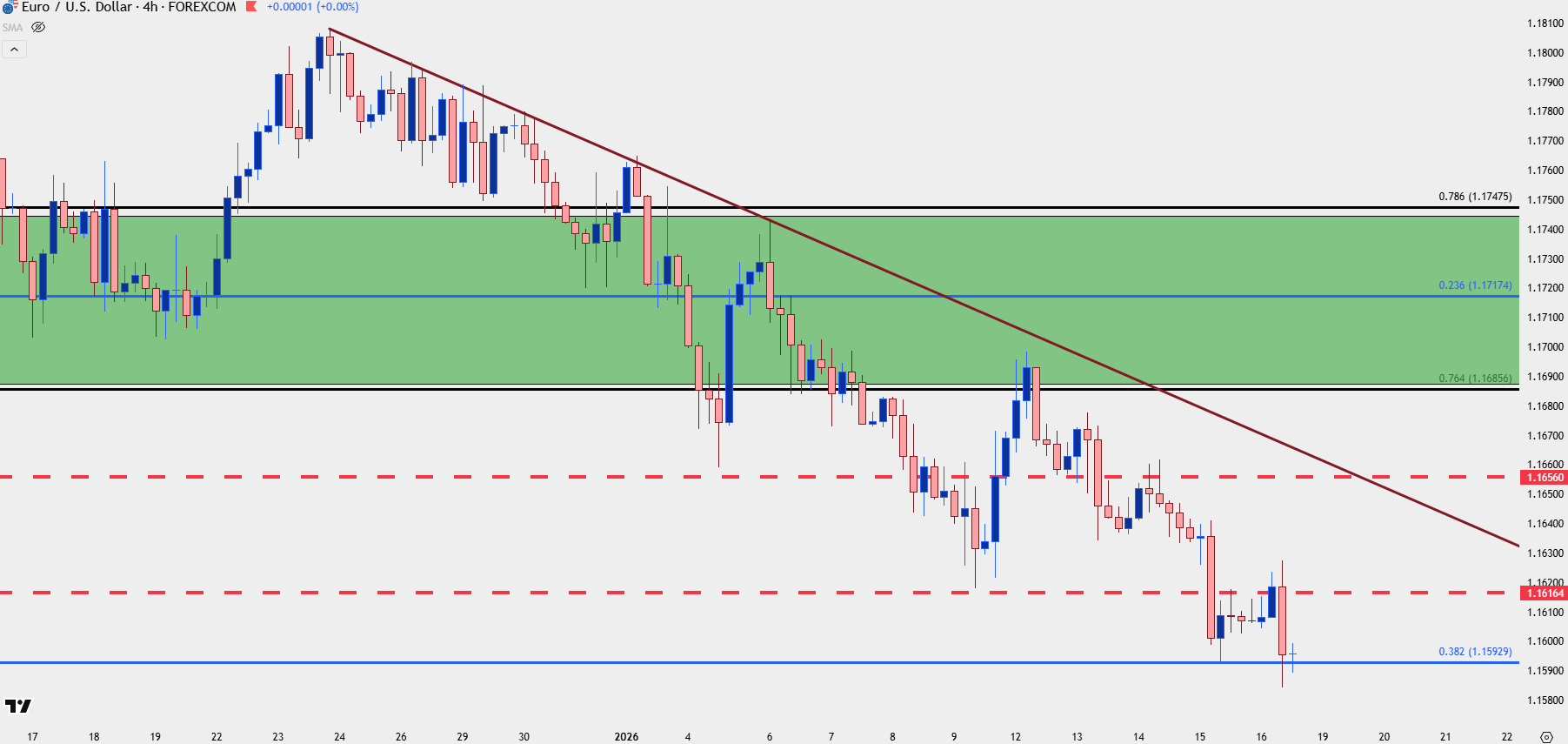
Chart prepared by James Stanley; data derived from Tradingview
GBP/USD
GBP/USD is still my favored pair for USD-weakness and while bears were able to push some lower-lows in the pair this week, there’s still a big spot of support that remains in-play at a familiar area on the chart. This was the same that I looked at last Friday and it spans from 1.3353-1.3371. There’s also been the build of a falling wedge, which is a bullish breakout formation, and this further points to the pair’s attractiveness if we do see USD-weakness play through next week.
GBP/USD Four-Hour Price Chart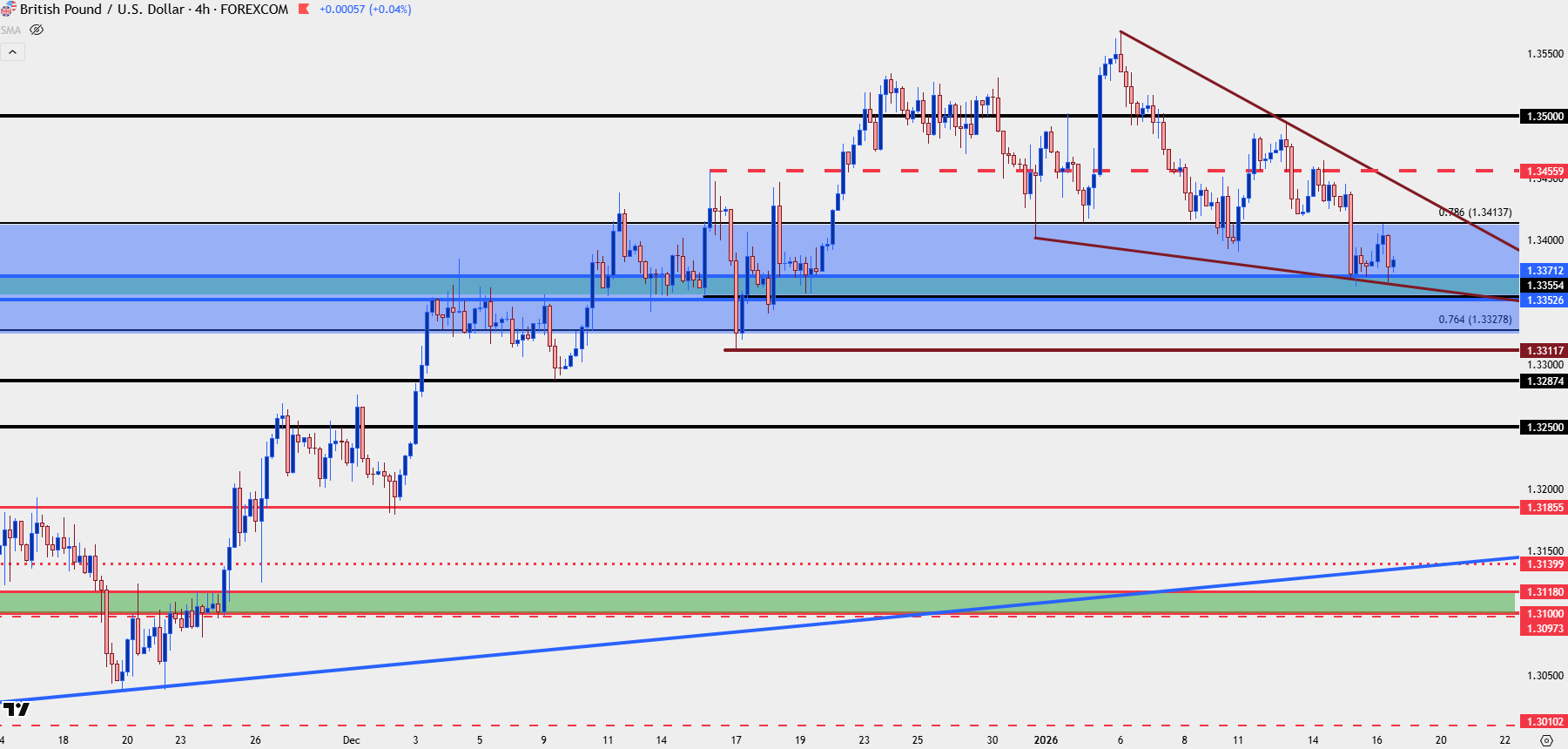
Chart prepared by James Stanley; data derived from Tradingview

USD/JPY
The intervention threat is real here and, longer-term, something from last week could take on more importance, and this was specifically Finance Minister Katayama mentioning that she had spoken with US Treasury Secretary Scott Bessent and that they both had a similar desire, widely read to mean that they both wanted to see the spot rate in USD/JPY to ease. Since then, we’ve seen a couple of different support hits from prior resistance in USD/JPY, but each has so far led to a lower-high.
This doesn’t necessarily mean trend reversal but it does further highlight what I’ve been talking about with USD/JPY, where chasing breakouts seems more and more perilous.
Given the US holiday on Monday, it would seem an opportune time for the Japanese Finance Minister to try to run some stops, and this highlights support structure in USD/JPY around 156.67 and 157.17. Or, for traders looking to avoid the USD altogether, GBP/JPY is testing a big spot of support from prior resistance as we wind into the end of the week.
USD/JPY Four-Hour Chart
Chart prepared by James Stanley; data derived from Tradingview
--- written by James Stanley, Senior Market Analyst, Global Macro