

The US Dollar has pushed down to a lower-low earlier today and that goes along with a continued breakout in GBP/USD and a test of fresh highs and bullish structure in EUR/USD. In USD/JPY, however, the broader bullish backdrop remains in-place as prices in the major pair are testing a significant area of support as taken from prior resistance of 154.45-155.00.
USD/JPY Daily Chart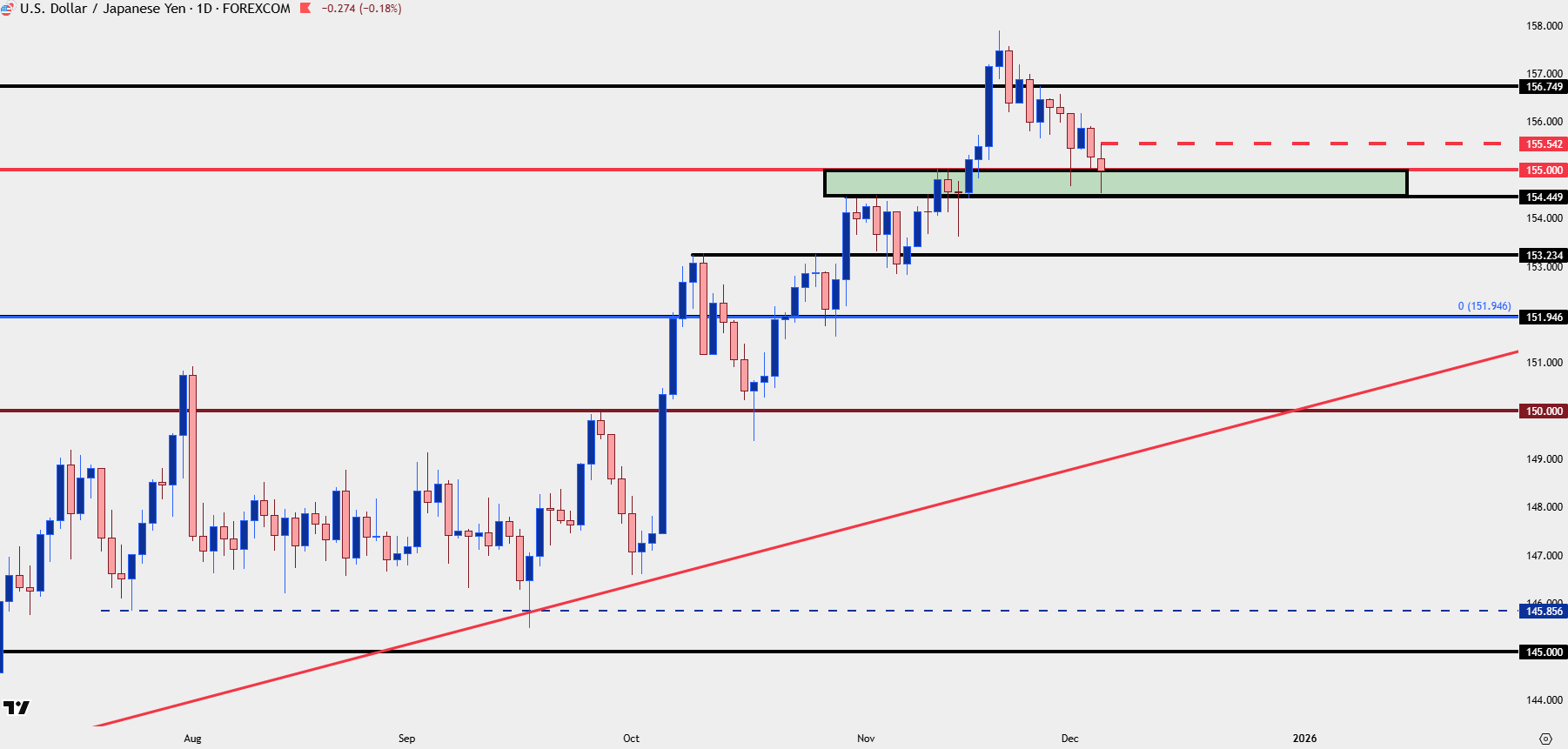
Chart prepared by James Stanley; data derived from Tradingview
Interestingly, this was the same zone I was looking at two weeks ago before the USD pullback started to take over. At the time, such a move probably seemed pretty distant, as USD/JPY led the way higher and the US Dollar threatened a breakout at a major spot on the long-term chart. But as markets gear up for next week’s FOMC rate cut and the possibility of assurance for more cuts in 2026, there’s been a paring back in each trend that’s allowed for pullback, and in USD/JPY, that has so far remained rather orderly.
To be sure there’s a drumbeat calling for more Yen-strength and anytime a market trends as this one has since April, that can make sense. On the part of Japanese Finance Minister Satsuki Ktayama, she believes the ‘fair level’ of USD/JPY is between 120 and 130. But ever since the carry trade took over in 2021 and launched the pair to fresh multi-decade highs, it’s the 140.00 level that’s been the major line in the sand. The question remains as to what the collateral damage could be of a diving USD/JPY pushing below that major psychological level that’s now held three pensive support tests over the past two years.
USD/JPY Weekly Price Chart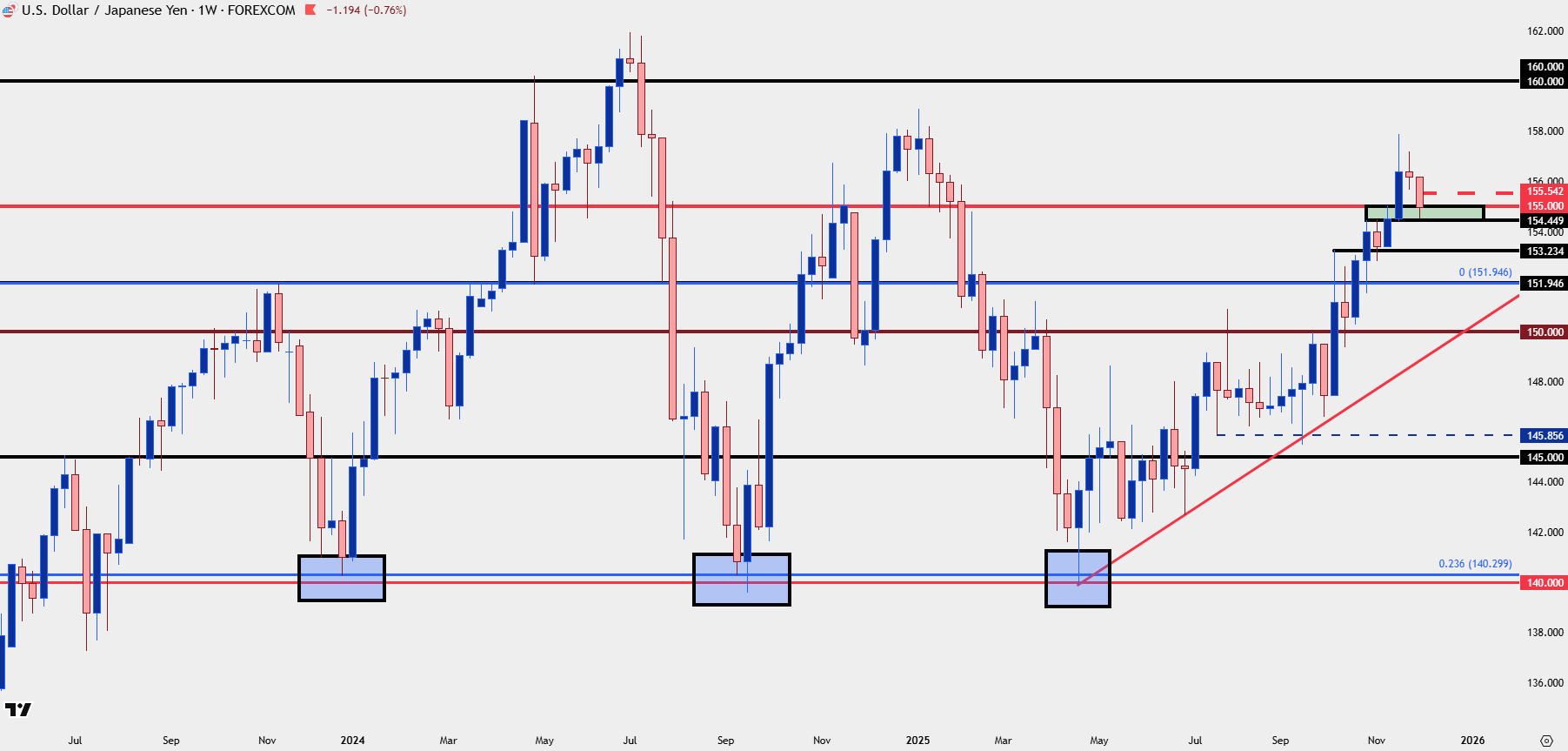
Chart prepared by James Stanley; data derived from Tradingview
This is seemingly at odds with newly-elected Prime Minister Sanae Takaichi, who has sounded very much against rate hikes, previously going so far as to call them ‘stupid.’ Perhaps ironically it’s just a couple months after her election that the Bank of Japan is highly expected to hike again at their December meeting in two weeks, but like with the FOMC, the bigger matter is what happens after.
This puts Kazuo Ueda on a tightrope, as no further assurance of additional rate hikes could simply spin the Japanese Yen back into a pattern of continued weakness; something that would or at least could be addressed by a Japanese Finance Ministry charged with monitoring (and often defending) the currency. And then on the other side, sounding too hawkish especially if at odds with a dovish FOMC, could compel a carry unwind scenario similar to what sparked last year.
This is the elephant in the room, the 800 pound gorilla, as the massive rally in the USD/JPY pair saw almost 58% added – in a non-levered currency pair - in just three-and-a-half years. The carry trade was the main driver and this shows in a few different ways.
If you’re a hedge fund or institution, you can go to Japan and borrow while rates are extremely low, helped along by low BoJ rates. That provides access to cheap capital which can then be invested elsewhere. The problem at that point is that you’re essentially long the Japanese Yen because you got that loan from Japan in their native currency, so if JPY weakness continues, the entire spread (and perhaps even then some) can be wiped away. So to address that currency risk you can sell JPY in the open market against another currency, such as the US Dollar, and that supply/demand push further drives USD/JPY prices higher as USD strengthens and JPY weakens.
For retail traders, they might be more familiar with the carry trade in the form of rollover or swap payments driven by the growing rate differential. Traders holding long USD/JPY can earn rollover payments at the close of each trading day while those short, or in other words, short the high-yielder and long the low-yielder, are forced to pay rollover. This, of course, incentivizes longs and punishes shorts, further pushing the supply/demand equilibrium of the market.
This is all good and fine until the market becomes incredibly one-sided, at which point it becomes vulnerable, and the 2021-2022 episode is illustration of that. We were in a similar space, where Yen-weakness was pervasive and the Finance Ministry was growing concerned that a weak currency would produce runaway inflation. When USD/JPY hit 145 the threats began and that helped to stall the pair. But the fundamental forces continued to push and eventually a breakout took hold with USD/JPY jumping up to the 150 marker. That was the point where the BoJ was ordered to intervene by the Finance Ministry and that quickly pushed the pair back to 145.00.
But what ultimately drove the larger pullback in that trend was what happened a few weeks later, and that was softening US inflation driving the idea that the Fed may be nearing finished with rate hikes. And this is where we could see that heavy, one-sided market taking over as it was a rush for the exits from longs trying to avoid getting trampled.

It took three months to erase 50% of the move that had taken 21 months to build – even with the fundamental drive behind USD/JPY remaining biased to the long side given rate differentials. But, this is the animal spirits of markets taking over as a one-sided market that had been guided higher-and-higher snapped back on the slightest hint of possible change.
USD/JPY Weekly Chart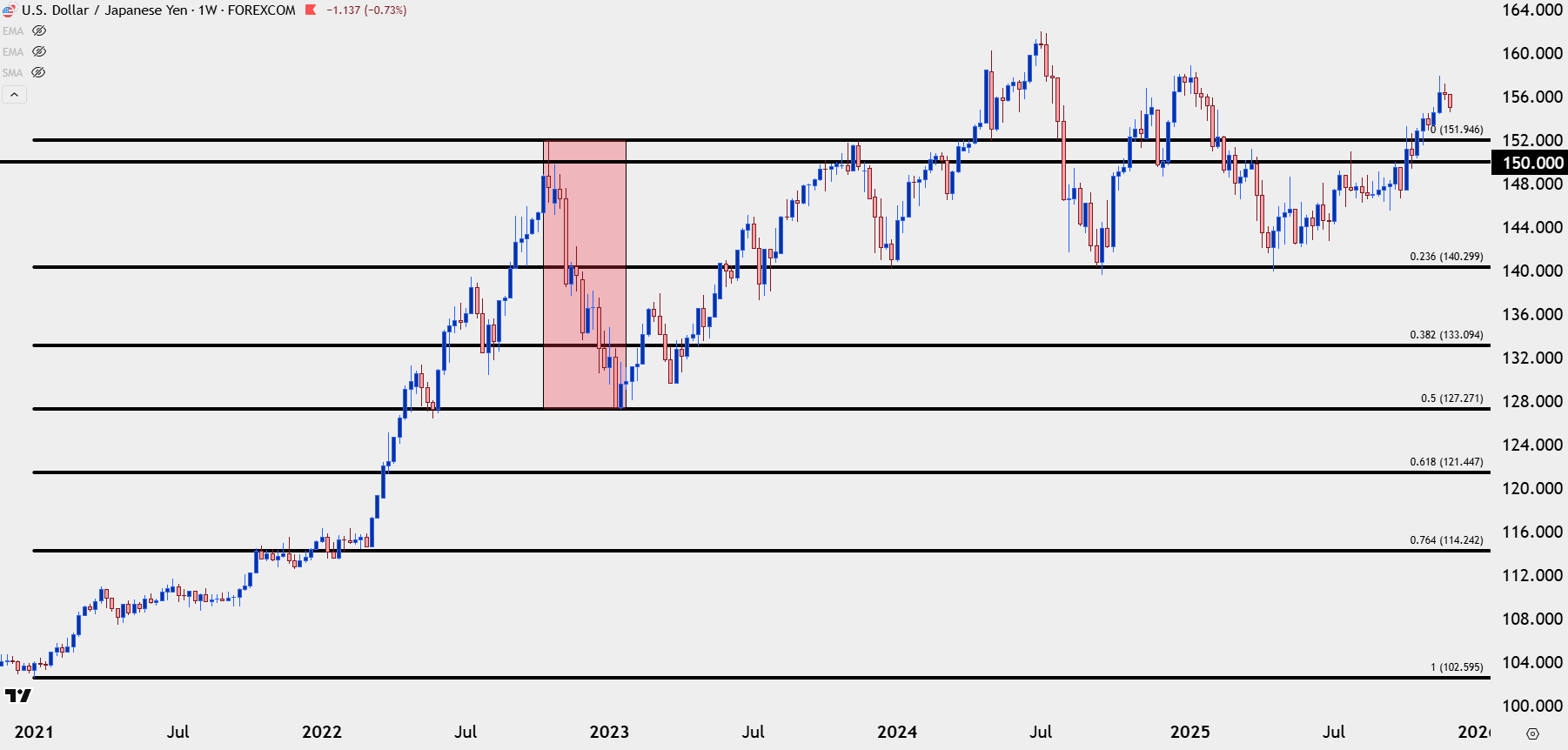
Another unwind episode showed up a year later and that, too, was driven by US CPI coming in weaker than expected. This time, however, it was a mere 23.6% pullback and price simply launched back up to the same 151.95 high in March.
In April of last year, US CPI was stronger than expected and at that point, 151.95 was finally broken-through as stops on short positions provided fuel for the next leg of the breakout, with USD/JPY eventually pushing up to 160.00.
Another intervention was ordered there but it only lasted for about a week – with the same 151.95 level coming in, but this time as support. By July, the Finance Ministry was again getting concerned and on the morning of July 11th, with another US CPI print set for release, the Bank of Japan intervened only this time, it was to much different result.
That US CPI print was below-expected and this what gave light to the fact that the Fed may actually be able to begin cutting rates. But the combined effort of an intervention plus weaker US data did the same thing that we saw in 2022, winding back a massive one-sided backdrop driven by the carry trade – and this time – there were collateral effects.
The trades that were pushed higher by that additional leverage also started coming off, with the Nasdaq dropping in tandem with USD/JPY from the July 11th high, and the S&P 500 joining a week later. By August 5th, we had the third highest ever read in the VIX index and fingers were pointed at the Bank of Japan as to the reason why. The BoJ soon cooled on rate cut talk and USD/JPY continued to drift lower, albeit with less violence, and eventually set a significant low at the 140.00 level just two days before the Fed started cutting rates.
The point of going through this entire saga again is to point out that if Ueda fails to walk this tightrope successfully, the results could be dramatic, as the leverage that’s been pushed into the global financial system over the past half-decade, helped along by a Bank of Japan standing away from the crowd with uber-low rates to help fuel carry trades, could quickly zap global markets of a major contributing factor to those gains.
A USD/JPY at 120 or 125 or 130 could certainly bring dramatic effect across the globe and like we saw last year, it won’t take long for the blame to be placed right on top of the Bank of Japan.
USD/JPY Weekly Chart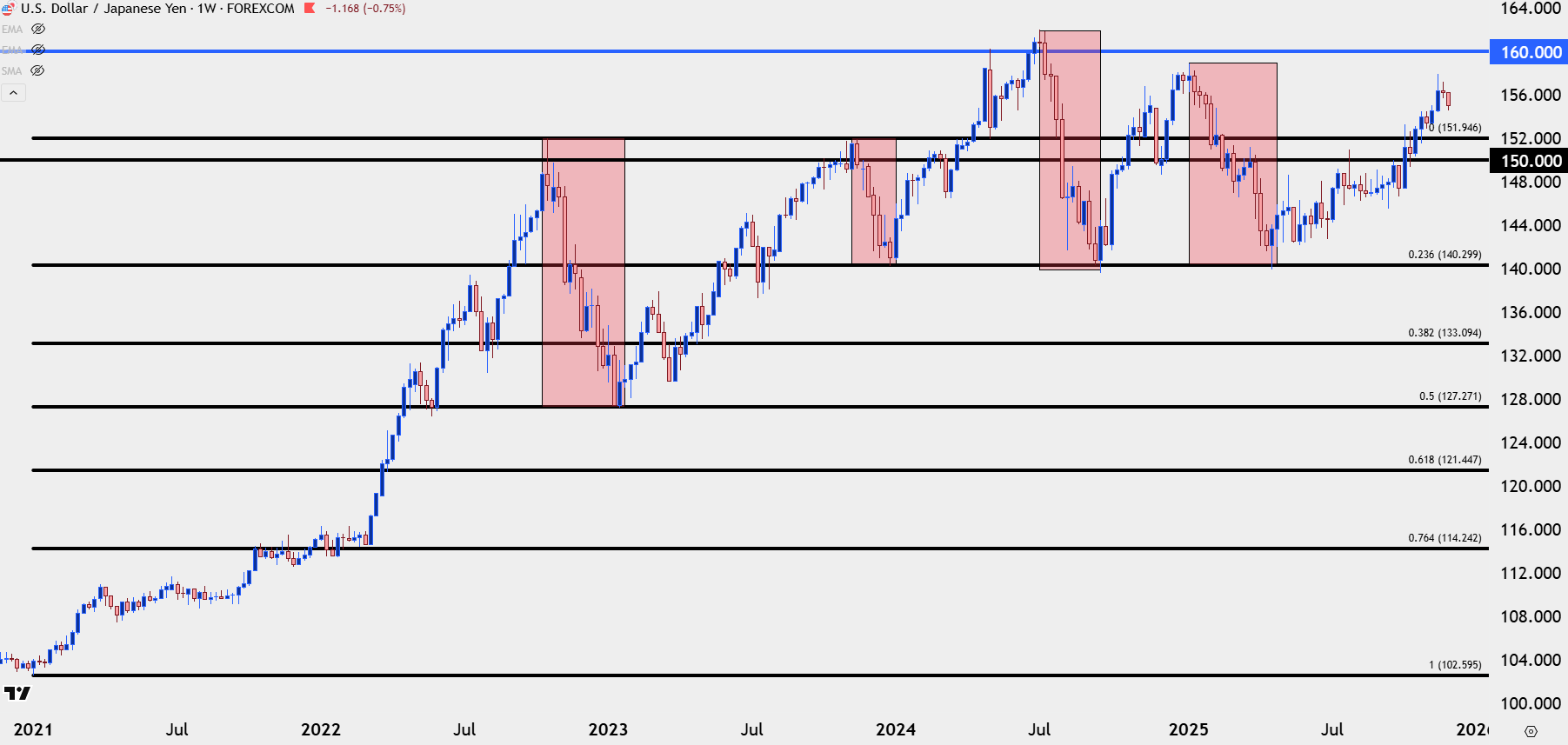
Chart prepared by James Stanley; data derived from Tradingview
Price Leads, Narrative Follows
While the nods towards a hike in December have seemingly avoided reprisal from Takaichi’s government, an economic advisor to the Prime Minister remarked that after the hike the BoJ should keep rates steady until 2027. Rates markets right now see the BoJ eventually hiking up to 1.5% by the middle of that year and that would still allow for some spread with US rates.
There’s considerable consequence here, but frankly, if markets were anticipating a wide-scale change at the BoJ I would expect that to reflect in price action first, and at this point, that’s a more difficult case to make. So until we get a more earnest sell-off in the pair, I’m going to continue to look to USD/JPY as one of the more attractive candidates for USD-strength.
And as I looked at in the above video, USD/JPY still has a case to be made on the long side with a significant area of support coming into play and showing a reaction.
USD/JPY Four-Hour Chart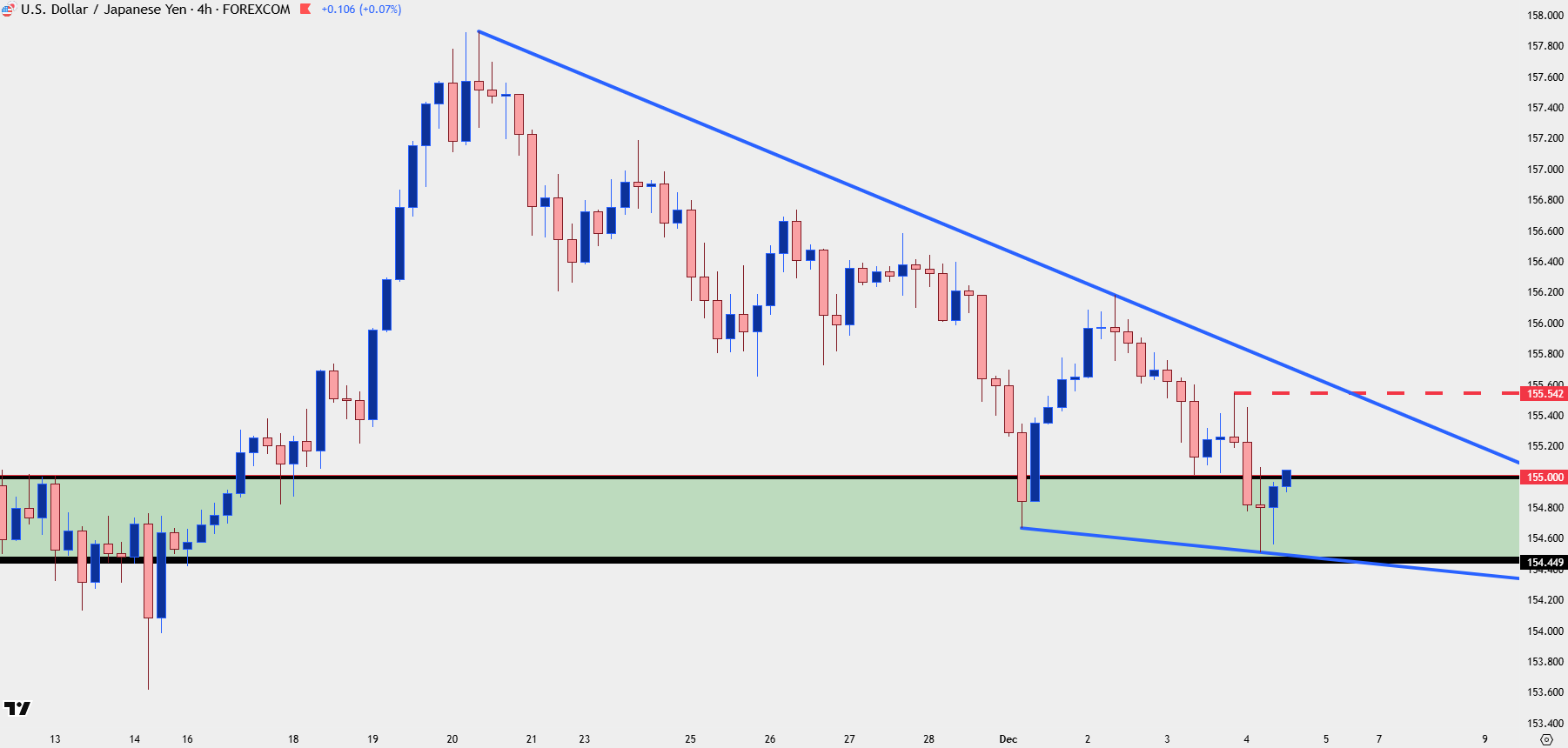
Chart prepared by James Stanley; data derived from Tradingview
--- written by James Stanley, Senior Market Analyst, Global Macro