

Over the past five trading sessions, USD/JPY has gained more than 0.8%, supported by steady buying momentum in favor of the U.S. dollar. The bullish pressure has remained consistent, driven by a more hawkish tone from the Federal Reserve, which aims to maintain neutral-to-high interest rates in the short term. This dynamic has prevented the Japanese yen from recovering sustainably, and as long as this trend persists, upward pressure on USD/JPY could remain relevant in the coming sessions.

What’s Next for Central Banks?
The Bank of Japan’s (BoJ) next monetary policy decision is tentatively scheduled for December 18–19. For now, no major surprises are expected, and consensus points to the bank maintaining its benchmark rate near 0.5%, the current level. Although some members have hinted at the possibility of raising rates once domestic conditions strengthen, the BoJ continues to adopt a predominantly neutral stance in the short term.
Meanwhile, the Federal Reserve (Fed) has started to surprise the markets. Following comments from several policymakers this week, the Fed has struck a more patient and cautious tone, suggesting that it may not commit to a series of rate cuts in its final meeting of 2025. This shift stems partly from the lack of key data on employment and inflation for October, which was not released due to the government shutdown, leaving the Fed with a limited picture of the current economic landscape. As a result, the central bank has begun to adopt a more neutral tone, hinting that it could maintain steady rates through year-end.
This new outlook is already reflected in CME Group data, which shows a 54.25% probability that the Fed will keep rates at 4.00% in its December 10 meeting—up from just 5.49% a month ago. This substantial increase highlights a clear shift in expectations, significantly reducing the likelihood of a rate cut to 3.75% by year-end.
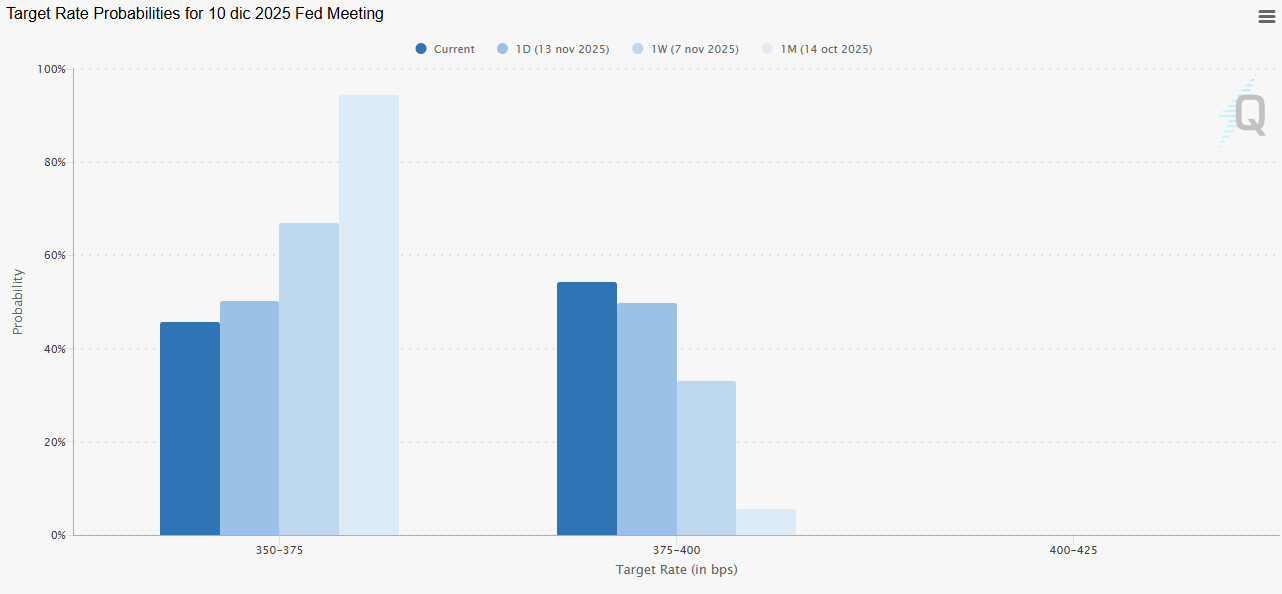
Source: CMEGroup
Given this change in perspective, it is important to note that the interest rate differential between the two central banks remains one of the widest among major global economies. The United States is likely to maintain a stable and neutral rate, while Japan has shown no clear intention of raising rates. This keeps a significant differential of 4.00% in the U.S. versus 0.5% in Japan in the short term.
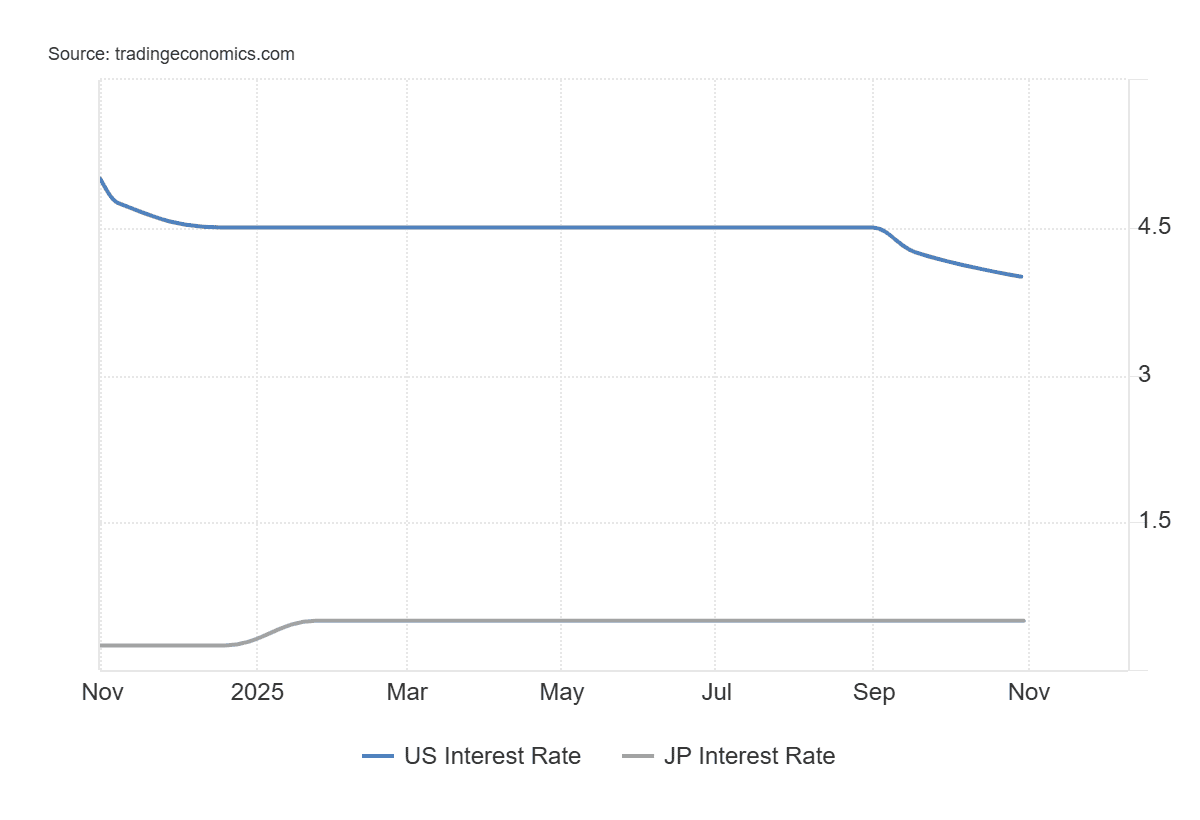
Source: TradingEconomics
This wide gap makes U.S. fixed-income assets more attractive than Japanese bonds, as they offer higher yields. As the Fed reinforces its commitment to elevated rates, the U.S. bond market has started to recover, drawing foreign capital seeking higher returns. In contrast, Japanese bonds, with their lower yields, are less appealing—further supporting demand for the U.S. dollar against the yen.
Therefore, under the Fed’s current stance, interest rates are expected to remain elevated in the U.S. through the end of the year, while Japan continues its ultra-loose monetary policy. This environment could diminish the attractiveness of yen-denominated investments, strengthen the U.S. dollar, and maintain significant buying pressure on USD/JPY in the weeks ahead.
USD/JPY Technical Outlook
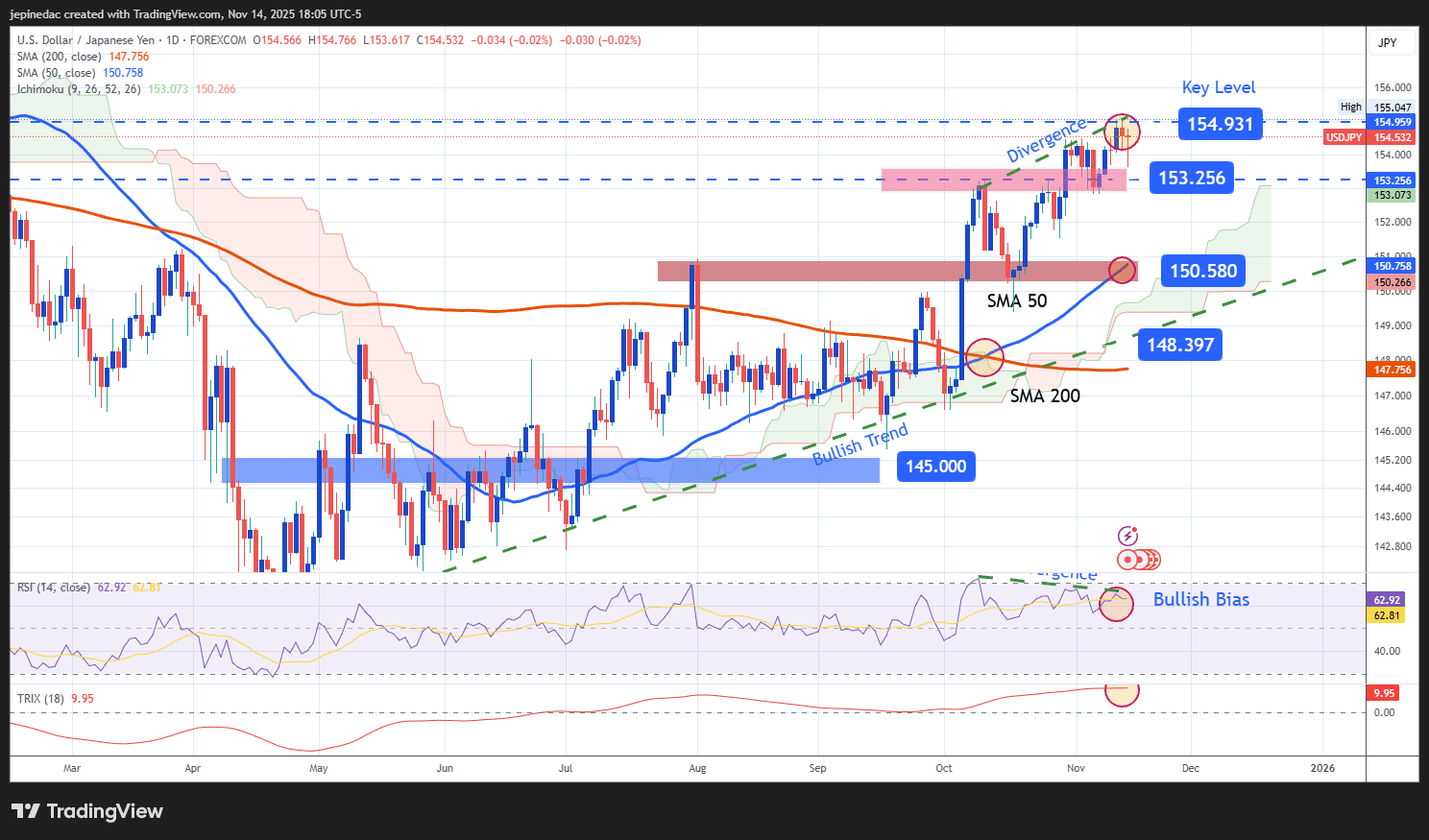
Source: StoneX, Tradingview
- Steady Uptrend: Since April, USD/JPY has maintained a consistent upward bias, forming a strong bullish structure that remains the dominant technical trend on the long-term chart. Buying pressure remains firm, with no signs of significant bearish corrections that could threaten the ongoing trend. As a result, the ascending trendline continues to dictate price action over the broader timeframe. However, as the price advances, a neutral tone has started to emerge, leaving room for moderate pullbacks in the short term.
- RSI: The RSI indicator continues to trade above the neutral 50 level, showing that market momentum remains bullish. However, the indicator has started to form lower highs while price action reaches new highs, signaling a bearish divergence that may point to a temporary imbalance caused by overextended buying momentum. This could lead to short-term corrective moves.
- TRIX: The TRIX indicator remains above the zero line, indicating strong buying momentum across exponential moving averages. As long as the line continues to rise, bullish pressure is expected to remain relevant in the medium-term outlook.
Key Levels to Watch:
- 154.931 – Key Resistance: This is the highest level since February and serves as the primary barrier for bullish moves. A sustained close above this area could strengthen the uptrend and trigger more aggressive buying momentum in the short term.
- 153.256 – Nearby Barrier: Represents a recent retracement area and serves as a technical reference for potential short-term pullbacks.
- 150.580 – Major Support: This level aligns with the 50-period simple moving average. A strong bearish correction back to this zone could undermine the current uptrend and introduce a moderate bearish bias in the medium term.
Written by Julian Pineda, CFA, CMT – Market Analyst
Follow him on: @julianpineda25