

Key Events
- Renewed BOJ intervention risks and US tariff uncertainty are pressuring the DXY and dollar pairs back toward their 2025 lows ahead of Wednesday’s FOMC meeting.
- The DXY’s approach toward the 96 level is reviving dollar debasement concerns, supporting gold and silver’s exponential rallies above 5,100 and 100, respectively.
- The Bank of Canada is expected to keep rates unchanged tomorrow at 2.25%, while the Fed is widely expected to hold at 3.75%, leaving room for volatility across policy outlooks amid FX intervention and tariff-related risks.
Trump’s coordination efforts to support the yen — effectively accepting short-term dollar weakness — have created a tailwind across FX markets, pushing the DXY and major dollar pairs toward defining support zones that separate long term bullish from bearish bias.
While the current pressure appears headline-driven in the short term, longer-term structures remain intact and will be key in confirming whether markets transition into a broader trend shift or stabilize. Several major assets are now testing relative extremes, including:
- Gold near 5,110
- Silver near 110
- DXY near 96
- US equity indices consolidating below their 2025 highs
- Bitcoin, a key risk barometer, pressured near the 87,000 support
Extreme market conditions driven by headline volatility and stretched momentum raise the risk of a priced-in corrective move or momentum reset, unless new catalysts emerge to extend the trend further.
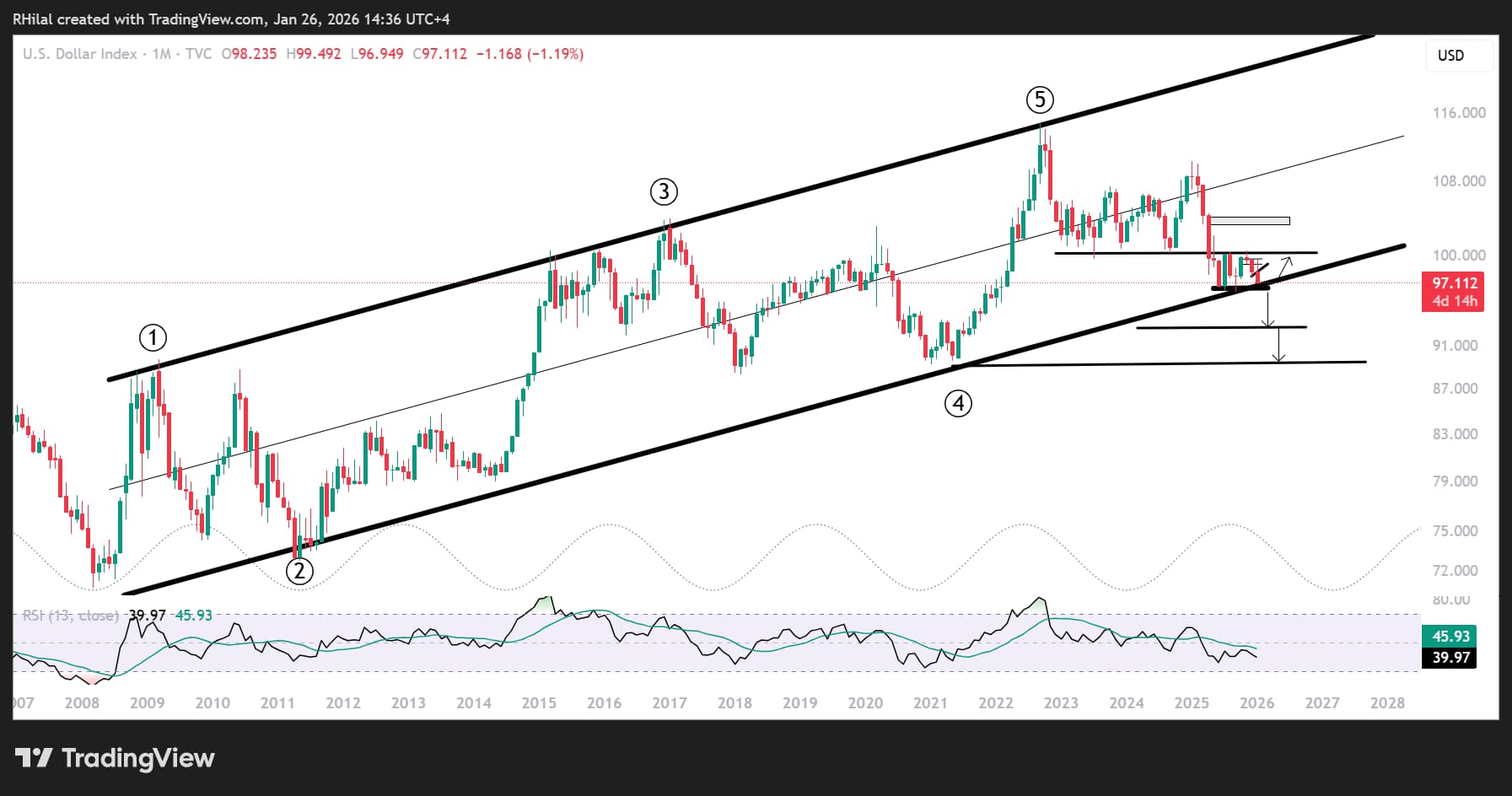
DXY Outlook: Monthly Time Frame – Log Scale
Source: Trading view
Fragile support on the DXY continues to elevate dollar debasement concerns and haven demand. On the monthly chart, price action is sitting near the lower boundary of a channel that has persisted since the 2008 lows, marking a defining moment between a potential 17-year bullish bias shift or continuation.
The key zone to monitor lies between 96 and 97. A sustained break below this region could trigger a steeper decline toward the 2021 lows near 89, potentially allowing global currencies to extend beyond their 2025 highs. Conversely, a successful defense of this zone would keep the longer-term bullish dollar bias intact, capping upside across major FX pairs.
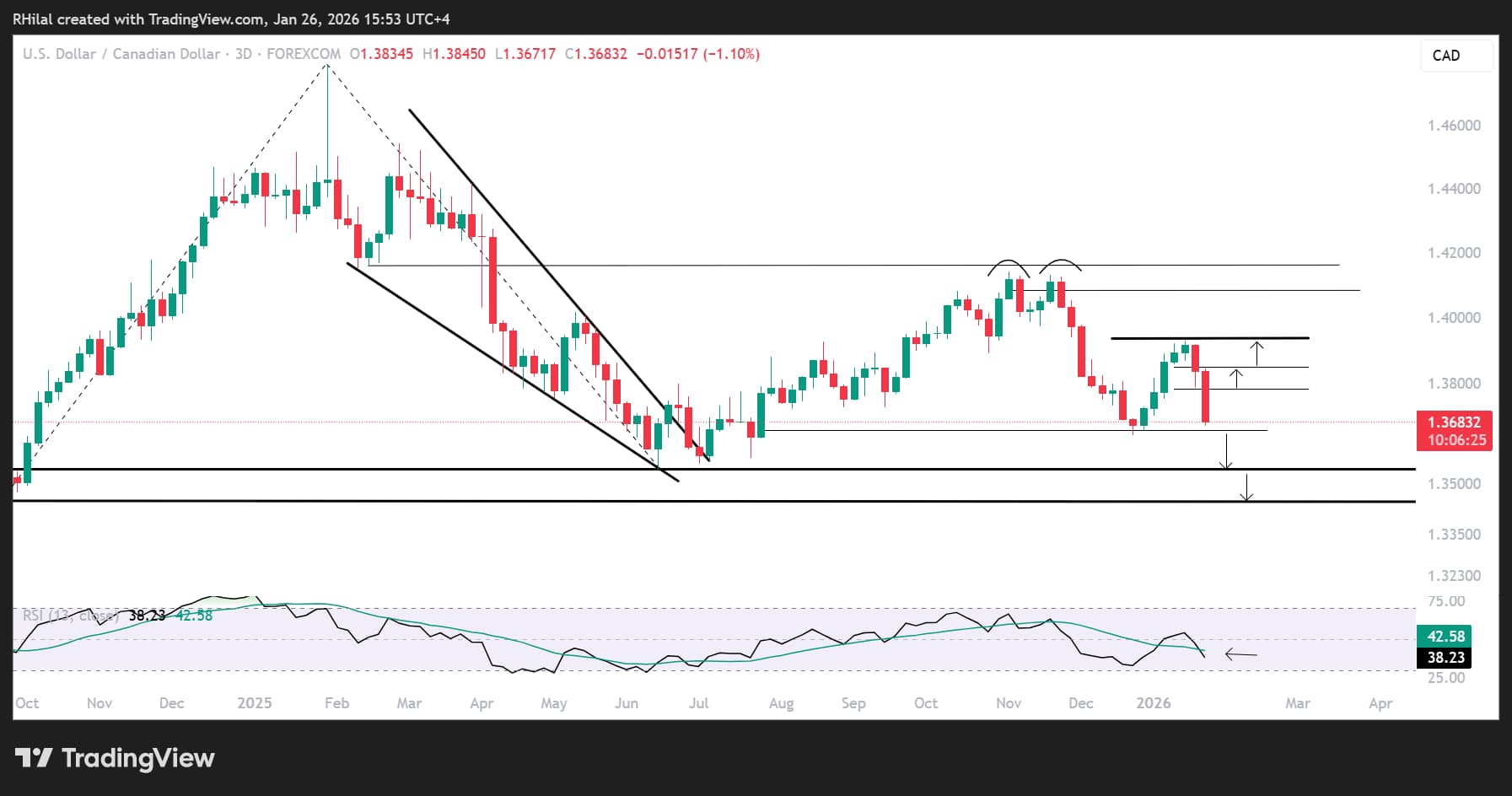
USDCAD Outlook: 3-Day Time Frame – Log Scale
Source: Trading view
From a 3-day time-frame perspective, USDCAD is pulling back toward its 2025 lows, testing support near 1.3650. A clean break below this level would likely expose downside targets at 1.3400 initially, followed by 1.3100 in more aggressive scenarios.
However, should the 1.3650 support hold, upside recovery would require a move back above 1.3780, 1.3850, and 1.3940 to reassert bullish bias and reopen the path above the 1.4000 zone.
From the 2025 peak, the broader trend remains predominantly negative, in line with the DXY’s struggle to stabilize above its fragile long-term support.
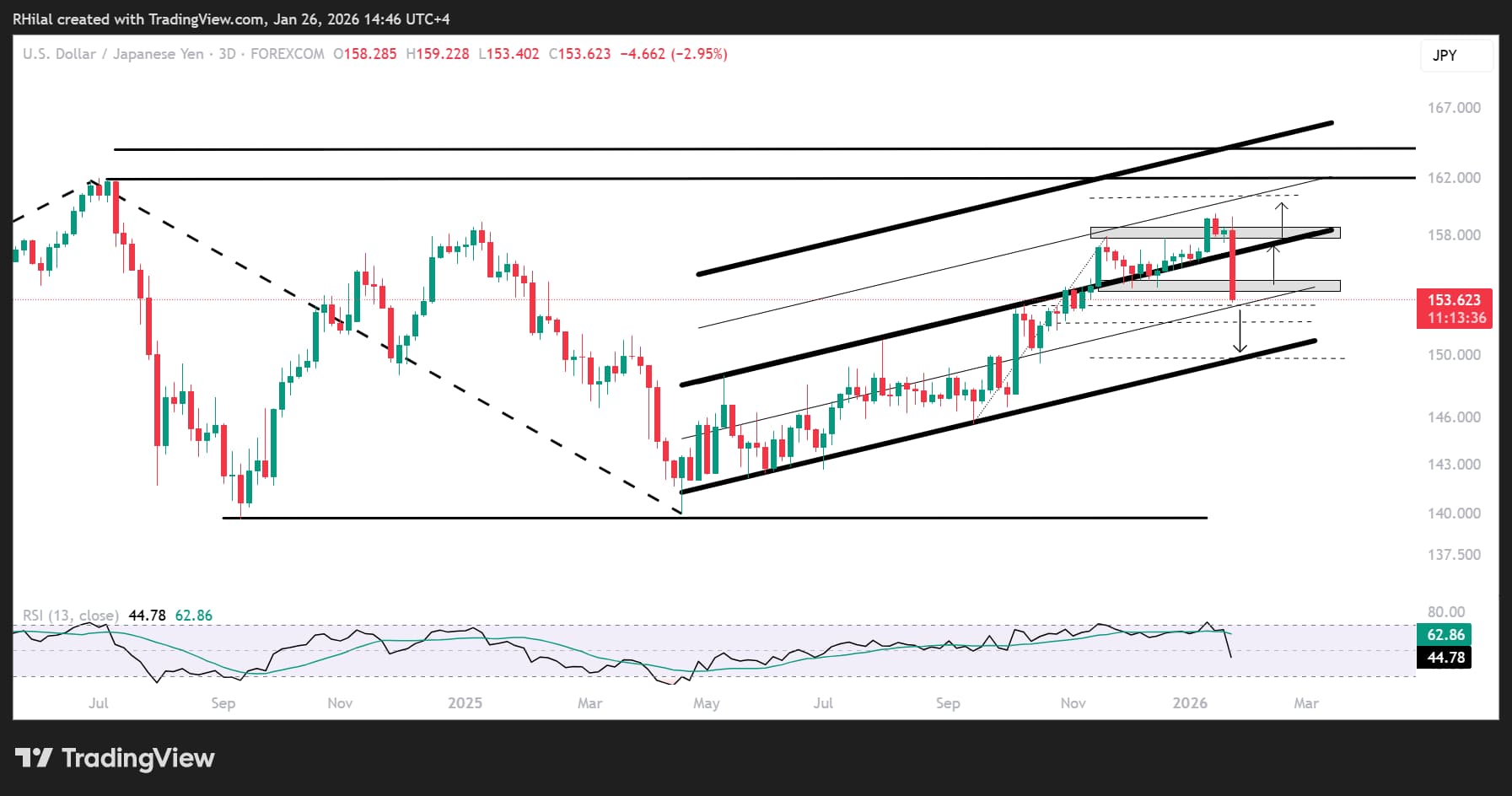
USDJPY Outlook: 3-Day Time Frame – Log Scale
Source: Trading view
USDJPY has retreated from overbought conditions on the 3-day time frame, breaking below the 160 resistance and the duplicated channel mid-zone, before pulling back toward the original uptrend that began in April 2025, now supported near 153.40.
A sustained hold below this level, in line with broader dollar weakness, would likely extend losses toward the lower channel boundary at 152.00 and 149.80, marking a critical zone between bullish continuation and bearish trend transition.
On the upside, the daily RSI is holding near oversold territory last seen in April 2025, while the 3-day RSI stabilizes near neutral levels. This suggests rebound potential, provided price can reclaim 154.80 and 155.80, reopening upside targets toward 158.50 and 160.50, respectively.
Written by Razan Hilal, CMT
Follow on X: @Rh_waves