
Since the beginning of 2026, USD/MXN has depreciated by more than 3%, moving closer to the 17 pesos per dollar area—levels not seen for several years. This move reflects a clear bearish bias that favors the Mexican peso. Selling pressure appears to be extending as the U.S. dollar enters a new phase of consistent weakness, driven by rising diplomatic tensions. This environment has allowed the Mexican peso’s strength to recover steadily, and as long as risk-related uncertainty persists, selling pressure could continue to gain relevance in USD/MXN price action over the coming sessions.

Tensions continue to weigh on the dollar
President Donald Trump participated in the Davos Forum today, and his remarks offered no clear signs of a near-term de-escalation in diplomatic tensions with Europe. During his speech, the president reiterated the importance of acquiring Greenland, arguing that its geostrategic location is key to U.S. global security. He even stated that “no nation or group of nations is in any position to be able to secure Greenland other than the United States.”, underscoring that his interest in the territory remains active and that this issue could continue to deepen tensions between Europe and the United States.
In addition, Trump criticized several European countries, suggesting that the bloc has not been sufficiently appreciative of U.S. support for NATO, and defended his rhetoric on tariff policies, arguing that trade levies are fair and could even be intensified if Europe does not align with U.S. interests. The speech maintained a political and provocative tone, suggesting that there is currently no clear short-term path toward easing the diplomatic frictions that have defined the recent backdrop.
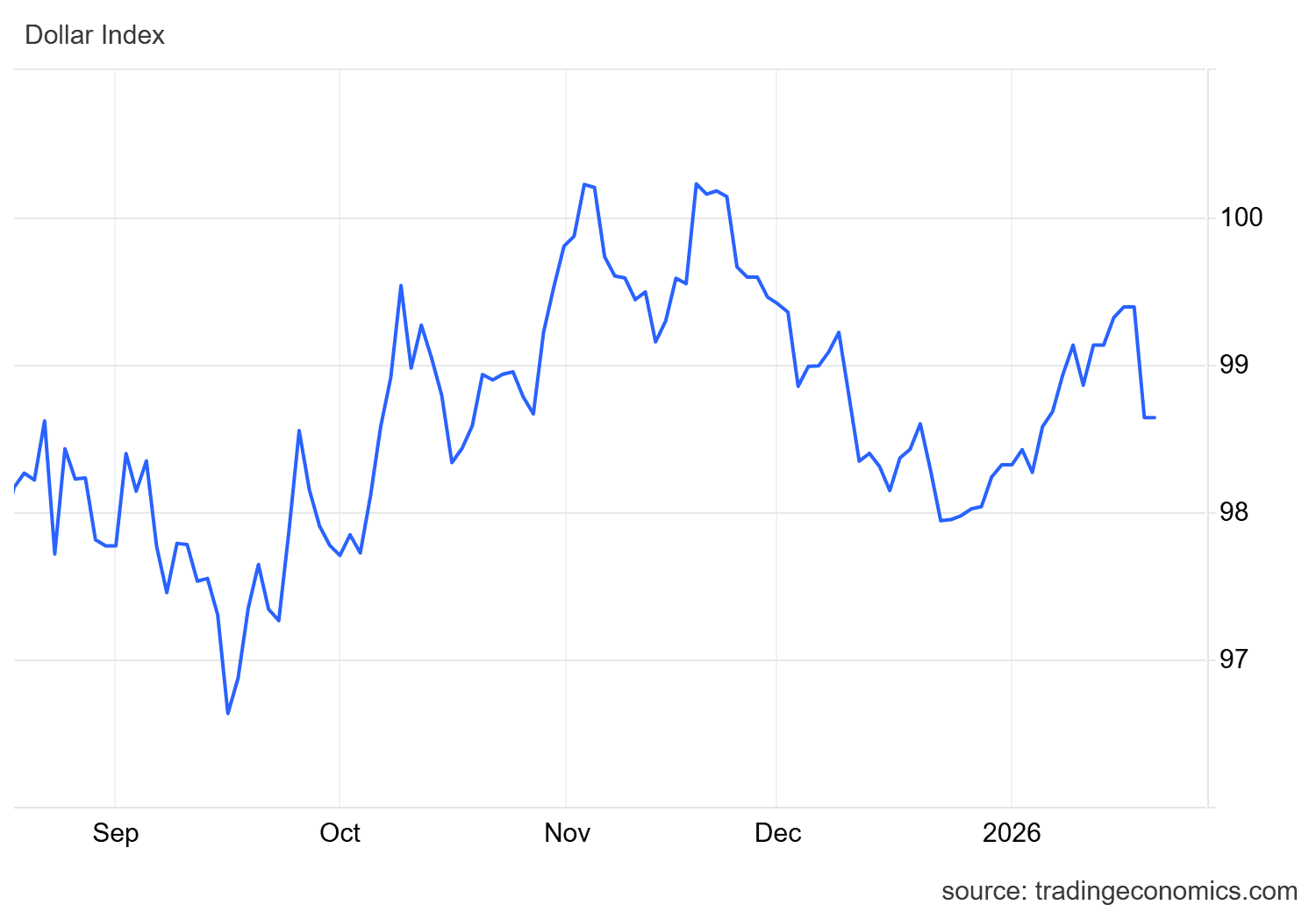
In this environment, U.S. dollar weakness has become a key factor. As the currency is directly involved in the escalation of tensions, it has suffered a loss of investor appetite, with market participants increasingly seeking alternative markets or short-term safe-haven assets. The DXY index, which measures the dollar’s strength against its major peers, continues to show consistent weakness, falling from around 99.4 to 98.6 in recent sessions, reflecting a notable loss of confidence in the currency’s performance.
Source: TradingEconomics
Taking all of this into account, Trump’s appearance in Davos appears to have added uncertainty rather than easing tensions, directly translating into further dollar weakness. This backdrop has favored a recovery in the Mexican peso, which, as an emerging market currency, may attract investors seeking exposure beyond traditional assets. As long as uncertainty stemming from tensions with Europe continues to weigh on confidence in the dollar, the Mexican peso could remain in the spotlight, acting as a key catalyst behind continued selling pressure in USD/MXN.
Do bonds support the peso?
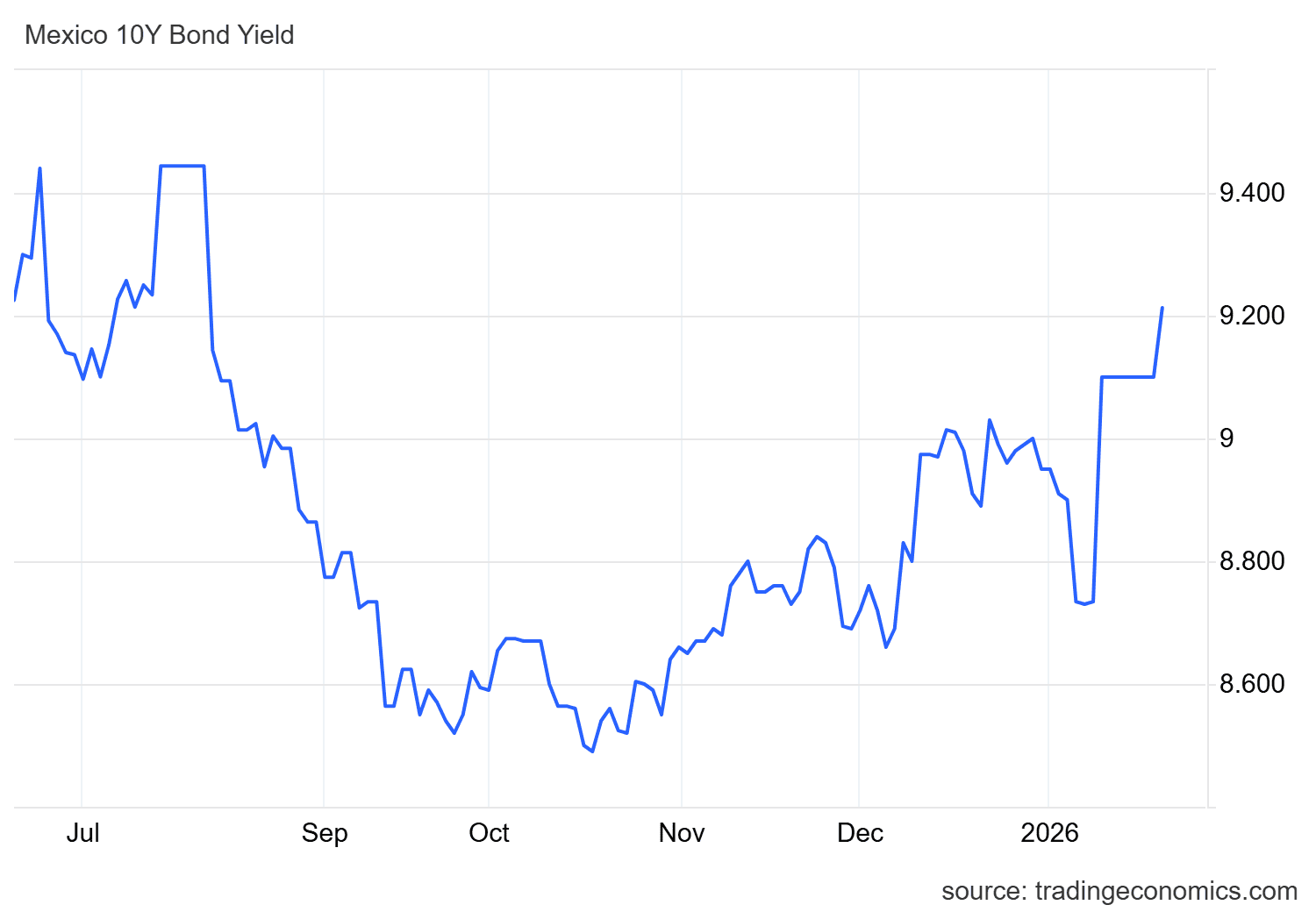
Beyond the diplomatic backdrop, a relevant domestic factor in Mexico is the behavior of 10-year government bonds. In recent sessions, fixed-income instruments have shown a steady increase in yields. After surpassing the 9% threshold, yields are now approaching the 9.5% area, displaying a consistently positive slope in the yield curve and signaling a solid recovery in bond attractiveness in the short term.
Source: TradingEconomics
Higher yields in fixed-income instruments often attract external demand, particularly from investors seeking exposure to markets offering attractive rates. This recent rise in yields may have encouraged foreign capital inflows, strengthening demand for the Mexican peso. As long as bonds continue to offer competitive returns, this factor could keep supporting strong peso demand, leading to additional selling pressure in USD/MXN.
USD/MXN Technical Outlook
Source: StoneX, Tradingview
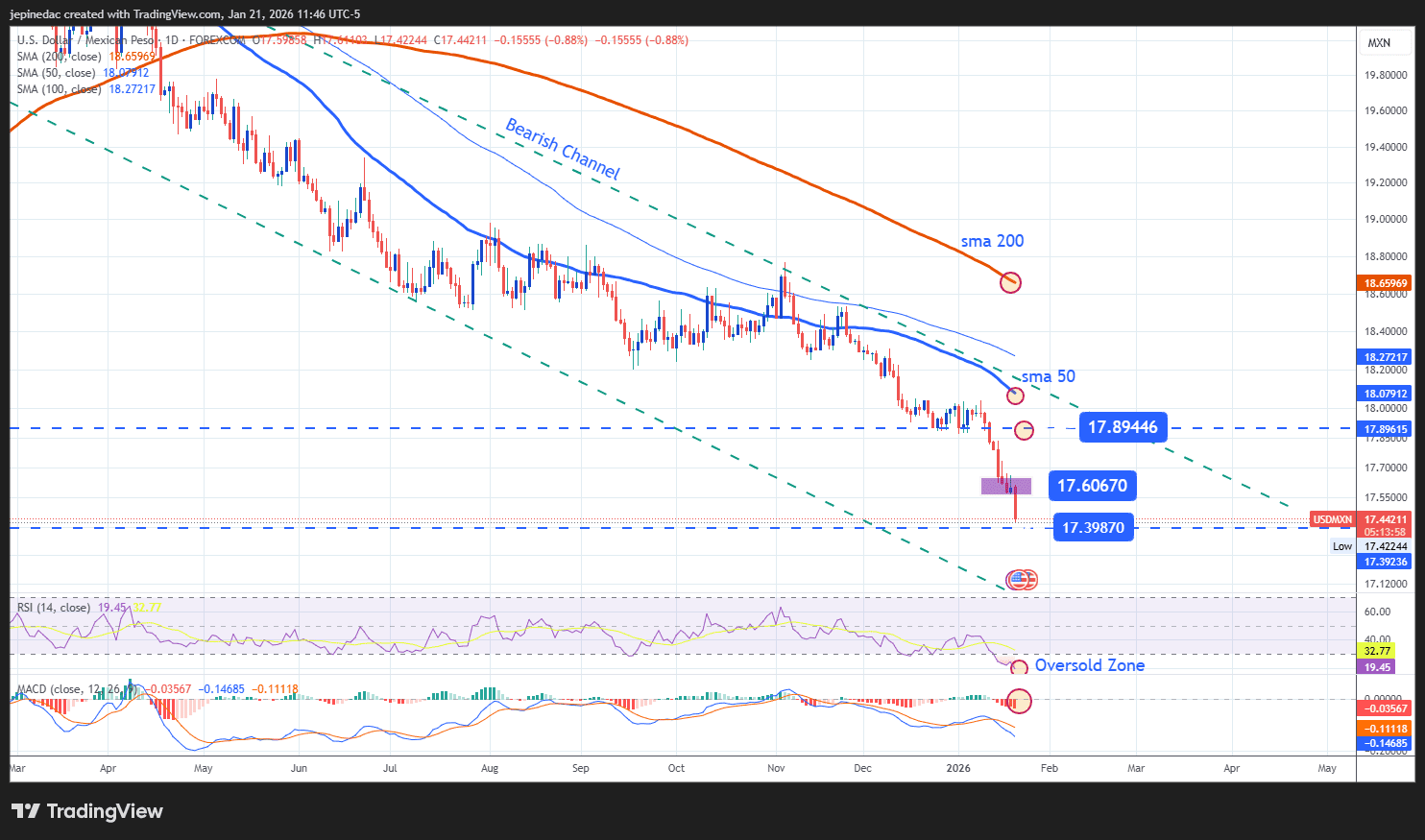
- The broader bearish channel remains dominant: USD/MXN price action continues to respect the bearish channel that has dominated since early 2025. So far, no meaningful corrections have emerged that would threaten this technical structure, keeping it as the most relevant formation in the short term. However, the continuous formation of new lows could open the door to short-term bullish corrections, even within a broader bearish context.
- RSI: The RSI remains below the neutral 50 level, reflecting the dominance of bearish momentum. However, the indicator has dropped toward the 20-point area, below the oversold threshold (30), suggesting a potential excess of selling pressure and opening the door to short-term technical rebounds.
- MACD: The MACD continues to display a histogram below the zero line, confirming selling pressure in short-term moving averages. As long as this behavior persists, the bearish bias could continue to dominate medium-term price action.
Key levels:
- 17.89 – Key resistance: A recent neutral zone that aligns with the bearish trendline and approaches the 50-period simple moving average. A sustained break above this level would put the current bearish structure at risk and could trigger a renewed bullish bias.
- 17.60 – Current barrier: A nearby resistance level, corresponding to the most recent neutral zone. It may serve as a key reference during potential short-term bullish corrections.
- 17.40 – Key support: A price area not seen since April 2024. A sustained move toward this level could enable a more aggressive bearish channel, reinforcing the dominance of selling pressure in USD/MXN.
Written by Julian Pineda, CFA, CMT – Market Analyst
Follow him on: @julianpineda25