
During the trading week, the USD/MXN pair has attempted to post gains of more than 0.5% in favor of the U.S. dollar, but these moves have been capped by the strength of the Mexican peso. For now, the pair has been unable to consolidate above the 19 pesos per dollar level in the short term. A notable neutral bias has begun to take shape in recent price action, as markets await clearer direction from the Federal Reserve. In Mexico, there have been no major comments that could trigger a directional shift. As long as this indecision persists, neutrality is likely to remain the dominant factor in the sessions ahead.
What’s Happening at the Federal Reserve?
Yesterday, Federal Reserve Governor Christopher Waller stated that he could support a more dovish approach at the September decision. He also highlighted that further rate cuts could be necessary in future meetings if upcoming labor market data, to be released next Friday, confirm a significant slowdown. These comments reinforce expectations that the Fed may be more inclined to cut rates in order to sustain economic momentum in the short term.
This comes against the backdrop of institutional tensions with the U.S. government, following recent developments involving Fed Governor Lisa Cook, who has filed a lawsuit against President Trump over her possible removal. Since early 2025, Cook has been a key voice in favor of holding rates steady, and her potential ouster is seen as a political maneuver that could compromise the independence of the central bank.
According to the CME Group, the probability of a 0.25% rate cut at the September 17 meeting stands at 87.1%, while the probability of leaving rates unchanged at the October 29 meeting is 47.4%. In summary, expectations continue to point to a Fed with a bearish bias, despite tensions with the government.
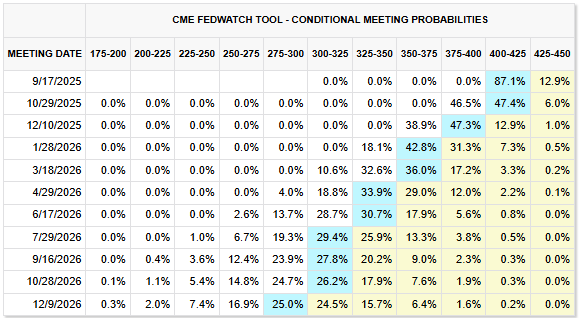
Source: CMEGROUP
Both the dovish stance and institutional tensions have reduced investor confidence in the U.S. dollar in the short term. Lower rates reduce the appeal of dollar-denominated investments, while questions about the Fed’s independence add to caution. This is evident in the DXY index, which has traded below 98 points for the past six sessions, showing steady downward pressure and sustained weakness in the greenback.
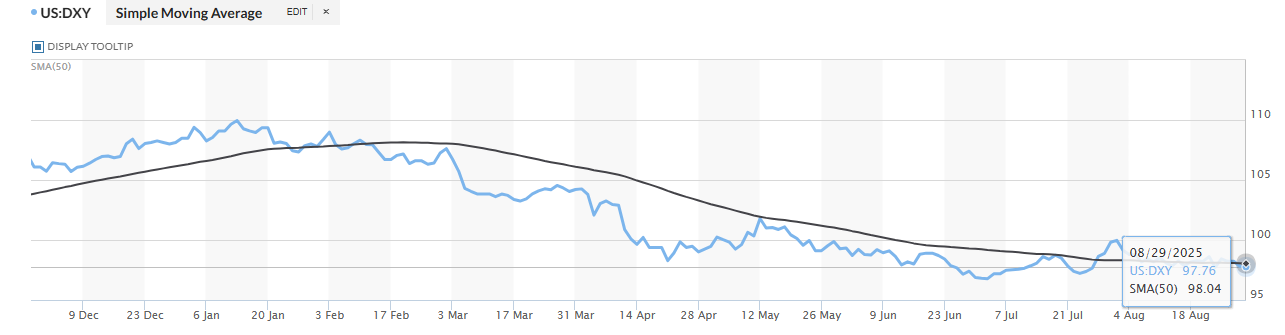
Source: MarketWatch
Against this backdrop, the dollar’s weakness has opened an opportunity for the Mexican peso to gain ground, preventing USD/MXN from breaking higher. If this trend persists, selling pressure on the pair could intensify in the coming sessions, reducing the current sense of neutrality.
Is Mexico Diversifying?
Brazil’s Vice President announced this week that Mexico and Brazil will sign a trade agreement in August 2026, focused on sectors such as battery and electric vehicle production, biofuels, and agribusiness, with the goal of modernizing and strengthening economic ties.
This announcement comes amid the context of the U.S. trade war, which has impacted both economies, and is seen as a strategy to reduce reliance on the U.S. in the coming years.
While the announcement did not have an immediate effect on the peso, it supports the perception that Mexico is seeking new growth opportunities, helping sustain confidence in the short term. If these initiatives continue, they could further stabilize the peso and become a factor supporting stronger buying pressure in USD/MXN.
USD/MXN Technical Outlook

Source: StoneX, Tradingview
- Sideways Range Holds: Despite the peso’s recent strength, the pair has been unable to break the 18.50 support, keeping a well-defined sideways range in place in the short term. As long as this structure continues, the lack of clear directional moves will remain a key factor in upcoming sessions.
- RSI: the indicator remains close to the neutral 50 level, reflecting a consistent balance between buying and selling pressure over the last 14 sessions. This confirms the validity of the current range and suggests neutrality will prevail until a clear breakout occurs.
- ADX: remains below 20, indicating weak trend strength and limited volatility. This supports the continuation of a neutral scenario, with markets awaiting fresh economic data to act as a catalyst.
Key Levels:
- 18.50 – Key Support: a psychological level aligned with recent lows. A sustained break below would reactivate selling pressure and extend the downtrend seen in previous weeks.
- 18.85 – Near-Term Resistance: corresponds to the top of the range and coincides with the 50-period moving average. This remains the most important barrier for containing upward corrections.
- 19.16 – Critical Resistance: aligned with the 23.6% Fibonacci retracement, this is the key reference for a potential bullish breakout. A sustained move above would validate a stronger buying bias and open the way for a more consistent upward phase.
Written by Julian Pineda, CFA – Market Analyst
Follow him at: @julianpineda25