

The USD/MXN pair has recorded eight consecutive bearish sessions in favor of the Mexican peso, with a decline of more than 2.5% in the short term. This selling pressure reflects the strength of the peso in a context where expectations of lower U.S. interest rates have weakened confidence in the dollar. For now, the trend remains intact and favors the peso, suggesting that pressure could intensify as the Federal Reserve (Fed) decision, scheduled for tomorrow, approaches.

Central Bank Dynamics
The Fed meeting is scheduled for tomorrow, and according to the CME Group, there is more than a 90% probability that a 0.25% cut will be announced, bringing the reference rate down from 4.5% to 4.25%. However, the most important aspect will be the subsequent comments: whether the central bank confirms that the cycle of lower rates will continue over the coming months. At present, the expectation of easing has consolidated as the dominant narrative, reducing the appeal of dollar-denominated investments.
In Mexico, the Bank of Mexico (Banxico) will meet on Thursday, September 25. Consensus also points to a 0.25% cut, which would bring the rate down to 7.5%. However, the probability of this happening in subsequent meetings is not as firm, as the latest inflation data showed an uptick from 3.51% in July to 3.57% in August. While the increase is modest, it could represent a risk if combined with a more aggressive pace of cuts. Banxico itself has stated it will closely monitor inflation before confirming a more accommodative stance, leaving room for a more neutral bias in future decisions.
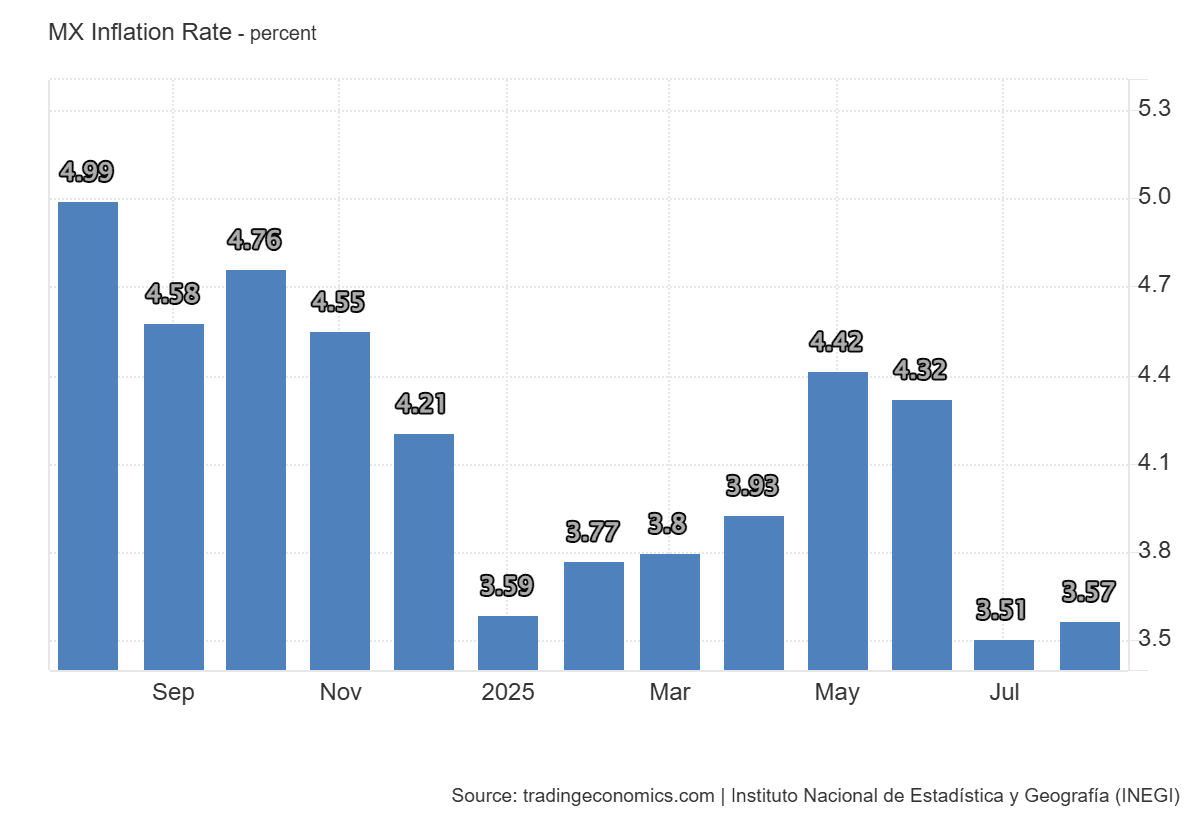
Source: TradingEconomics
Thus, the dynamics of both central banks point to a short-term divergence: the Fed appears determined to cut rates to close out the year, while Banxico may adopt a more cautious stance if inflation persists. This contrast could be crucial for the rate differential, which currently stands at 3.25 percentage points in favor of Mexico. If the Fed confirms tomorrow that it will continue cutting and Banxico does not follow suit next week, the differential could widen further, increasing the appeal of peso-denominated assets over those in U.S. dollars.
In this scenario, the peso could continue strengthening, and the selling pressure on USD/MXN observed in recent weeks could intensify, especially if the Fed insists on keeping rates lower while Banxico shows greater concern about inflation.
Is Mexico Facing China?
Beyond monetary policy factors, the peso has also found support on the trade front. Mexico recently announced tariffs on Chinese goods, including an increase of up to 50% on imported cars, as part of a package covering more than 1,400 products without official trade agreements. The measure seeks to protect domestic industry and jobs, although it could generate artificial inflationary pressure in the short term.
If the new tariffs drive up domestic prices, Banxico could be forced to maintain a more restrictive stance to prevent inflation from exceeding its 3% target. Paradoxically, this would reinforce Mexico’s appeal as an investment destination, as it would keep real interest rates elevated. Thus, even tariff-induced inflation could end up benefiting the peso, by sustaining confidence in peso-denominated assets. In the short term, this would support the persistence of high interest rates, which could act as a key catalyst to maintain selling pressure on USD/MXN.
USD/MXN Technical Forecast
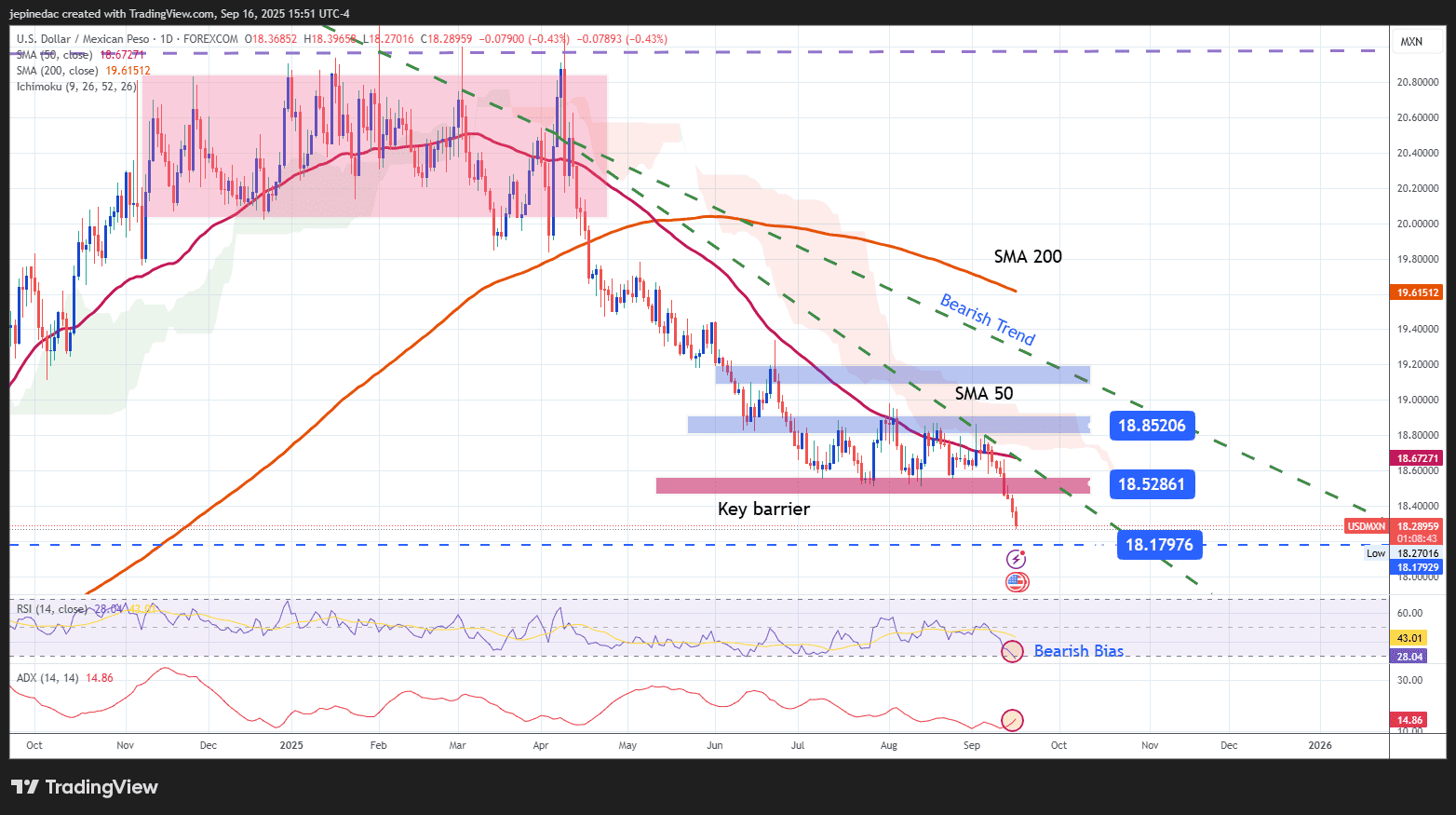
Source: StoneX, Tradingview
- New bearish momentum: Since early September, USD/MXN has resumed a steady downward bias, breaking key support levels and reactivating the long-term downtrend that had been on hold in recent weeks. This renewed selling impulse suggests the pair could continue moving lower in the short term, maintaining the long-term bearish line that has prevailed for most of 2025.
- RSI: The RSI line maintains a negative slope and trades below the neutral 50 level, confirming the dominance of selling pressure. However, it is approaching the oversold zone, which could open space for short-term bullish corrections if excessive selling is detected.
- ADX: The ADX has begun to climb and is approaching the 20 level, signaling an increase in the pair’s average volatility. If the line continues to rise, it could confirm more consistent directional moves in favor of the prevailing bearish trend.
Key Levels:
- 18.17 – Key Support: A level not seen since July 2024, serving as the next major barrier for the downtrend. A break below would strengthen bearish pressure in the short term and add continuity to the long-term selling trend that has re-emerged in the technical outlook.
- 18.50 – Nearby Barrier: Corresponds to the lows of a recent sideways range. It may act as provisional resistance in the event of technical rebounds.
- 18.85 – Final Resistance: Aligned with the Ichimoku cloud, marking recent weekly highs. A rebound to this level would put the current downtrend at risk and could open the door to a relevant bullish bias.
Written by Julian Pineda, CFA – Market Analyst
Follow him: @julianpineda25