



Crypto Fundamental Analysis: Inflation relief fails to revive crypto confidence
As we move into mid-July, the lack of demand around the cryptocurrency market is once again standing out across financial markets. This is partly because the market failed to maintain consistent strength after the inflation data released at the beginning of the trading week.
Share this:

As we move into mid-July, the lack of demand around the cryptocurrency market is once again standing out across financial markets. This is partly because the market failed to maintain consistent strength after the inflation data released at the beginning of the trading week.
For now, caution remains around the possibility of a more aggressive central bank in the United States, which could continue to limit appetite for risk markets such as cryptocurrencies. If this effect continues, a phase of indecision or weakness could remain relevant over the next few sessions.


A week of inflation data
At the beginning of the trading week, relevant inflation data was released in the United States. First, annual CPI came in at 3.5%, below the expected 3.8%. Shortly after, Core PPI registered a reading of 0.2%, also below the expected 0.3%.
Both figures suggested a slowdown in inflation pressures, both in consumer prices and producer prices, during June. This dynamic opened room for expectations of a less aggressive Federal Reserve and helped temporarily stabilize risk appetite in markets such as cryptocurrencies.
However, this sentiment only lasted a couple of sessions. For now, a scenario of a calmer U.S. central bank in the short term has not been confirmed, especially as risk perception around the Middle East remains present.
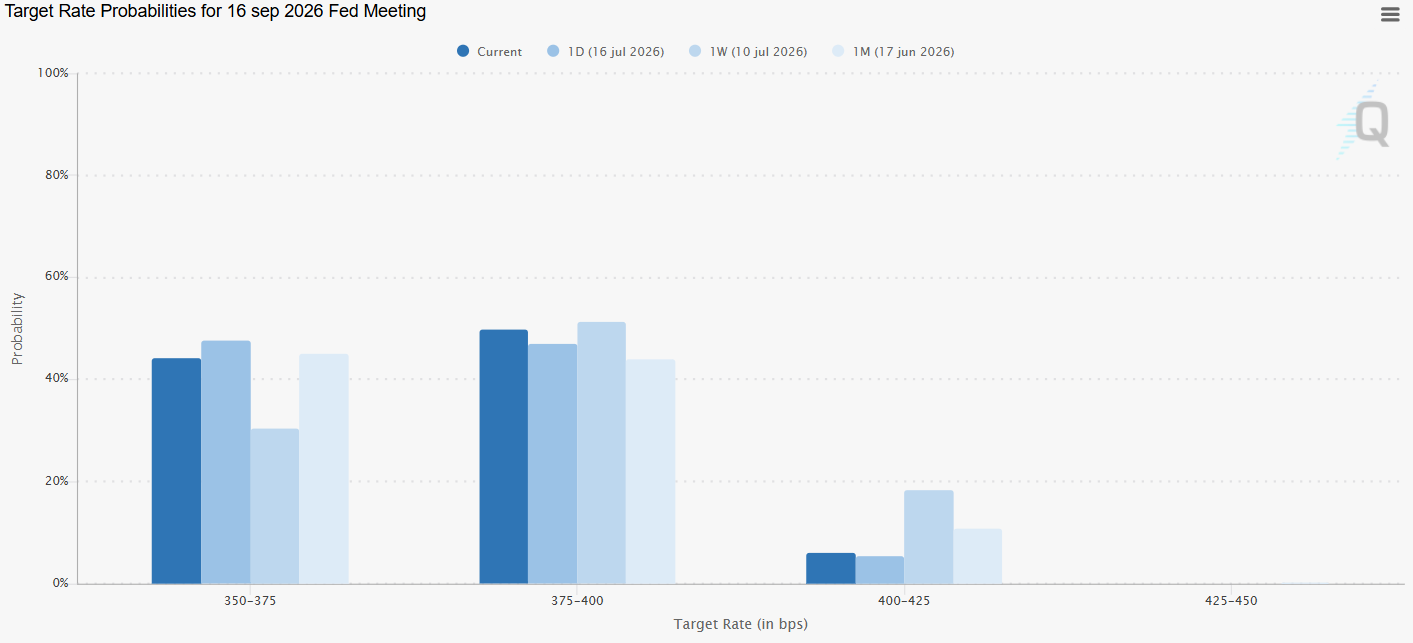
In addition, probabilities around what the Fed could do in the coming months continue to show a relevant figure. For the September 16 decision, the market still assigns a probability of just over 49.5% to a 0.25% increase in U.S. interest rates.
This is partly because the recent inflation slowdown is still not considered enough to return to the central bank’s 2.00% target. For this reason, the possibility remains that the Fed could continue to focus on a higher-rates scenario over the coming months.
Source: CMEGROUP
This dynamic remains relevant for the cryptocurrency market, as the prospect of higher rates in the United States can increase borrowing costs and reduce available liquidity for consumption and investment. In this scenario, demand for risk markets such as cryptocurrencies could remain limited.
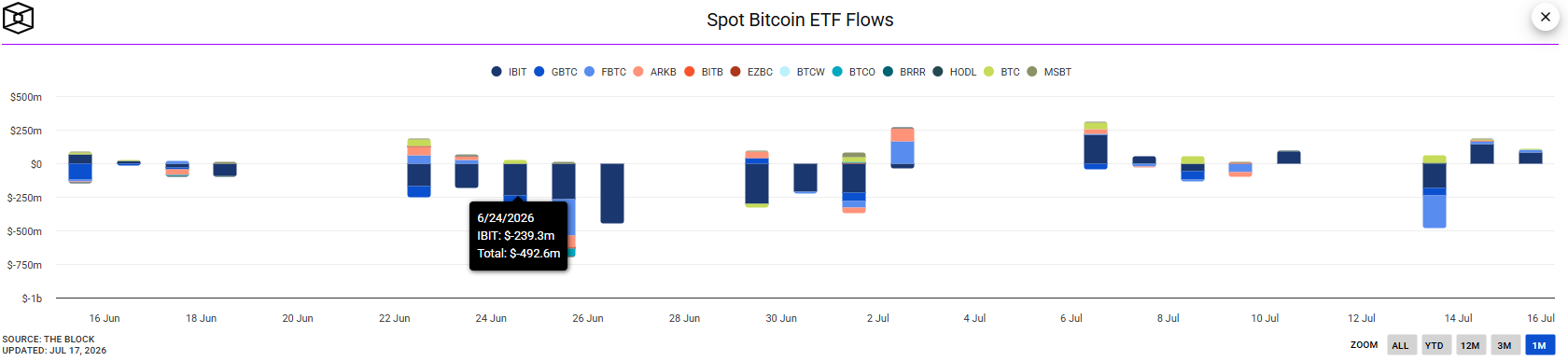
In fact, the slowdown in demand continued during the week, even after inflation data showed signs of moderation. The Bitcoin ETF market, as the reference crypto asset, failed to accumulate relevant positive flows. After the release of the inflation data, inflows were only recorded on July 14 and 15, totaling just over 100 million dollars. This does not reflect consistent demand for BTC and coincides with caution around a potentially more aggressive U.S. central bank over the coming months.
Source: Theblock
This dynamic is important because, if there is no clearer resolution to the conflict in the Middle East or signs that could open the door to a more flexible Fed, caution could continue to limit appetite for risk assets. For now, the recent inflation data do not appear sufficient to clearly restore the appeal of markets such as cryptocurrencies. If this effect continues, a phase of indecision or weakness could continue to affect the crypto market over the next few sessions.
Bitcoin compared to other markets
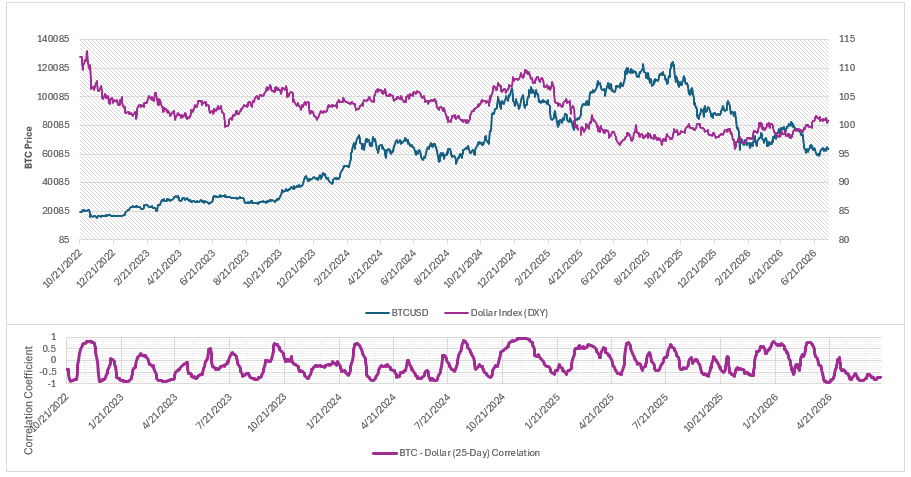
One of the most relevant short-term behaviors is the increase in the negative correlation between the DXY, the U.S. dollar index, and Bitcoin price movements, as the reference currency of the crypto market.
Now, the coefficient remains very close to the -1 area, showing an important inverse relationship between both markets over the last 25 sessions. This indicates that movements in the U.S. dollar and Bitcoin currently tend to move in opposite directions. However, it is important to remember that the correlation coefficient can change over time.
Source: Data – TVC, StoneX, Tradingview
This relationship is important because the recent weakness and neutrality in Bitcoin coincides with some strength in U.S. dollar demand toward the end of the trading week. This suggests that caution continues to dominate market risk sentiment.
It may also reflect a possible rotation of capital toward more stable markets, such as the dollar, reducing interest in higher-risk assets like cryptocurrencies. This dynamic remains in place in a context where concerns about more aggressive central banks over the coming months are still present.
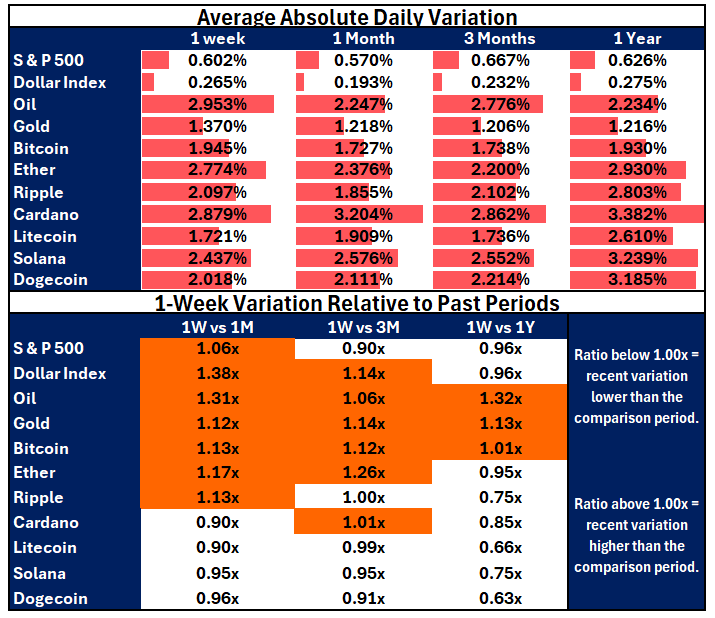
In addition, when looking at the average daily variation of the cryptocurrency market during the last trading week, only Bitcoin, ETH, and Ripple managed to exceed their average variation from the last month. The rest of the main cryptocurrencies remain below that level, reflecting a broader lack of activity in the market.
In contrast, markets such as the dollar and oil have shown an average weekly variation above 1.3 times their monthly variation. This shows that, for now, market activity and interest appear to be more focused on the U.S. dollar and oil, as an asset sensitive to the situation in the Middle East, leaving cryptocurrency activity in the background.
Source: Data – TVC, StoneX, Tradingview
With all of this in mind, if no more relevant movements are observed in the daily variations of the crypto market and more stable substitute assets continue to show greater appeal, weak cryptocurrency demand could remain important. This scenario could maintain a phase of indecision or weakness in the crypto market in the short term.
Confidence does not show a relevant recovery
Looking at the behavior of the cryptocurrency Fear and Greed Index, despite the slight recovery seen in recent sessions, the indicator still remains near 32 points, within the “fear” zone and without reaching “neutrality.” This shows that confidence perception in the crypto market remains sensitive.
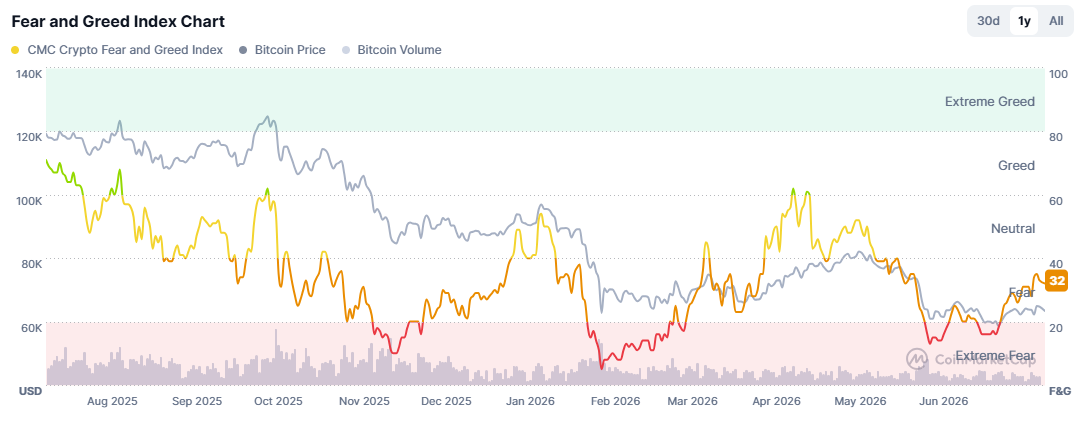
Source: Coinmarketcap
This dynamic suggests that, for now, there is not enough stability to support dominant demand. If the index fails to move into positive territory, confidence could continue to show fragility and reflect a phase of indecision or weakness in the market over the next few sessions.
Written by Julian Pineda, CFA, CMT – Market Analyst
Follow him on: @julianpineda25
Latest market news




The complete CFD trading experience
Award-winning platforms, competitive spreads, low commissions and dedicated support.
We live and breathe the markets and are dedicated to helping traders realise their ambitions as we continue to set the industry bar.
Economic calendar
Web Trader platform
Our sophisticated web-based platform is packed with features.
Related articles

Bitcoin Analysis: Is Uncertainty Returning to BTC?
Recent trading sessions have not been particularly supportive of a clear directional move in Bitcoin. This can be seen in the behavior of the price over the last four sessions, where fluctuations have remained close to 1.00% without establishing a consistent trend. As a result, a growing sense of neutrality is beginning to emerge around BTC.

Gold Forecast: Are Bears Regaining Control of XAU/USD?
The start of the trading week has not been particularly favorable for gold. This can be seen in recent XAU/USD price action, with the metal falling nearly 4.00% over the last two trading sessions and bringing renewed attention to a bearish bias within the market.

Gold Dips Below Three-Month Uptrend, Bitcoin Pulls Back from Nine-Month High
Gold has dipped below its three-month uptrend, while Bitcoin has pulled back from a nine-month high as U.S. bond yields test levels last seen in 2004 and 2007. Risks build as Fed rate-hike expectations remain above 70%, while the Dollar Index holds near yearly highs.

StoneX Europe Ltd may make third party material available on this website which may contain information included but not limited to the conditions of financial markets. The material is for information purposes only and does not contain, and should not be construed as containing, investment advice and/or investment recommendation and/or an investment research and/or an offer of or solicitation for any transactions in financial instruments; any decision to enter into a specific transaction shall be made by the client following an assessment by him/her of their situation.
StoneX Europe Ltd makes no representation or warranty and assumes no liability as to the accuracy or completeness of the information provided, nor any loss arising from any investment based on a recommendation, forecast or other information supplied. You should always seek independent advice as to your suitability to speculate in any related markets and your ability to assume the associated risks, if you are at all unsure. We are not under any obligation to update any such material. Any opinion made may be personal to the author and may not reflect the opinion of StoneX Europe Ltd.