


Dow Jones Analysis: Is the DJIA Making a Comeback?
Recent trading sessions have become increasingly relevant for the Dow Jones, as the index has started to regain bullish momentum heading into the end of the week. Over the last three sessions, the DJIA has advanced by more than 0.6%, allowing buying pressure to regain prominence and raising the possibility of a more consistent short-term recovery.
Share this:

Recent trading sessions have become increasingly relevant for the Dow Jones, as the index has started to regain bullish momentum heading into the end of the week. Over the last three sessions, the DJIA has advanced by more than 0.6%, allowing buying pressure to regain prominence and raising the possibility of a more consistent short-term recovery.
For now, this move appears to be supported by two main factors. On one hand, the relative attractiveness of the U.S. bond market has begun to fade following a recent moderation in yields. On the other, the index's largest components continue to display relatively stable performance, helping to preserve confidence around the Dow Jones. As long as these conditions remain in place, buying pressure could continue to be relevant in the sessions ahead.

Are Lower Bond Yields Beginning to Support the Market?
Over recent sessions, a moderation in 10-year U.S. Treasury yields has become increasingly evident. Part of this move follows recent comments from Federal Reserve officials, who suggested that there is currently no immediate need to adopt a more aggressive monetary policy stance during October. As a result, markets have begun to scale back expectations of a more aggressive central bank in the short term, with Treasury yields retreating toward the 5.0% area after reaching recent highs.
This environment tends to be supportive for equity markets, as less aggressive rate expectations help maintain more stable financial conditions while reducing some of the relative attractiveness of fixed-income assets. What makes the current situation particularly interesting, however, is that not all U.S. equity indices are responding in the same way.
While the Nasdaq 100 continues to face pressure from ongoing concerns surrounding the technology sector and elevated valuations, the Dow Jones has managed to sustain a more consistent recovery. This divergence suggests that part of investor demand may be rotating toward sectors perceived as more defensive within the U.S. equity market. Due to its composition, the Dow has benefited from lower bond yields without being as directly exposed to the concerns currently weighing on the technology sector. As a result, the index is beginning to stand out as a relatively more stable alternative and has once again attracted buying interest during the short term.
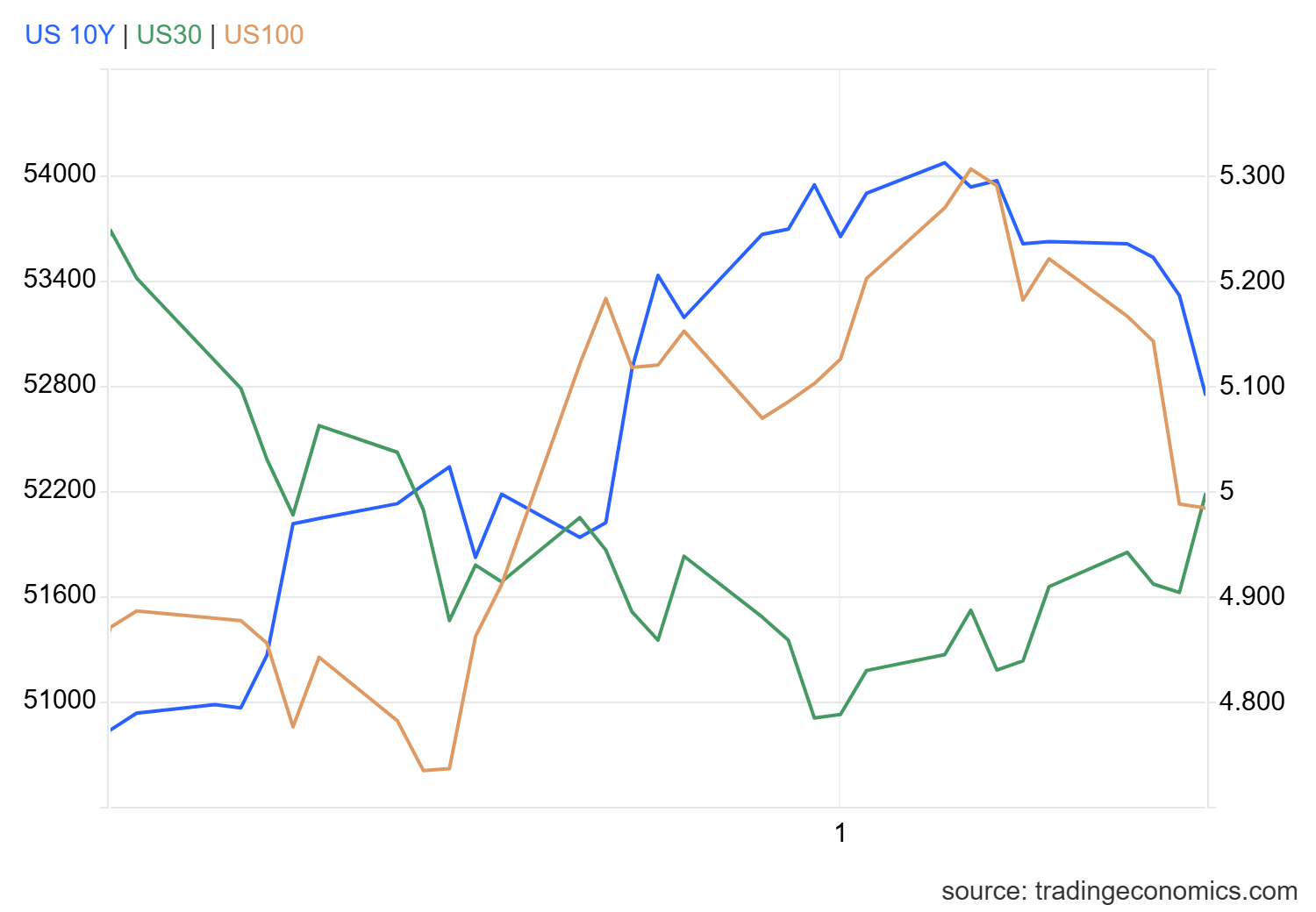
Source: TradingEconomics
All of this remains important because the market appears to be facing less competition from alternative investments such as bonds in the short term, while the Dow Jones continues to display stronger stability than several major U.S. equity benchmarks. This dynamic has helped support demand and may continue to underpin the buying pressure observed in recent sessions.
Can Demand Remain Strong?
It is also important to monitor the performance of Dow Jones' largest components. During the latest session, only two of the ten largest constituents posted losses: Caterpillar (-1.44%) and Apple (-0.36%). The remaining major components delivered either positive or relatively stable performance.
Among the strongest performers, UnitedHealth (+2.86%) stood out following better-than-expected earnings results and improved full-year guidance. Amgen (+1.96%) also posted solid gains, benefiting from a rotation of capital toward more defensive sectors, while Travelers (+1.64%) reflected a similar dynamic.
This remains important because the recent strength in the Dow Jones is not solely dependent on isolated corporate developments. Part of the stability comes from the defensive nature of many of its components, a characteristic that tends to become increasingly attractive when more cyclical segments of the market, such as technology, begin to lose momentum.
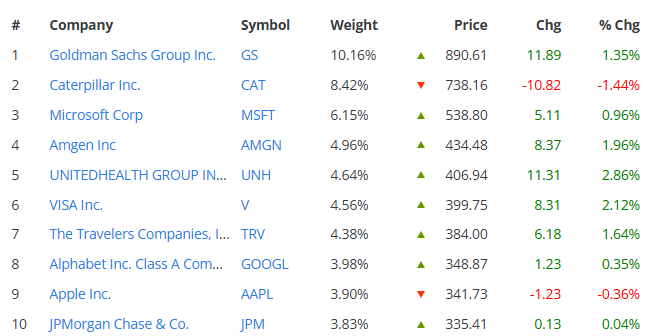
Source: Slickcharts
With this in mind, Dow's constituents continue to act as recipients of capital flows seeking exposure to more defensive sectors within the U.S. equity market. As long as this dynamic remains in place and concerns persist around more sensitive segments of the market, demand for Dow Jones could continue to display stability and support a constructive bias in the sessions ahead.
Dow Jones Technical Forecast
Source: StoneX, Tradingview
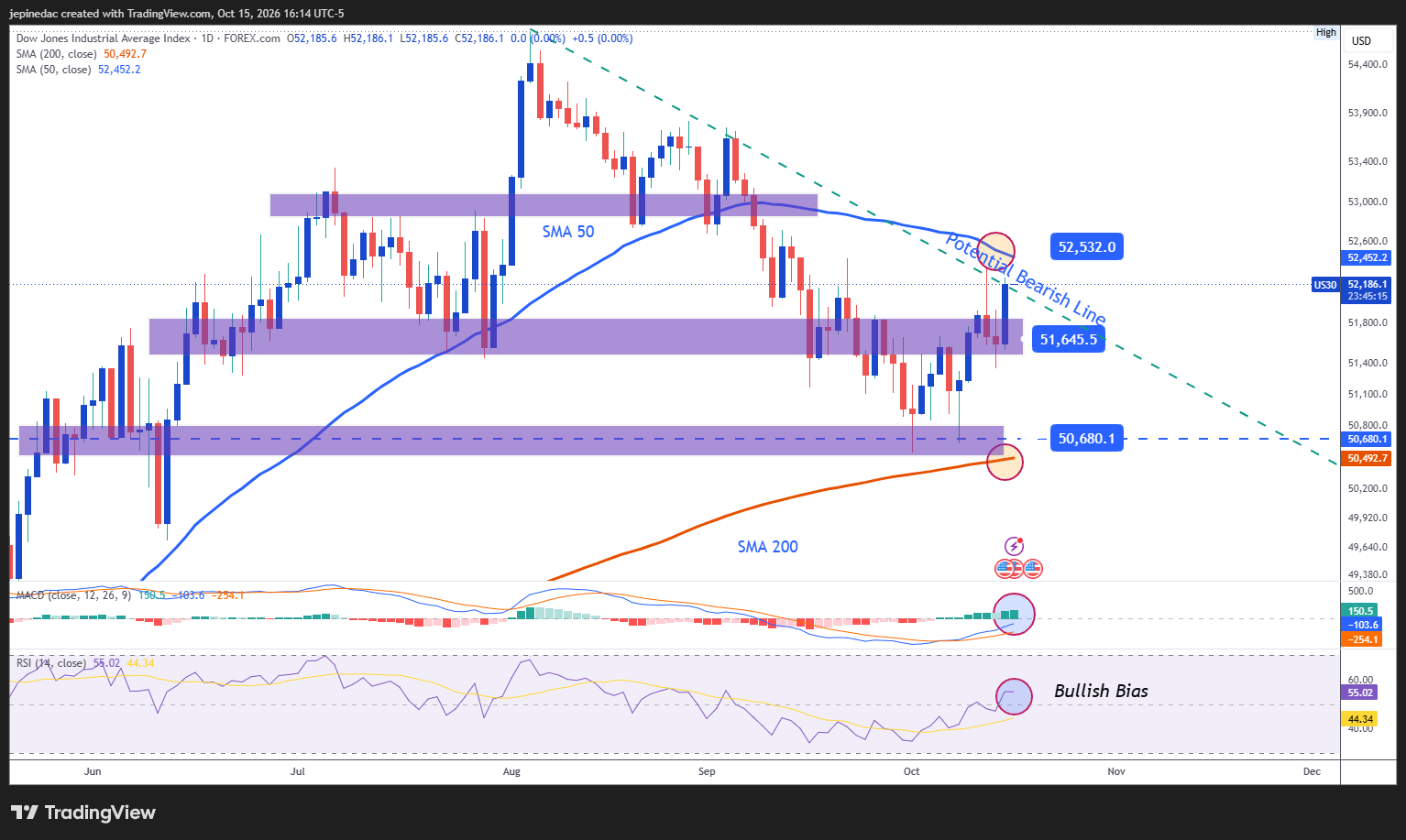
- The bearish trendline is entering a risk zone: For several weeks, the Dow Jones developed a sequence of lower lows that contributed to the formation of a bearish structure on the daily chart. However, the recent rebound has begun to place this technical reference under pressure as price approaches the primary bearish trendline once again. If buying pressure continues to strengthen and key resistance levels are overcome, a breakout of this structure could begin to take shape and open the door to a more consistent bullish trend.
- RSI: The RSI has moved above the 50 neutral level, a reading that reflects improving bullish momentum. As long as this dynamic remains in place, the bullish bias could continue gaining relevance in the coming sessions.
- MACD: A similar picture can be observed in the MACD, whose histogram continues to trade above the 0 neutral line. This reading supports the recent strength in short-term moving averages and reinforces the importance of the bullish bias that has emerged in recent days.
Key Levels:
- 52,500 points – Key Resistance: This level represents the most important upside barrier on the chart, located above the bearish trendline and close to the 50-period simple moving average. A sustained move above this area could signal a meaningful shift in market structure and support a more consistent bullish trend.
- 51,700 points – Near-Term Barrier: An important equilibrium zone that aligns with retracement levels observed in previous weeks. If price continues to develop around this area, a more neutral environment could remain in place and support the formation of a broader trading range in the short term.
- 50,700 points – Key Support: A major support level that aligns with both previous lows and the 200-period simple moving average. A break below this area could significantly alter the current structure of the chart and restore the long-term bearish trendline as the dominant technical pattern in the weeks ahead.
Written by Julian Pineda, CFA, CMT – Market Analyst
Follow him on: @julianpineda25
Latest market news




The complete CFD trading experience
Award-winning platforms, competitive spreads, low commissions and dedicated support.
We live and breathe the markets and are dedicated to helping traders realise their ambitions as we continue to set the industry bar.
Economic calendar
Web Trader platform
Our sophisticated web-based platform is packed with features.
Related articles
Dow Jones Analysis: Is the DJIA Making a Comeback?
Recent trading sessions have become increasingly relevant for the Dow Jones, as the index has started to regain bullish momentum heading into the end of the week. Over the last three sessions, the DJIA has advanced by more than 0.6%, allowing buying pressure to regain prominence and raising the possibility of a more consistent short-term recovery.

Dow Jones outlook: CPI, oil and yields put the rally to the test
US index futures rebounded in the first half of Wednesday’s session, along with European indices ahead of the release of US CPI. Some slightly dovish remarks from the Fed’s Williams seem to have helped sentiment a little, but whether those comments will be backed by data remains to be seen. While slightly hotter than expected inflation data shouldn’t be enough for markets to price in an October Fed hike with more than a coin flip probability, it can nonetheless reinforce expectations of further tightening later in the year.


Dow Jones Forecast: DJIA rises as Oil slips and Treasury yields pause
U.S. stocks are rising on Friday as oil prices ease on signs of reduced Middle East supply risks, although the telecom sector remains under pressure following SpaceX’s acquisition deal.

StoneX Europe Ltd may make third party material available on this website which may contain information included but not limited to the conditions of financial markets. The material is for information purposes only and does not contain, and should not be construed as containing, investment advice and/or investment recommendation and/or an investment research and/or an offer of or solicitation for any transactions in financial instruments; any decision to enter into a specific transaction shall be made by the client following an assessment by him/her of their situation.
StoneX Europe Ltd makes no representation or warranty and assumes no liability as to the accuracy or completeness of the information provided, nor any loss arising from any investment based on a recommendation, forecast or other information supplied. You should always seek independent advice as to your suitability to speculate in any related markets and your ability to assume the associated risks, if you are at all unsure. We are not under any obligation to update any such material. Any opinion made may be personal to the author and may not reflect the opinion of StoneX Europe Ltd.