


EUR/USD Analysis: The euro approaches the end of the week with a consistent neutral bias
The EUR/USD has maintained a consistent neutral tone and, over the last four trading sessions, has posted a modest move of just 0.36%, reflecting a phase of structural indecision in the short term.
Share this:

The EUR/USD has maintained a consistent neutral tone and, over the last four trading sessions, has posted a modest move of just 0.36%, reflecting a phase of structural indecision in the short term. This dynamic persists amid the absence of meaningful updates from the central banks in Europe and the United States, as well as lingering uncertainty surrounding the US dollar due to doubts over potential trade tensions. Unless greater clarity emerges on these fronts, neutrality is likely to remain the dominant feature in EUR/USD price action.


Neutrality driven by central bank expectations
One of the most relevant factors influencing directional movements in EUR/USD is the monetary policy stance of both regions. At present, expectations of stability from both the European Central Bank and the Federal Reserve have reinforced the neutral bias observed in the pair.
The ECB probability table shows a 96.2% probability that the deposit rate will remain at 2.00% for the March 17, 2026 decision. For April and June, the likelihood of unchanged rates remains above 60%, pointing to a stable monetary policy outlook in the coming months. With no expectations of higher rates, there is also no projection of improved yields in euro-denominated fixed income that could support stronger demand for the currency in the short term.
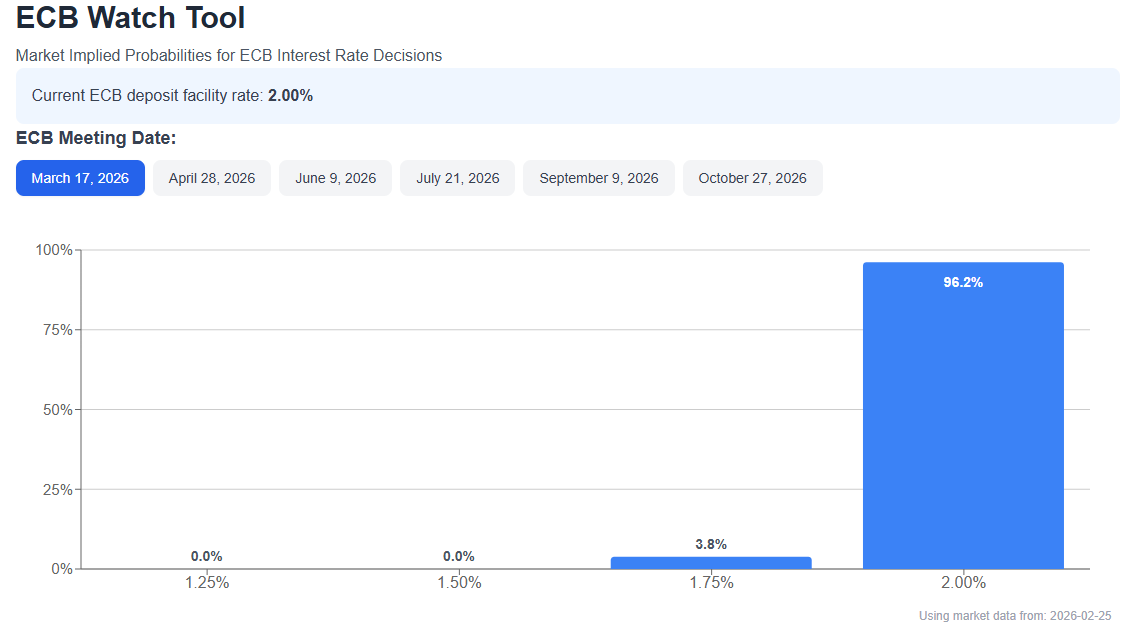
Source: ECBWATCH
On the US side, the scenario is very similar. There is a 97.9% probability that the benchmark rate will remain at 3.75% for the March decision, and for April and June markets also price in a probability above 50% of unchanged rates. This environment does not introduce structural changes that would significantly alter market perception of the dollar in the near term.
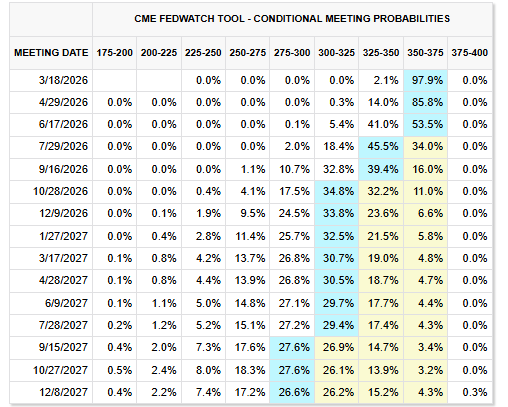
Source: CMEGROUP
Taken together, the lack of monetary updates has intensified the neutral bias in the pair. However, it is important not to overlook the rate differential (3.75% in the US versus 2.00% in Europe), which continues to provide relative support to the dollar. If markets begin to perceive that the Federal Reserve could adopt a more restrictive tone than the ECB, this differential could become a catalyst for more consistent selling pressure in EUR/USD over the medium term.
The dollar also faces neutrality
Since last week, there has been discussion about the potential implementation of 15% tariffs proposed by President Trump’s administration. However, there has been no official confirmation or detailed guidance, beyond requests for clarification from the European Union. This lack of definition has kept markets in a wait-and-see mode, maintaining a state of indecision.
This has begun to reflect in the DXY index, which measures the strength of the US dollar. The index is hovering around 97.7 points, with its slope losing momentum after the recovery observed in previous sessions. This behavior suggests that markets are waiting for greater clarity on trade tensions before adopting a more decisive stance on the dollar.
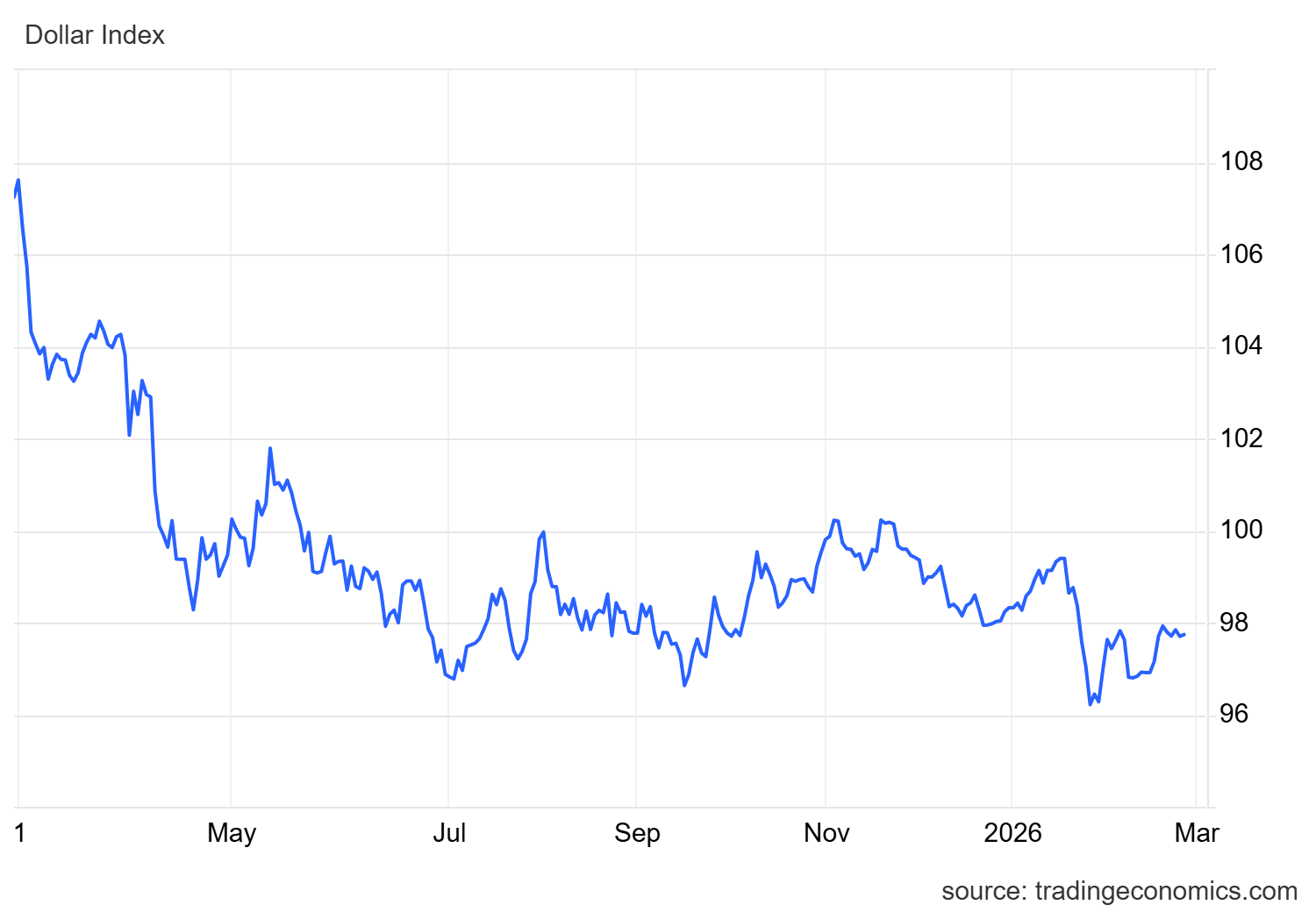
Source: TradingEconomics
If this dynamic continues, the neutrality observed in the dollar could continue to translate into EUR/USD price action, sustaining an indecisive environment unless more forceful fundamental catalysts emerge.
Technical outlook for EUR/USD
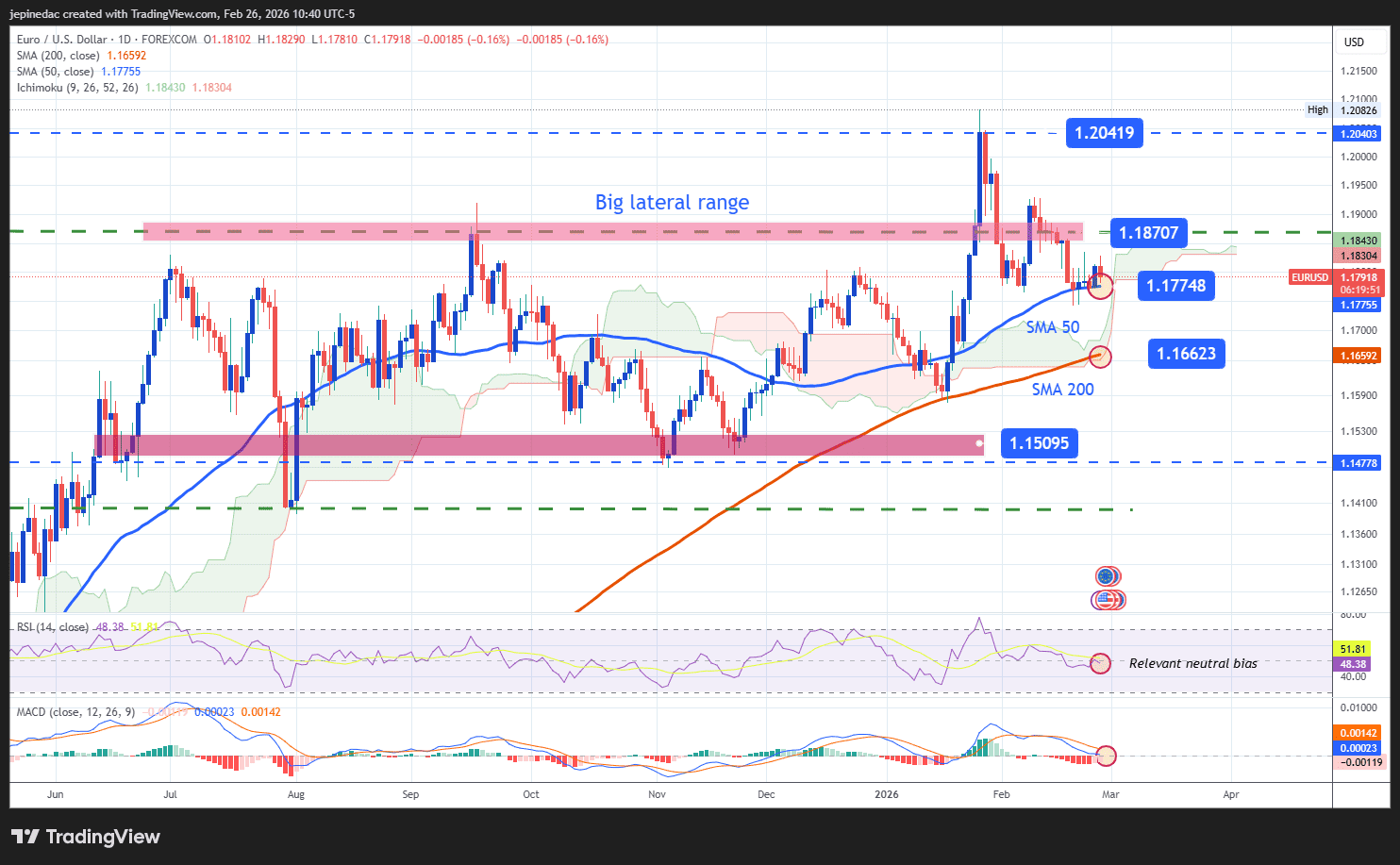
Source: StoneX, Tradingview
- The broad sideways range remains relevant: Since June 2025, EUR/USD has maintained a wide trading range, with resistance at 1.18707 and support at 1.15095. Despite recovery attempts in recent weeks, buying pressure has not been strong enough to break this dominant structure. Unless a clearer directional move materializes, the extension of the current range could continue to dominate price action in both the short and medium term.
- RSI: The RSI remains fluctuating around the neutral 50 level, indicating balance between buying and selling impulses in the short term. As long as this dynamic persists, indecision is likely to prevail.
- MACD: The MACD shows a similar scenario, with the histogram oscillating near the zero line. This reflects the absence of dominant bullish or bearish momentum in short-term moving averages, reinforcing the neutral outlook for the pair.
Key levels:
- 1.18707 – Relevant resistance: Level aligned with the upper boundary of the sideways range. Sustained moves above this area could trigger a renewed bullish bias and open the door to a new short-term trend.
- 1.17784 – Near-term barrier: Recent neutrality zone aligned with the 50-period simple moving average. As long as price fails to move decisively away from this level, the range extension could remain intact.
- 1.16623 – Key support: Level aligned with the 200-period simple moving average. Moves toward this zone could reinforce short-term selling pressure; however, such pressure would likely remain insufficient to break the broader sideways channel currently in place.
Written by Julian Pineda, CFA, CMT – Market Analyst
Follow him on: @julianpineda25
Latest market news




The complete CFD trading experience
Award-winning platforms, competitive spreads, low commissions and dedicated support.
We live and breathe the markets and are dedicated to helping traders realise their ambitions as we continue to set the industry bar.
Economic calendar
Web Trader platform
Our sophisticated web-based platform is packed with features.
Related articles
USD/JPY Update: Can the Japanese Yen Sustain Its Recovery?
Short-term price action around the Japanese yen has started to show some relative improvement over recent sessions. This can be seen in the recent performance of USD/JPY, which has now recorded three consecutive daily declines in favor of the Japanese currency, resulting in a depreciation of roughly 0.35% over the period.

EUR/USD Sell-Off Snaps Back, What’s the True Trend?
EUR/USD was mired in an aggressive continuation of the sell-off after CPI yesterday, but a strong rally from the lows illustrates a stretched marked showing elements of exhaustion.


US Dollar Technical Outlook: DXY, Treasury Yields Retreat Despite Hot CPI 10 15 2026
The US Dollar is testing major support despite hotter inflation as Fed pushback cools yields and forces markets to reassess the path for tightening.

StoneX Europe Ltd may make third party material available on this website which may contain information included but not limited to the conditions of financial markets. The material is for information purposes only and does not contain, and should not be construed as containing, investment advice and/or investment recommendation and/or an investment research and/or an offer of or solicitation for any transactions in financial instruments; any decision to enter into a specific transaction shall be made by the client following an assessment by him/her of their situation.
StoneX Europe Ltd makes no representation or warranty and assumes no liability as to the accuracy or completeness of the information provided, nor any loss arising from any investment based on a recommendation, forecast or other information supplied. You should always seek independent advice as to your suitability to speculate in any related markets and your ability to assume the associated risks, if you are at all unsure. We are not under any obligation to update any such material. Any opinion made may be personal to the author and may not reflect the opinion of StoneX Europe Ltd.