


How FX Majors Stack Up Against US Dollar Weakness in December
December has historically favoured a weaker US dollar. We compare the seasonal performance and timing of the major currency pairs.
Share this:

December brings more than the festive season—it also carries some well-established market tendencies. Stock markets have generally performed well, while the US dollar has tended to weaken, particularly during the second half of the month and between Christmas and New Year.
This article compares December seasonality across the FX majors to identify which pairs have produced the cleanest US dollar-weakness patterns and when those moves have historically emerged.
Seasonality is not a roadmap for the future. Historical averages can be overwhelmed by macro events, particularly around Christmas when thinner liquidity can amplify market moves. Seasonal patterns are therefore best used alongside fundamental and technical analysis rather than in isolation.
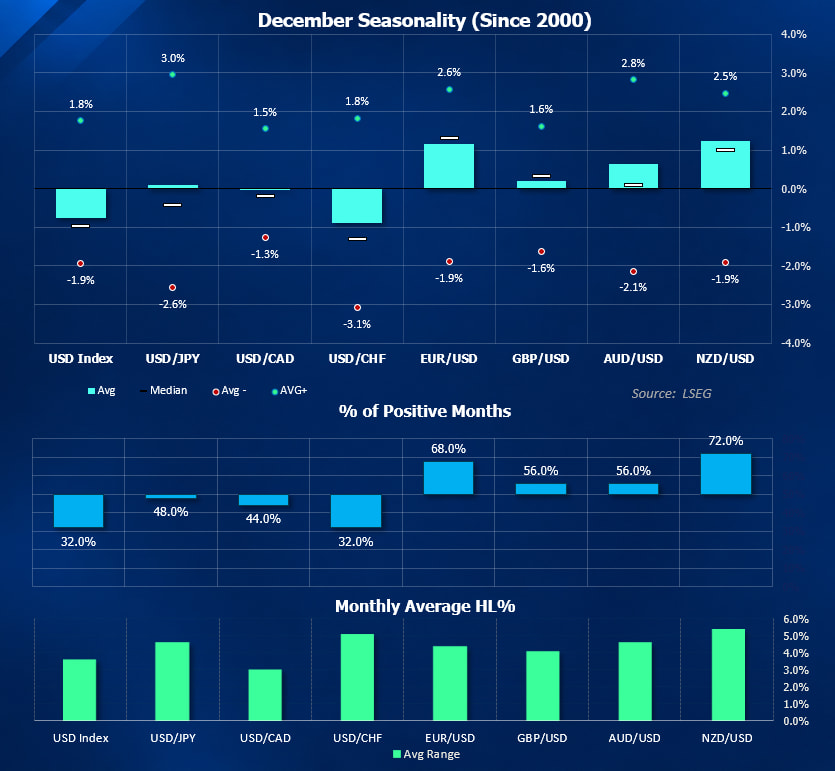
December FX Seasonality Reveals How Majors Respond to Dollar Weakness
- NZD/USD has produced the strongest December pattern, rising in 72% of months since 2000 and generating the largest average gain.
- EUR/USD has risen 68% of the time, with its positive median return reinforcing the bullish seasonal bias.
- The US Dollar Index and USD/CHF have risen in just 32% of Decembers, providing the cleanest evidence of broad US dollar weakness.
- AUD/USD has delivered a respectable average gain, although its 56% win rate makes the pattern less reliable than NZD/USD or EUR/USD.
- USD/JPY and USD/CAD show little directional edge, with average returns close to flat despite sizeable intra-month ranges.
- NZD/USD and USD/CHF have recorded the widest average monthly ranges, offering greater movement but also potentially higher volatility.
This content was created by an affiliate of FOREX.com and represents the views and opinions of the author/speakers, not the views and opinions of FOREX.com, StoneX Group Inc., or its subsidiaries. The content has not been independently reviewed by FOREX.com.
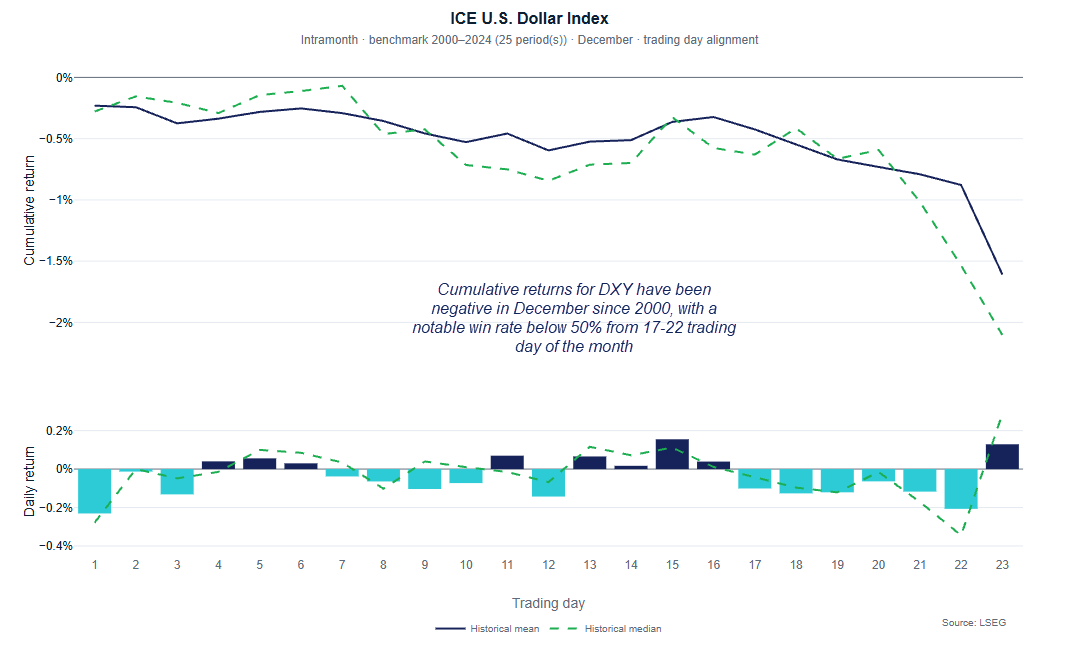
US Dollar Seasonality Weakens Into Year-End
Looking at intramonth returns for the US dollar shows a steadily declining cumulative return for both the average and median, with the decline accelerating during the final third of December. Note that the chart is aligned by trading day rather than calendar date.
More importantly, both average and median daily returns are negative from trading days 17 to 22. This roughly corresponds with 22–30 December and supports the tendency for the US dollar to weaken between Christmas and New Year. The sequence ends with a positive return on the final trading day of the month.
Another four-day run of negative average returns appears between trading days 7 and 10. Interestingly, the first trading day of December has generated the weakest average daily return.
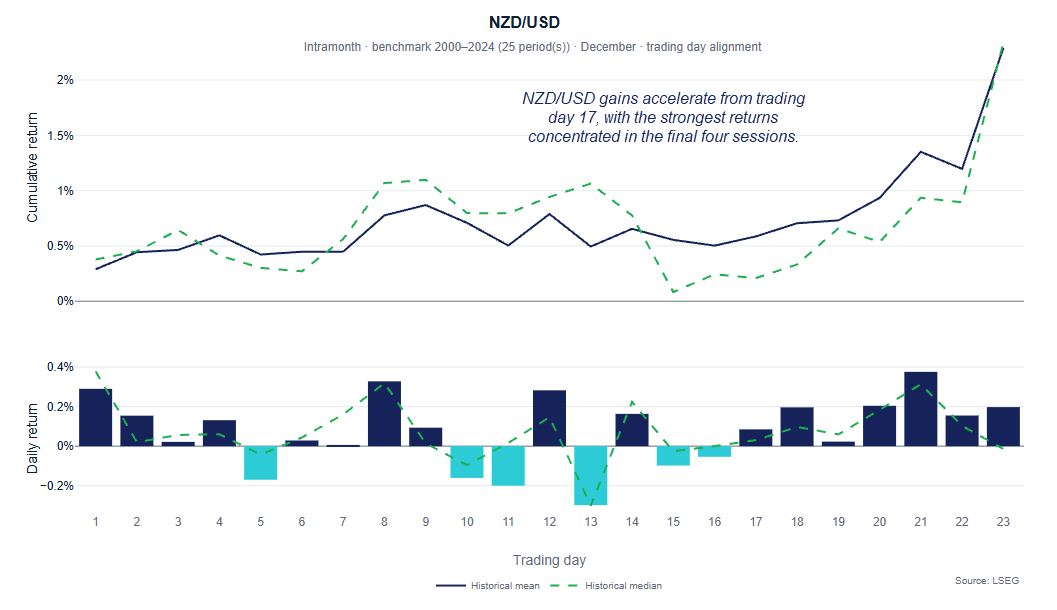
NZD/USD Seasonality Strengthens into Year-End
It may be a bumpy ride earlier in December, but NZD/USD has generally ended the month on a high note. Average and median cumulative returns remain positive from the opening session, although both oscillate throughout the first half of the month. Note that it has also averaged the best returns for December among the FX majors, with the highest average range.
The cleaner bullish pattern emerges from trading day 17. Average daily returns are positive across each remaining session, while median returns remain positive through trading day 22. The strongest gains are concentrated in the final four trading days, lifting average and median cumulative returns above 2% by month-end.
This aligns with the US Dollar Index’s tendency to weaken between trading days 17 and 22. DXY has typically rebounded on the final session, which may explain NZD/USD’s slightly negative median return that day.

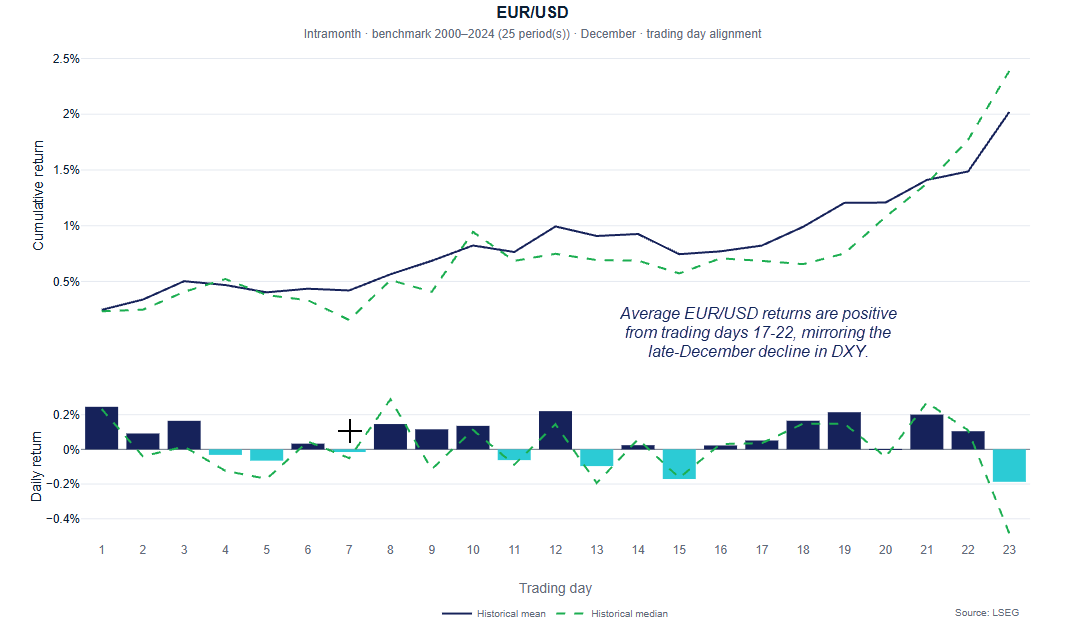
EUR/USD Gains Track Late-December Dollar Weakness
I felt compelled to include EUR/USD, not because it produces the most interesting December study, but because it is the world’s most heavily traded currency pair.
The euro accounts for 57.6% of the US Dollar Index, so the results should broadly mirror the inverse of DXY. Cumulative EUR/USD returns trend higher throughout December, with the bullish pattern strengthening during the final third of the month.
Average daily returns are positive from trading days 17 to 22, directly opposing the negative DXY returns across the same period. However, median returns are less consistent, while both average and median returns turn negative on the final trading day as DXY typically rebounds.
USD/CHF Seasonality Favours Bears Into Year-End
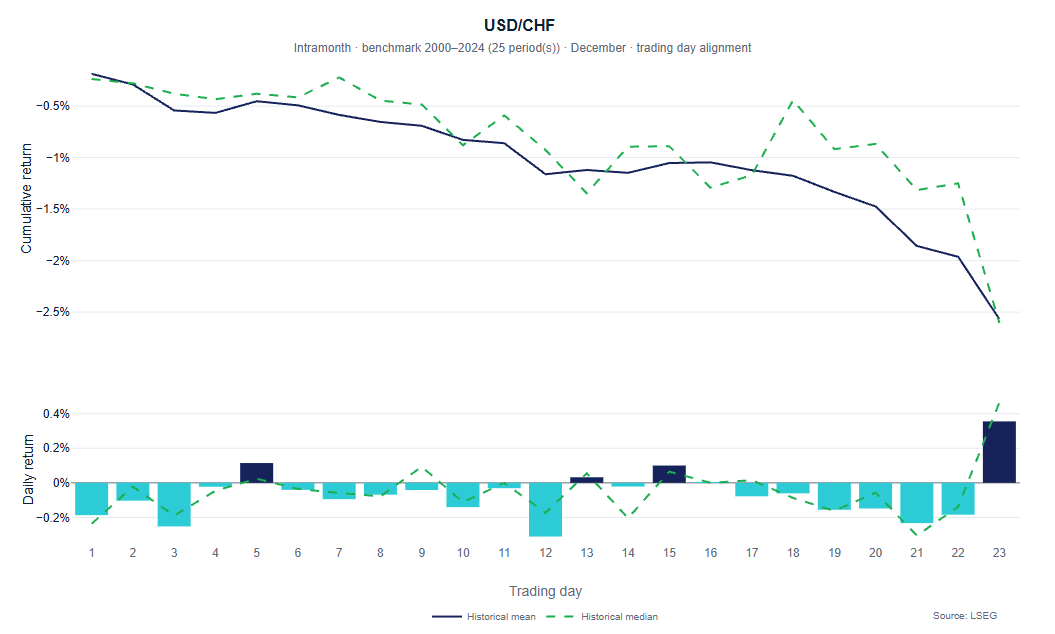
The Swiss franc appears to offer a cleaner way to short the US dollar if NZD/USD is not one’s thing. Average cumulative losses are fairly consistent throughout December, while median returns accelerate lower alongside the average during the final third of the month.
Both average and median daily returns are negative from trading days 18 to 22. Interestingly, they turn sharply positive on the final trading day, potentially offering a counter-trend opportunity heading into year-end.
From a fundamental perspective, short USD/CHF currently looks attractive given the shift towards a more hawkish SNB outlook and the risk-off tone stemming from the selloff in AI-linked equities. If these themes persist through December, the Swiss franc could enjoy another strong month at the expense of the US dollar.
AUD/USD Seasonality Shifts Into Bullish Overdrive
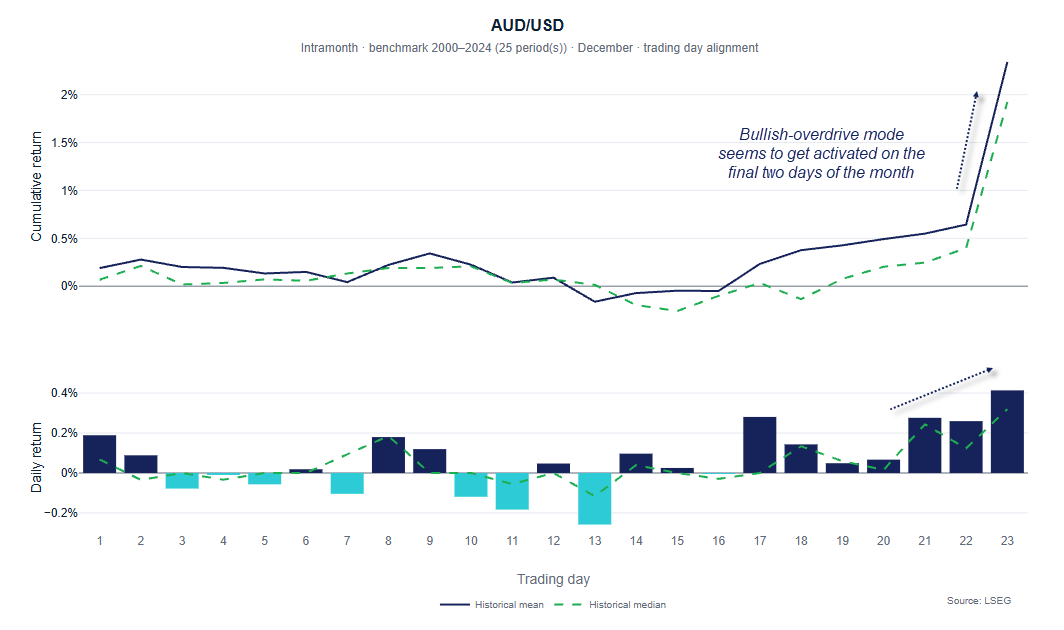
What makes AUD/USD compelling is how it spends much of December seemingly undecided about which way it wants to trade, before shifting into bullish overdrive—as if remembering it has a bullish reputation to maintain.
Average daily returns turn positive from trading day 17, while both average and median returns remain positive from trading day 18 onwards. The bullish pattern strengthens further across trading days 21 to 23, where a large proportion of the cumulative gains appear.
View related analysis:
- USD/CHF Outlook: Swiss Franc Surges as AI Trade Capitulates and SNB Bets Shift
- Nasdaq 100: AI Valuation Fears Meet Thanksgiving Seasonality
- Australian Inflation Accelerates, RBA Cut Hopes Get Reality Check
- Nasdaq 100: AI Valuation Fears Meet Thanksgiving Seasonality
Related tags:


The complete CFD trading experience
Award-winning platforms, competitive spreads, low commissions and dedicated support.
We live and breathe the markets and are dedicated to helping traders realise their ambitions as we continue to set the industry bar.
Economic calendar
Web Trader platform
Our sophisticated web-based platform is packed with features.
Related articles
How FX Majors Stack Up Against US Dollar Weakness in December
December has historically favoured a weaker US dollar. We compare the seasonal performance and timing of the major currency pairs.

USD/JPY Weekly Outlook: Fed Hikes, AI Volatility and a Sleeping Yen
USD/JPY is tracking the direction of US rates without responding with its usual magnitude. Can Jensen Huang and the payrolls lottery wake the pair from its slumber?


USD/MXN Forecast: Mexican Peso Weakness Persists as Year-End Approaches
These continue to be challenging sessions for the Mexican peso. The currency has remained under pressure in recent weeks, a trend clearly reflected in USD/MXN, which has now posted seven consecutive bullish sessions, gaining more than 7.0% over that period.

StoneX Europe Ltd may make third party material available on this website which may contain information included but not limited to the conditions of financial markets. The material is for information purposes only and does not contain, and should not be construed as containing, investment advice and/or investment recommendation and/or an investment research and/or an offer of or solicitation for any transactions in financial instruments; any decision to enter into a specific transaction shall be made by the client following an assessment by him/her of their situation.
StoneX Europe Ltd makes no representation or warranty and assumes no liability as to the accuracy or completeness of the information provided, nor any loss arising from any investment based on a recommendation, forecast or other information supplied. You should always seek independent advice as to your suitability to speculate in any related markets and your ability to assume the associated risks, if you are at all unsure. We are not under any obligation to update any such material. Any opinion made may be personal to the author and may not reflect the opinion of StoneX Europe Ltd.