


Japanese Yen Forecast: BOJ Intervention, Election and Fed Speculation to Drive USD/JPY
Politics holds the key to USD/JPY direction, from Japan’s snap‑election timing to intervention risks. Add rising speculation over Trump’s Fed chair pick, and the week’s directional drivers sit firmly outside the data calendar.
Share this:

- Japan’s 2s10s curve remains dominant USD/JPY driver
- Fed cut expectations continue to unwind
- Event calendars light, politics heavy
- Technicals hint at a short‑term top
Summary
USD/JPY is being driven mainly by Japan’s reflation push and a steepening yield curve, with U.S. data taking a back seat. With the calendar quiet, political developments, BOJ intervention risk and speculation over who may lead the Federal Reserve are likely to determine direction, while technicals warn of a possible short‑term peak.
Japan Takes the Wheel
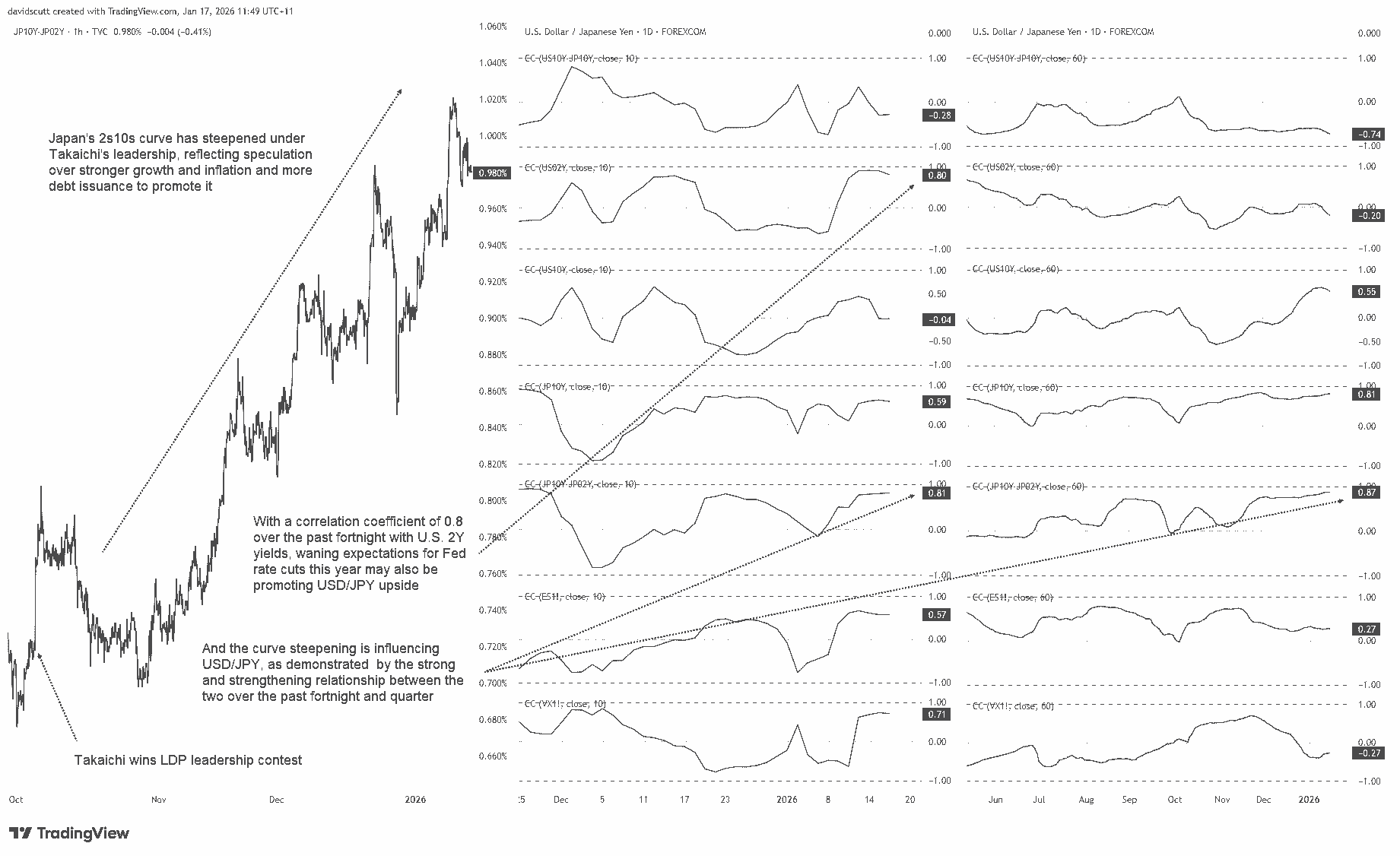
Having long been driven by interest rate differentials between the United States and Japan along with risk appetite, USD/JPY has undergone something of a changing of the guard when it comes to directional drivers, with domestic‑driven factors now playing a far more significant role than in the past. That can be seen in the graphic below tracking the relationship between USD/JPY with a variety of different market variables over the past fortnight (middle pane) and quarter (right‑hand pane).
Source: TradingView
With correlation coefficients of 0.81 and 0.87 respectively across both timeframes, USD/JPY has demonstrated a significant relationship with Japan’s 2s10s curve (the differential between 10‑year government bond yields and two‑year yields), suggesting speculation over stronger growth and inflation in Japan driven by newly appointed Prime Minister Sanae Takaichi’s reflationary policies, and the debt required to finance them, has played a major role in pushing USD/JPY higher. If inflation is expected to erode the purchasing power of the yen as government bond issuance increases, it makes fundamental sense, especially with Japan’s already world‑leading debt levels.
But Fed Pricing Still Matters
For anyone trading USD/JPY, it is arguably more important to follow Japanese developments rather than those in the United States. However, while the once strong link between longer‑dated yield differentials shows little sign of re‑establishing itself based on the analysis, the 0.8 correlation with moves in U.S. two‑year yields over the past fortnight suggests a continued unwind in market pricing for Fed rate cuts in 2026 may also be contributing to the move higher in USD/JPY this year.
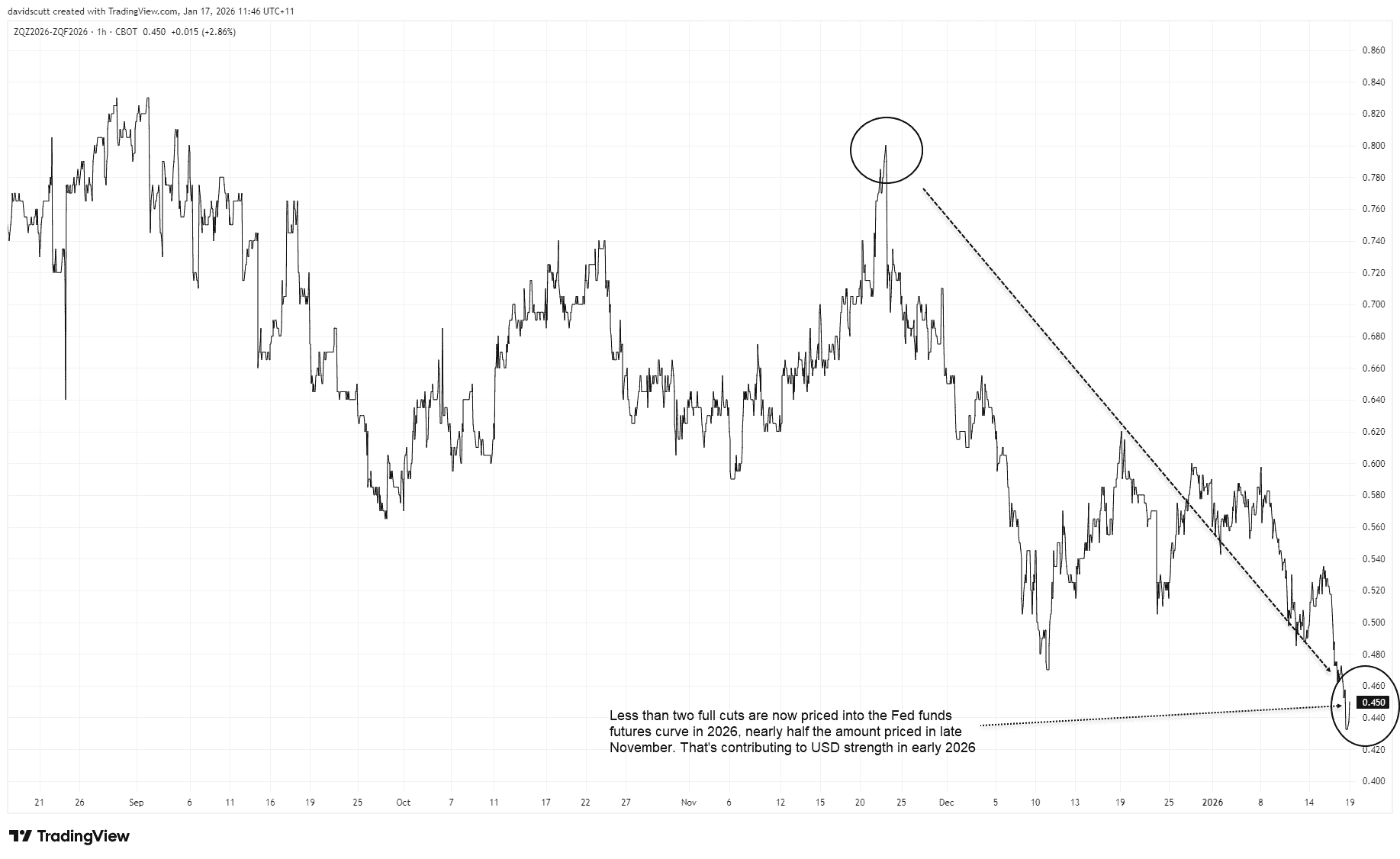
As the graphic below reveals, futures are now pricing just 45 basis points of cuts from the Fed, or less than two full 25bp moves. That is substantially less than levels seen in late November, indicating a sizeable hawkish recalibration has taken place.
Source: TradingView
Heavy Calendar, Light Impact
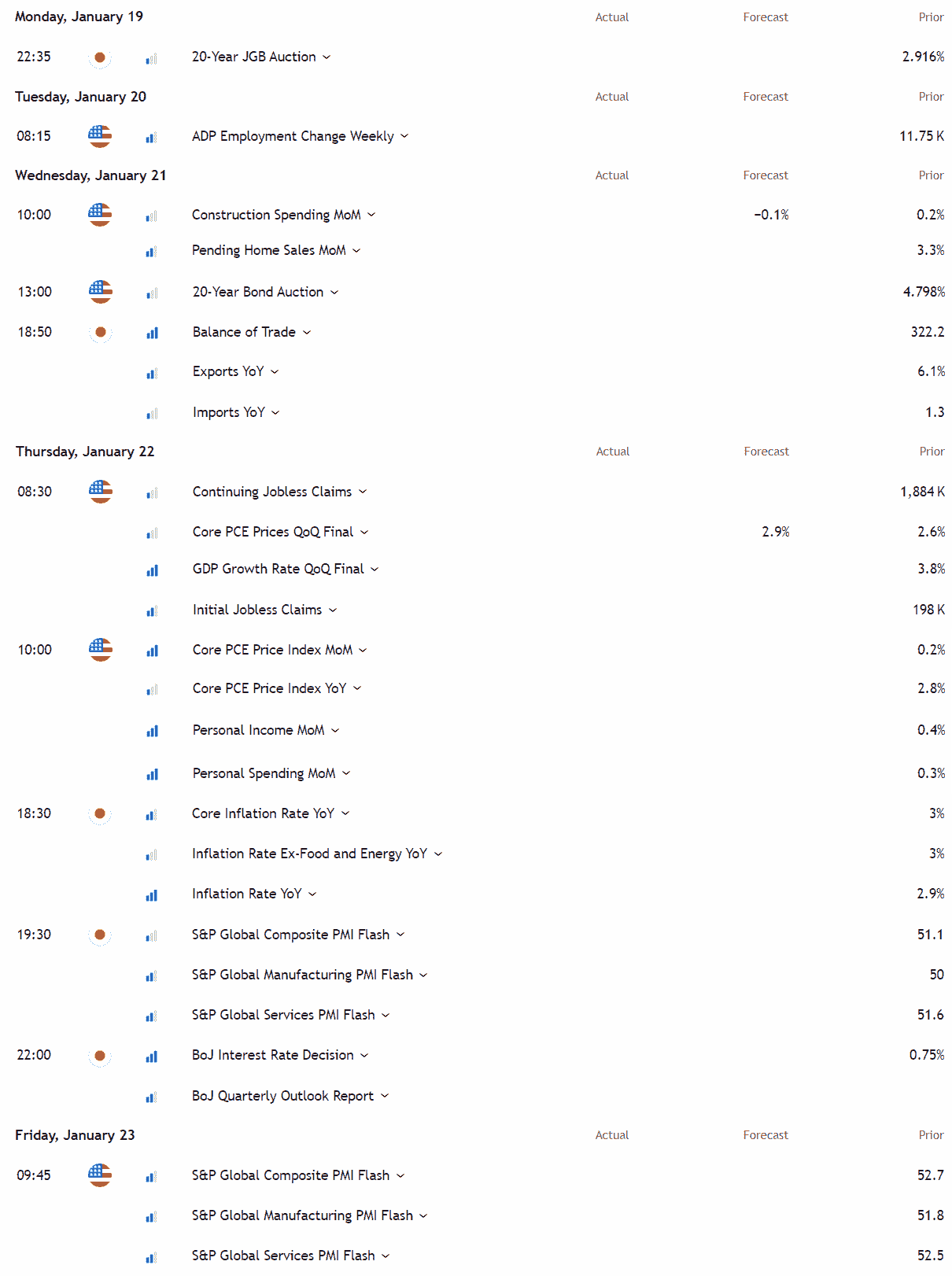
Having outlined what has been influencing USD/JPY direction, this information can then be used to assess what matters most for USD/JPY in the week ahead. Despite the stacked calendar below, the most important drivers may prove to be political than economic.
Source: TradingView
I may be accused of being blunt or complacent, but the known risk events do not screen as being overly risky. In the United States, there will be plenty of data released, but almost all of it is heavily dated due to the impact of the government shutdown last year. It may create some volatility, but the PCE report on Thursday covers November. We are now midway through January. Even when released promptly, markets treat CPI and PPI figures published earlier in the month as far more influential for Fed pricing, even though core PCE is the Fed’s preferred underlying measure. The income and consumption figures may also garner some interest, but do not expect this report to be a game‑changer for USD/JPY.
Elsewhere, the final print of Q3 GDP looks like a non‑event, as does the run of second‑tier releases throughout the week. As more up‑to‑date measures, jobless claims data on Thursday and the flash PMI report on Friday are worthy of more attention, although they would require a significant surprise relative to consensus to meaningfully impact the dollar.
In Japan, the calendar also lacks major risks. That includes the inflation figures for December and the BOJ rate decision that follows only hours later on Friday.
For some time, the national inflation report has been superseded in importance by the timelier Tokyo inflation report released three weeks earlier, given the latter often provides an accurate steer on nationwide trends.
Source: Bloomberg
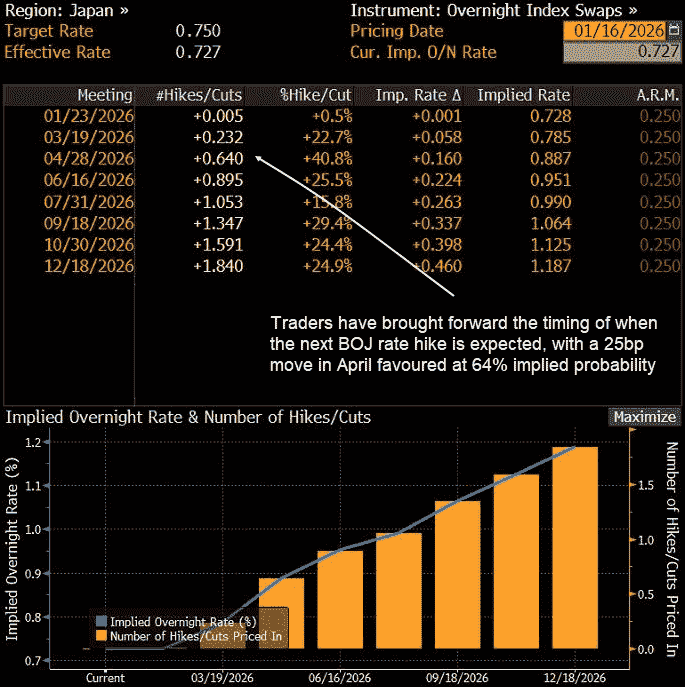
As for the BOJ, there is almost zero chance it will hike again following its move in December, with swaps assigning a 99.5 percent implied probability of overnight rates remaining at 75 basis points. Updated forecasts could generate volatility, but the risk does not appear high. Given BOJ governor Ueda was on the wires last week affirming the view that rates are likely to increase again should the bank’s forecasts materialise, any surprise may come through the board vote rather than policy changes.
Tokyo Politics Take Centre Stage
Despite the packed calendar, political developments may prove the most influential factor for USD/JPY this week. Key questions include whether Japanese PM Sanae Takaichi will call a snap lower house election, whether the government will instruct the BOJ to intervene to reverse yen weakness, and whether Donald Trump will announce his nomination for the next Fed chair. These answers are likely to shape USD/JPY performance.
On Japanese election speculation, Takaichi looks almost certain to dissolve the House of Representatives on 23 January, lining up a snap election on either 8 or 15 February, a timetable that fits her strong polling. More importantly, it is what markets have priced. With senior coalition figures acknowledging preparations are well advanced, the biggest surprise would be if Takaichi does not press ahead. Given how freely speculation has been allowed to run, such an outcome seems improbable.
BOJ Intervention Risk
Linked to election rumours, the more uncertain question is whether the BOJ will be instructed to intervene to support the yen via direct purchases. As discussed earlier, a major factor behind recent yen weakness has been government policy, or speculation around what may be enacted should Takaichi secure a thumping lower house majority. I wrote about the paradox facing the government last week, arguing that not only would intervention be largely ineffectual beyond the very short term, it would also contradict the reflationary environment it aims to nurture. That remains my view.
Even though the United States appears to have given the green light for intervention should it be deemed necessary, with the election largely priced and the BOJ unlikely to surprise, the risk of intervention next week appears to be subsiding, not growing. USD/JPY has retraced some of its losses rather than continuing to surge, as typically precedes prior intervention episodes.
If intervention does occur, Monday, coinciding with the Martin Luther King holiday in the United States, appears the most likely window, with reduced liquidity allowing for maximum impact for minimal outlay. But my confidence in that timing has waned in recent days, even with government officials sounding more alarmed than usual.
Trump’s Fed Pick Looms Large
Another key question is who Donald Trump will nominate as the next Federal Reserve chair, with his comments last Friday shifting probability markets away from Kevin Hassett towards former Fed governor Kevin Warsh as the leading candidate. Interest in the appointment is understandable given it concerns the most powerful banking position in the world, but whether Hassett or Warsh, both Kevin's align with Trump’s desire for lower interest rates. The real questions are whether they can convince the rest of the FOMC to adopt that view and whether they will be confirmed by Congress.
It may not lead to a major move in the dollar, but Fed Governor Lisa Cook’s Supreme Court hearing on the legality of her dismissal by Trump last year begins Wednesday. Watch this space given already heightened concerns over Fed independence.
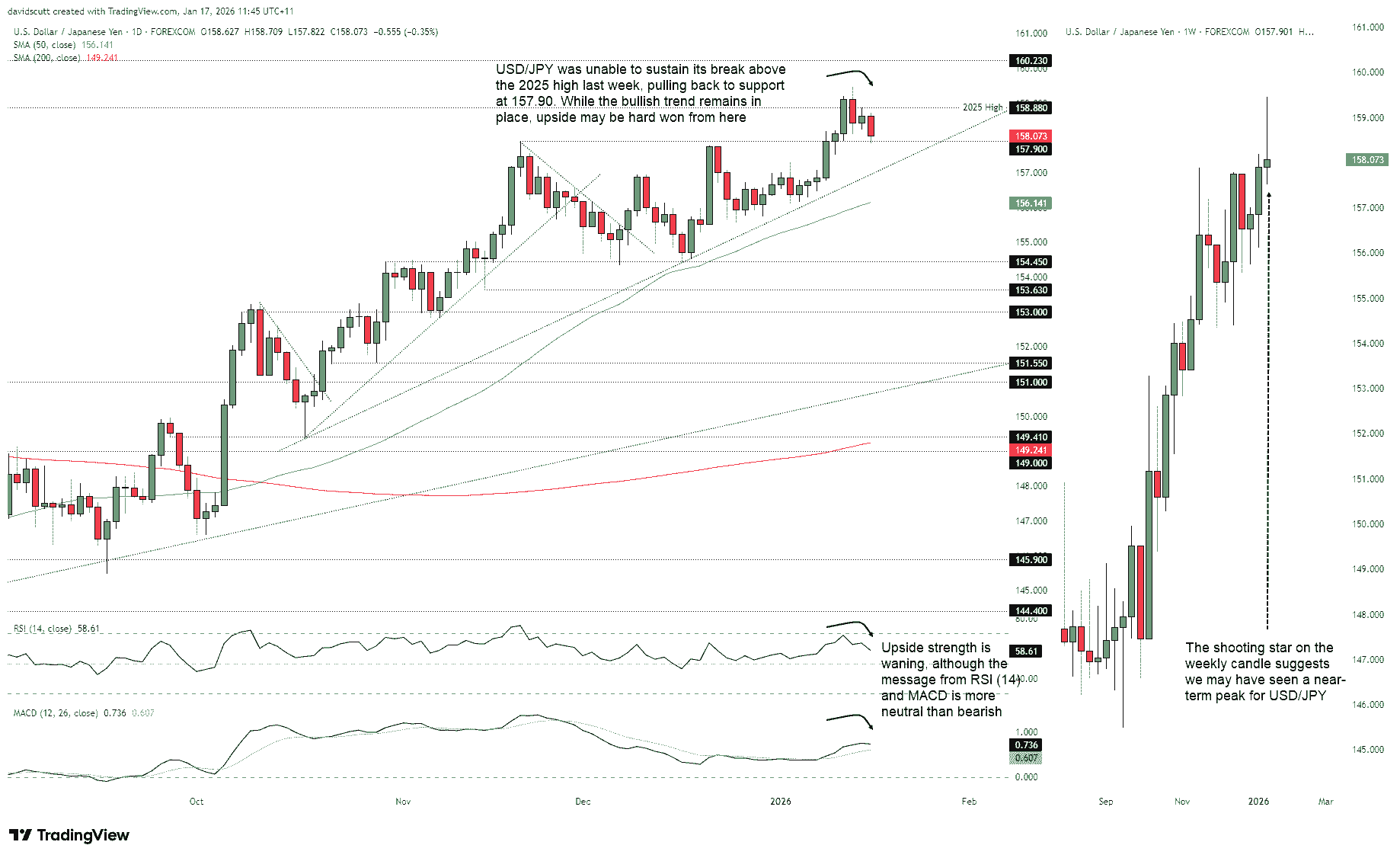
USD/JPY Candles Flash Caution
Source: TradingView
With the fundamentals covered, it is time to look at the technical picture for USD/JPY. While the pair ended the week higher than where it began, the intra‑week price action warns of a potential near‑term top. The shooting star candle on the weekly timeframe is often seen at turning points, with the signal strengthened given it followed a lengthy bullish trend.
Zooming into the daily timeframe, the pair was unable to sustain a break above the 2025 highs during the week, reversing after a brief push above 159 which prompted a torrent of warnings from Japanese officials. While USD/JPY found support at the November 2025 highs later in the week, Wednesday’s dark cloud cover pattern, combined with the weekly shooting star, suggests risks may be skewing sideways to lower.
Downside levels of note include the October 2025 uptrend just above 157, with big figures at 157 and 156 seeing considerable price action over recent months, making them potential entry and exit points. The 50DMA is close to the latter, although it has a mixed track record in terms of relevance. Below that, 154.45 is a more important level.
Should the bearish signals prove false and USD/JPY resume its bullish trend, the 2025 high at 158.88, last Wednesday’s high at 159.46 and then 160.23 are the key upside levels to watch.
RSI (14) and MACD on the daily chart suggest waning bullish momentum, offering a broadly neutral message on near‑term directional risks. Should RSI fall below 50 and MACD cross below the signal line next week, the bias would turn lower.


The complete CFD trading experience
Award-winning platforms, competitive spreads, low commissions and dedicated support.
We live and breathe the markets and are dedicated to helping traders realise their ambitions as we continue to set the industry bar.
Economic calendar
Web Trader platform
Our sophisticated web-based platform is packed with features.
Related articles
USD/CAD shooting star puts September surge on notice
USD/CAD has printed a clear bearish reversal pattern after an extraordinary September surge, but confirmation may depend heavily on how US Treasury yields react to Friday’s payrolls report.

USD/MXN Analysis: Is Super Peso Starting to Fade?
Over recent trading sessions, the Mexican peso has continued to show signs of weakness against the U.S. dollar. This can already be seen in USD/MXN, which has gained more than 1.7% over the last three sessions, highlighting sustained buying pressure in favor of the dollar in the short term.


Canadian Dollar Analysis: USD/CAD Returns to July Highs Ahead of NFP
The Canadian dollar continues to face one of its most challenging environments in recent months when it comes to maintaining strength against the U.S. dollar. The weakness of the Canadian currency is clearly reflected in USD/CAD, which has now recorded nine consecutive bullish sessions and gained more than 1.7% during that period.
StoneX Europe Ltd may make third party material available on this website which may contain information included but not limited to the conditions of financial markets. The material is for information purposes only and does not contain, and should not be construed as containing, investment advice and/or investment recommendation and/or an investment research and/or an offer of or solicitation for any transactions in financial instruments; any decision to enter into a specific transaction shall be made by the client following an assessment by him/her of their situation.
StoneX Europe Ltd makes no representation or warranty and assumes no liability as to the accuracy or completeness of the information provided, nor any loss arising from any investment based on a recommendation, forecast or other information supplied. You should always seek independent advice as to your suitability to speculate in any related markets and your ability to assume the associated risks, if you are at all unsure. We are not under any obligation to update any such material. Any opinion made may be personal to the author and may not reflect the opinion of StoneX Europe Ltd.