





US CPI Recap: USD/JPY Holds at Post-Tariff Highs as US Inflation Falls to 4-Year Lows
USD/JPY is showing bullish consolidation after the US CPI report showed that US consumer prices rose less than expected in April, marking the smallest annual increase since February 2021.
Share this:

US CPI Key Points
- US CPI came in a tick below expectations at 0.2% m/m (2.3% y/y) vs. 0.3% (2.4%) eyed.
- Core CPI was 0.2% m/m (2.8% y/y) vs. 0.3% m/m (2.8% y/y) anticipated.
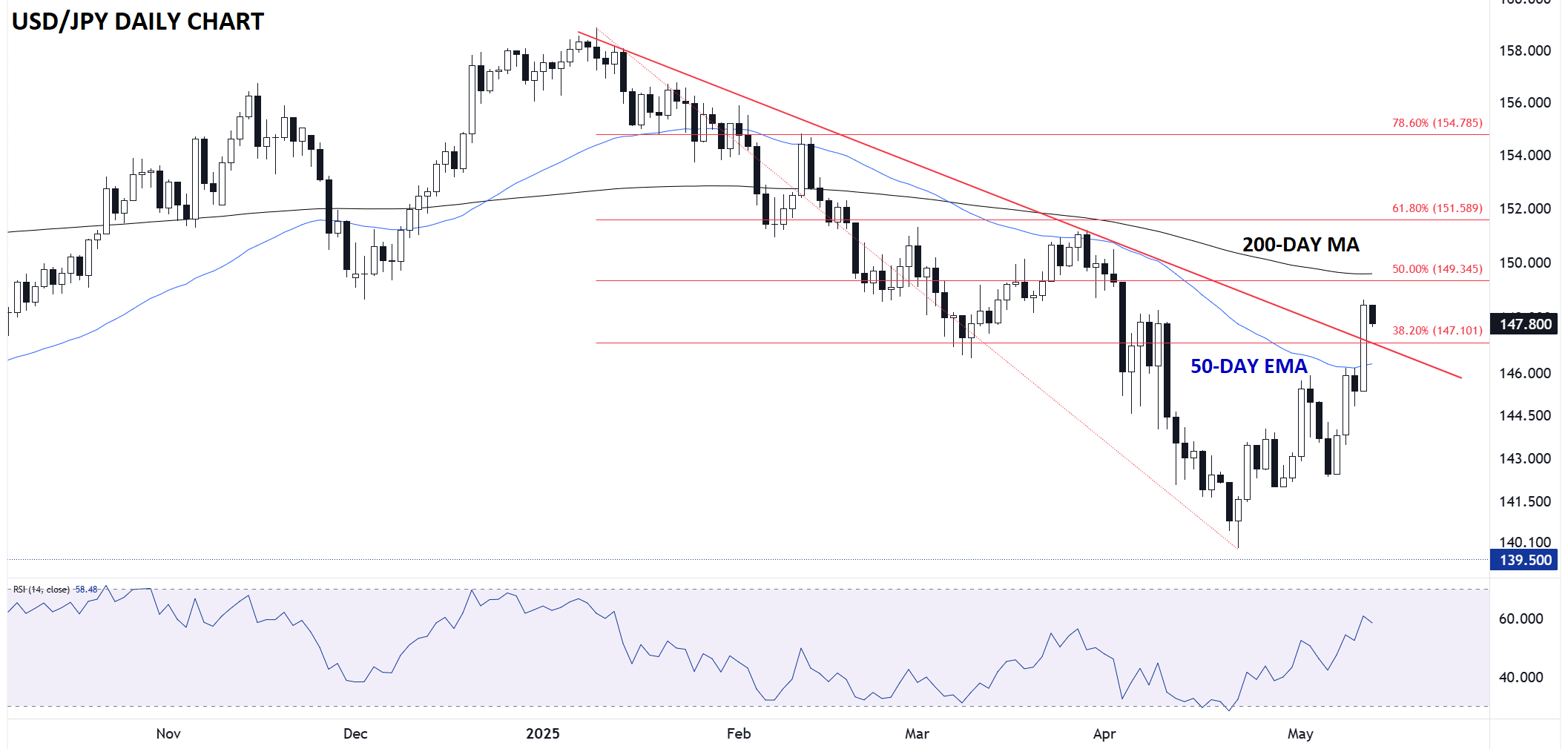
- USD/JPY is showing near-term bullish consolidation, potentially setting the stage for a continuation above 149.00 in the coming days.
The just-released US CPI report showed that US consumer prices rose less than expected in April, marking the smallest annual increase since February 2021.
The Consumer Price Index (CPI) increased by 0.2% month-over-month and 2.3% year-over-year, slightly below forecasts. Core CPI, excluding volatile food and energy prices, also rose by 0.2% m/m and 2.8% y/y, aligning closely with expectations.
In terms of the details of the report, significant price declines were seen in several categories, particularly groceries, which dropped 0.4%, the largest decline since September 2020. Notably, egg prices plummeted by 12.7%, the steepest monthly decrease since 1984, reflecting relief from earlier avian flu-induced hikes. Airfares fell by 2.8%, and lodging prices dipped slightly by 0.1%, signaling a potential slowdown in travel demand. Apparel costs also saw a modest decrease of 0.2%.
However, shelter continued to drive overall inflation, rising 0.3% and accounting for more than half of the total CPI increase. Energy prices edged up 0.7%, despite a 0.1% adjusted drop in gasoline prices. Motor vehicle insurance increased notably by 0.6% month-over-month and 6.4% year-over-year.
The report suggests minimal immediate impact from April’s “Liberation Day” tariffs from the Trump administration, though inflationary effects could intensify in the coming months as pre-tariff inventories are depleted. Given the mostly as-expected reading and uncertainty around the impact of tariffs, the Federal Reserve is likely to leave interest rates unchanged in the near term, with the CME’s FedWatch tool suggesting less than 40% odds of an interest rate cut before September.
Japanese Yen Technical Analysis: USD/JPY Daily Chart
Source: TradingView, StoneX
Turning our attention to the forex market, USD/JPY is consolidating after yesterday’s big tariff truce surge through resistance at the 50-day EMA and 38.2% Fibonacci retracement. The (so far) small range near the top of yesterday’s big candle is sign of bullish consolidation from a near-term perspective, potentially setting the stage for a continuation higher in the latter half of the week.
To the topside, the next levels of resistance to watch are the 50% Fibonacci retracement near 149.35, followed by the 200-day MA closer to 150.00. Meanwhile, any pullbacks may find support on the topside of the broken bearish trend line near 147.00. Only a break below that area would erase the near-term bullish bias.
-- Written by Matt Weller, Global Head of Research
Check out Matt’s Daily Market Update videos on YouTube and be sure to follow Matt on Twitter: @MWellerFX


The complete CFD trading experience
Award-winning platforms, competitive spreads, low commissions and dedicated support.
We live and breathe the markets and are dedicated to helping traders realise their ambitions as we continue to set the industry bar.
Economic calendar
Web Trader platform
Our sophisticated web-based platform is packed with features.
Related articles
USD/CAD shooting star puts September surge on notice
USD/CAD has printed a clear bearish reversal pattern after an extraordinary September surge, but confirmation may depend heavily on how US Treasury yields react to Friday’s payrolls report.

USD/MXN Analysis: Is Super Peso Starting to Fade?
Over recent trading sessions, the Mexican peso has continued to show signs of weakness against the U.S. dollar. This can already be seen in USD/MXN, which has gained more than 1.7% over the last three sessions, highlighting sustained buying pressure in favor of the dollar in the short term.


Canadian Dollar Analysis: USD/CAD Returns to July Highs Ahead of NFP
The Canadian dollar continues to face one of its most challenging environments in recent months when it comes to maintaining strength against the U.S. dollar. The weakness of the Canadian currency is clearly reflected in USD/CAD, which has now recorded nine consecutive bullish sessions and gained more than 1.7% during that period.
StoneX Europe Ltd may make third party material available on this website which may contain information included but not limited to the conditions of financial markets. The material is for information purposes only and does not contain, and should not be construed as containing, investment advice and/or investment recommendation and/or an investment research and/or an offer of or solicitation for any transactions in financial instruments; any decision to enter into a specific transaction shall be made by the client following an assessment by him/her of their situation.
StoneX Europe Ltd makes no representation or warranty and assumes no liability as to the accuracy or completeness of the information provided, nor any loss arising from any investment based on a recommendation, forecast or other information supplied. You should always seek independent advice as to your suitability to speculate in any related markets and your ability to assume the associated risks, if you are at all unsure. We are not under any obligation to update any such material. Any opinion made may be personal to the author and may not reflect the opinion of StoneX Europe Ltd.