



USD/JPY, EUR/USD Forecast: Dollar finds a floor as policy pushback emerges
A short-covering dollar rally delivered sharp reversals in EUR/USD and USD/JPY. But with Japan going it alone and ECB uneasy on euro strength, the next move may hinge on action rather than words.
Share this:

- ECB officials push back against euro strength
- US rules out intervening to support the yen
- Dollar rebound driven by positioning, not conviction
- Intervention risk rising for USD/JPY
Summary
Markets finally found a reason to pause the dollar rout, but not one built on conviction. Pushback from ECB officials and mixed messaging from Washington acted as a release valve on USD weakness, triggering sharp reversals in EUR/USD and USD/JPY before quickly fading. With Japan left to defend the yen alone and euro strength increasingly clashing with the ECB’s inflation mandate, the next phase looks less about policy promises and more about whether officials are prepared to back words with action.
ECB officials lean against euro strength
This shift in tone was most evident in Europe, where policymakers wasted little time responding to renewed euro strength. It didn’t take long for a barrage of dovish commentary from European officials once EUR/USD punched above the 1.20 mark, with ECB Governing Council member François Villeroy de Galhau noting Wednesday that he is “closely monitoring this appreciation of the euro and its possible implications for lower inflation”, flagging that the stronger currency’s impact on prices will be a key factor “in the months ahead”. While the ECB publicly insists it does not target exchange rates, it is clear policymakers are alert to the risk that further euro strength could place additional downward pressure on inflation, which is already expected to undershoot its 2% target based on its latest forecasts.
Doubling down on the dovish tone, Austria’s central bank governor Martin Kocher told the Financial Times that if the euro continues to strengthen to the point it materially weighs on inflation forecasts, “at some stage this might create…a certain necessity to react in terms of monetary policy”. Kocher said any response would be driven by the inflation outlook rather than the exchange rate itself, noting there is no immediate need to adjust rates but that policymakers should retain “full optionality” amid uncertainty. In short, if euro strength blunts the inflationary impulse from abroad, the ECB could yet find itself back in easing mode.
US shuts the door on yen support
Across the Atlantic, U.S. Treasury Secretary Scott Bessent poured cold water on speculation of coordinated FX action, stating the U.S. is “absolutely not” intervening to support the yen and reiterating Washington’s commitment to a strong dollar policy. His remarks contradict comments from Donald Trump less than a day earlier welcoming recent declines in the dollar as “great”, extending the now familiar good-cop, bad-cop dynamic within the administration. The result, once again, was mixed messaging that generated two-way volatility across markets.
Stepping back, Bessent’s comments suggest reported rate checks in USD/JPY conducted by the New York Fed late last week were likely undertaken on behalf of Japan’s Ministry of Finance rather than the U.S. Treasury. That implies Japan is attempting to stem yen weakness on its own, without U.S. backing. History suggests that approach can prove problematic unless Tokyo is prepared to back its warnings with action, including putting its money where its mouth is and instructing the BOJ to intervene directly.
The remarks from both sides of the Atlantic acted as a relief valve on USD weakness. The move was assisted by a slightly more hawkish FOMC statement, which nudged up its growth assessment while downside risks to the labour market were notably absent. With short-term positioning stretched after the recent dollar plunge, the rebound gathered momentum before fading during Jerome Powell’s press conference, which failed to deliver any meaningful hawkish surprises.
Japan’s intervention credibility under scrutiny
Of all the key macro developments overnight, Bessent’s remarks towards the yen were perhaps the most telling, likely emboldening some market participants to test the resolve of Japan’s Ministry of Finance through another bout of yen depreciation. At this stage, the price action suggests no actual intervention has taken place, only a string of well-timed rate checks. Like the boy who cried wolf, the more times authorities attempt to verbally intervene in the yen, the less traders are likely to listen, adding not only to the risk of renewed USD/JPY upside but also increasing the likelihood of actual intervention via the sale of currency reserves.
USD/JPY bounces following rapid unwind
Source: TradingView
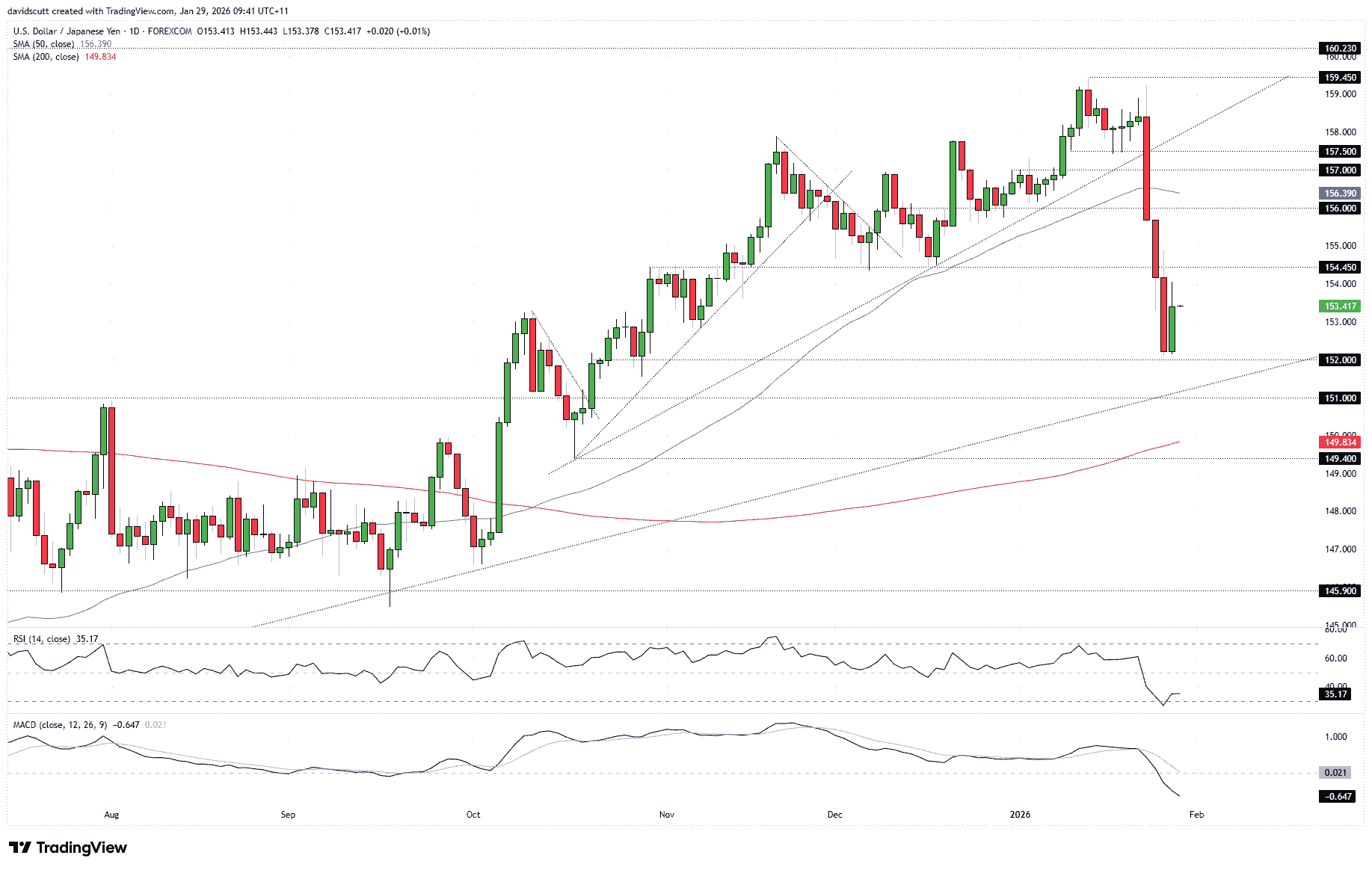
Given the sheer scale of the downside flush, many historic levels have been completely obliterated in USD/JPY, providing something of a clean slate for price signals to guide direction.
On the downside, it’s notable that two attempts to break below 152.00 have been thwarted this week, with the bearish move stalling at 152.10. That sits just above a support zone running from 152.00 down to 151.00, including important uptrend support dating back to the lows struck during the Liberation Day risk rout episode of April 2025. Should price ease back towards that zone, it could make for an appealing entry level for longs.
On the topside, 154.45 remains relevant given an attempted push back above the level failed earlier this week, with Wednesday’s bounce also stalling just below. That screens as a zone for longs to target, with a sustained push above it opening the door for a run towards 156.00.
While I’m placing less emphasis on these signals given the tricky macro backdrop, both RSI (14) and MACD are generating bearish signals, indicating building downside momentum that would normally favour selling into strength.
For anyone considering setups involving USD/JPY, risk management must be at the forefront of thinking given elevated intervention risks, especially for longs.
EUR/USD breakout stalls
Source: TradingView
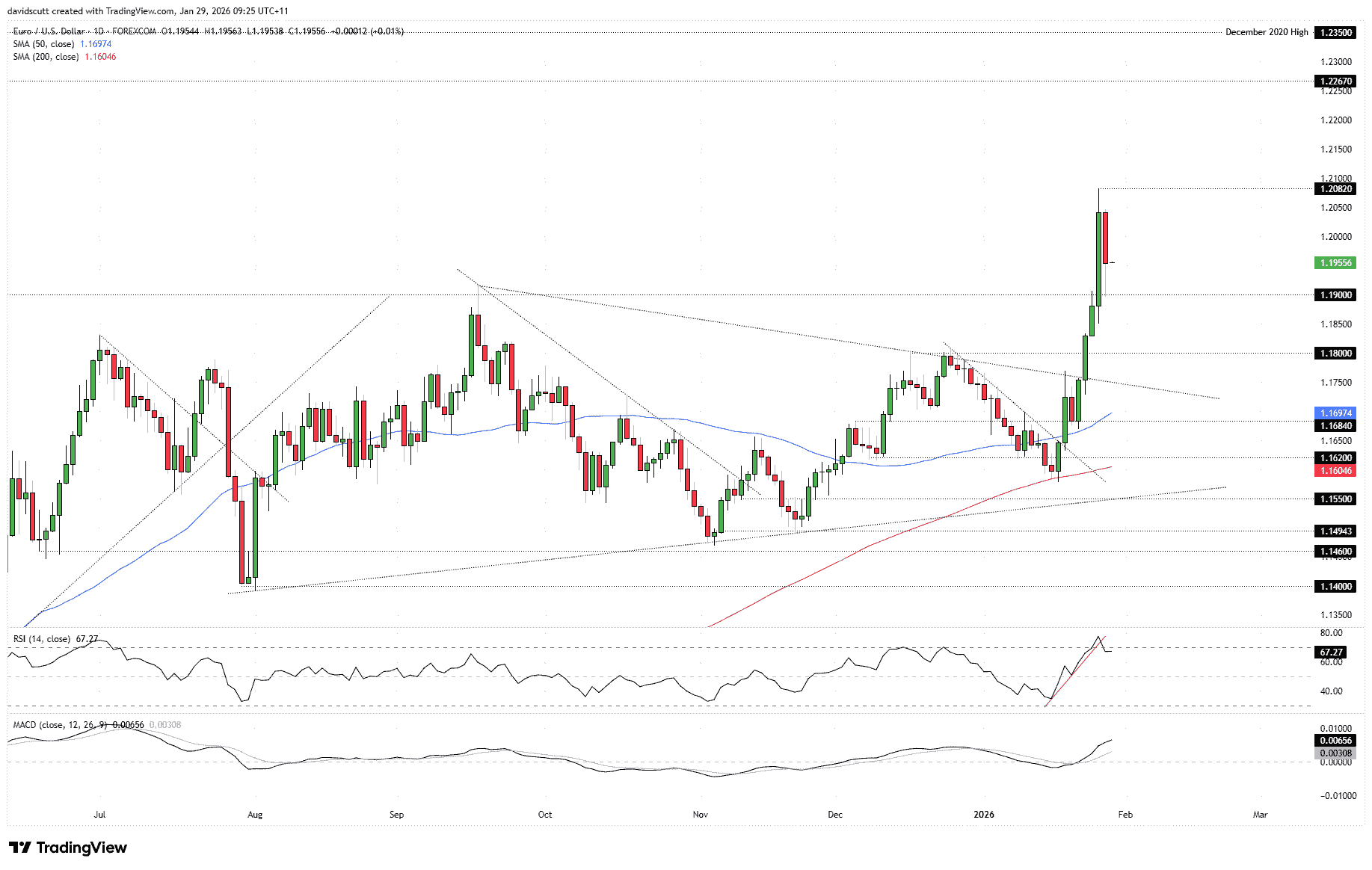
Turning to EUR/USD, Tuesday’s bullish move ran into sellers at 1.2082, ultimately sparking an unwind back to 1.1900 on Wednesday before bouncing into the close. As such, 1.1900 is the level to watch on the downside over the coming days, with 1.2082 above. Outside that range, the May 2021 peak of 1.2267 and the December 2020 high of 1.2350 are levels of note should we see an extension of the bullish breakout. On the downside, 1.1800 and former wedge resistance, located today around 1.1750, should be on the radar.
While RSI (14) and MACD continue to flash bullish, there are signs upside momentum may be topping out, generating an overall cautious signal for bulls chasing upside at current levels.
From a macro perspective, given the euro area has consistently struggled to sustain inflationary pressures outside the pandemic period, while bilateral trade outside the bloc remains a key growth pillar, it comes as little surprise we’ve already seen pushback from ECB officials. I expect we’ll hear a whole lot more should the euro’s bullish move extend, potentially capping upside beyond levels already seen.
Economic calendar a secondary consideration
Source: TradingView
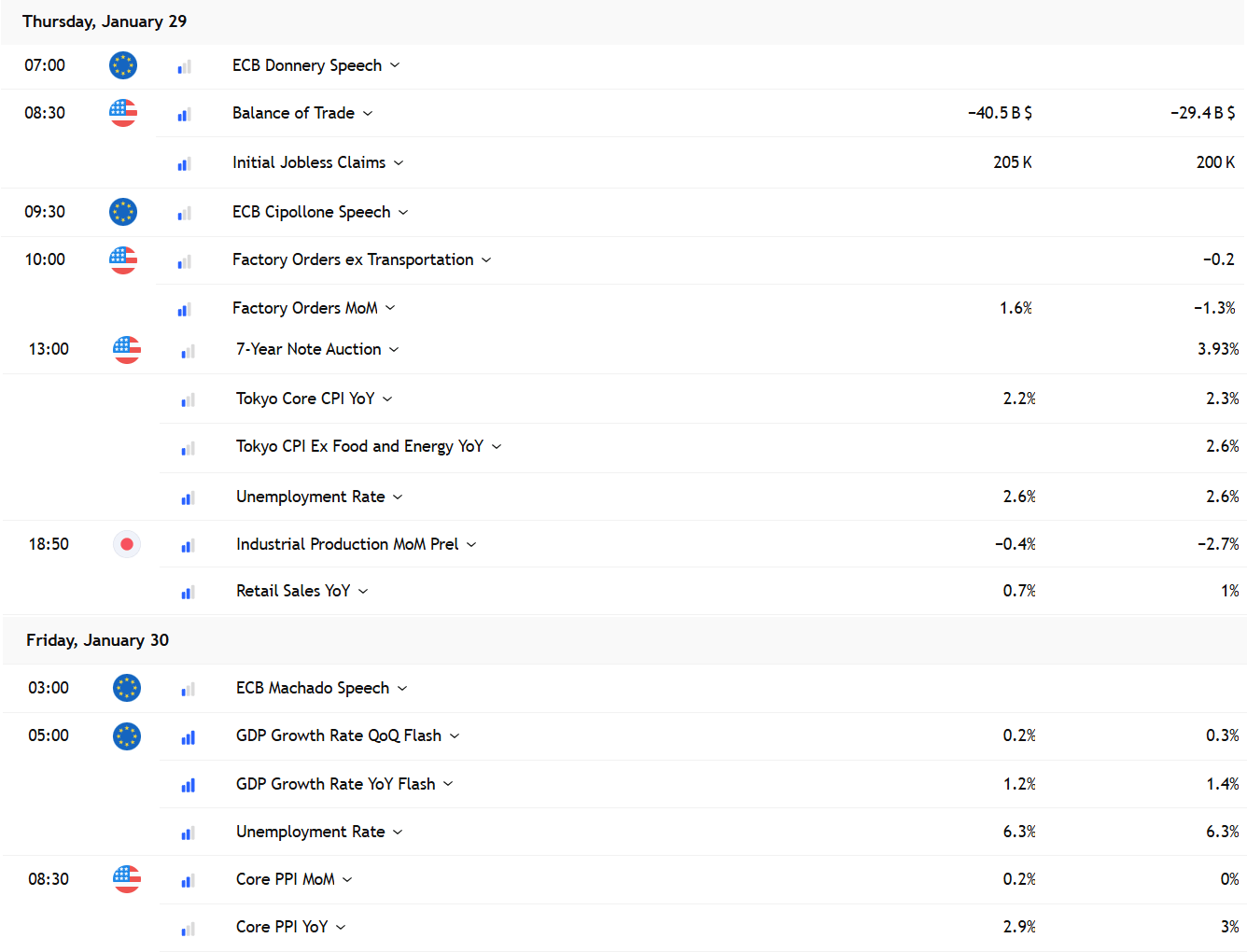
While the economic calendar is relatively busy across the US, Europe and Japan over the next two days, the scope for any single data release to generate a lasting market impact looks limited in what remains a headline-driven environment. That said, Tokyo CPI, Eurozone GDP and US PPI stand out as the releases most likely to move the needle, alongside any further commentary from ECB officials on the euro, which could quickly feed back into FX pricing if policymakers lean harder against recent strength.
Latest market news




The complete CFD trading experience
Award-winning platforms, competitive spreads, low commissions and dedicated support.
We live and breathe the markets and are dedicated to helping traders realise their ambitions as we continue to set the industry bar.
Economic calendar
Web Trader platform
Our sophisticated web-based platform is packed with features.
Related articles
USD/MXN Analysis: Is Super Peso Starting to Fade?
Over recent trading sessions, the Mexican peso has continued to show signs of weakness against the U.S. dollar. This can already be seen in USD/MXN, which has gained more than 1.7% over the last three sessions, highlighting sustained buying pressure in favor of the dollar in the short term.
Canadian Dollar Analysis: USD/CAD Returns to July Highs Ahead of NFP
The Canadian dollar continues to face one of its most challenging environments in recent months when it comes to maintaining strength against the U.S. dollar. The weakness of the Canadian currency is clearly reflected in USD/CAD, which has now recorded nine consecutive bullish sessions and gained more than 1.7% during that period.
Gold Price Forecast: XAU/USD Plunges 12.4% Toward Critical Support 10 1 2026
Softer inflation has revived expectations for a Fed pause, but Friday’s payrolls could put gold’s recovery prospects to the test.

StoneX Europe Ltd may make third party material available on this website which may contain information included but not limited to the conditions of financial markets. The material is for information purposes only and does not contain, and should not be construed as containing, investment advice and/or investment recommendation and/or an investment research and/or an offer of or solicitation for any transactions in financial instruments; any decision to enter into a specific transaction shall be made by the client following an assessment by him/her of their situation.
StoneX Europe Ltd makes no representation or warranty and assumes no liability as to the accuracy or completeness of the information provided, nor any loss arising from any investment based on a recommendation, forecast or other information supplied. You should always seek independent advice as to your suitability to speculate in any related markets and your ability to assume the associated risks, if you are at all unsure. We are not under any obligation to update any such material. Any opinion made may be personal to the author and may not reflect the opinion of StoneX Europe Ltd.