



USD/CAD Analysis: Is the Canadian dollar losing momentum?
Recent trading sessions have not been particularly favorable for the Canadian dollar, as USD/CAD has posted a gain of more than 0.4% over the last five sessions in favor of the US dollar.
Share this:

Recent trading sessions have not been particularly favorable for the Canadian dollar, as USD/CAD has posted a gain of more than 0.4% over the last five sessions in favor of the US dollar.
For now, the mild buying pressure that has stabilized in price action is mainly explained by the central bank dynamics of both countries, which have begun to impact the behavior of the bond market and, in turn, the relative strength of their currencies. In this context, the United States holds a slight advantage, which could remain relevant in the coming sessions and support a mild bullish bias in USD/CAD.


Rate differential remains the structural catalyst
Several sessions have passed since the monetary policy decisions in Canada and the United States, and the main common factor has been a stance of rate stability, with no significant changes expected in the short term.
This is largely because both central banks have emphasized that inflationary pressures have not fully disappeared, maintaining the need for a relatively restrictive policy in the coming months.
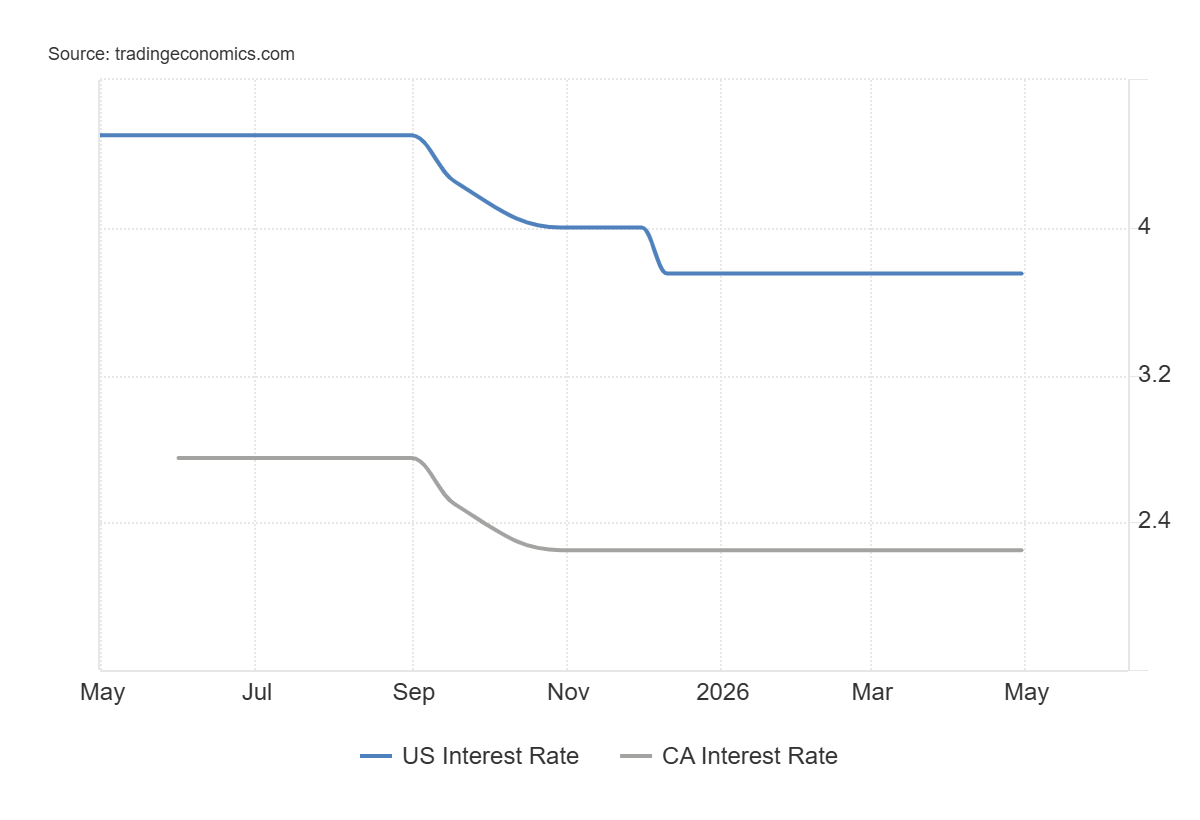
However, despite this similarity in stance, the rate differential remains a key factor. Currently, the United States maintains a benchmark rate of 3.75%, while Canada stands at 2.25%, reflecting a significant gap in favor of the US dollar.
Given that no major changes are expected in the short term, this differential is likely to remain a relevant structural driver for USD/CAD dynamics in the coming weeks.
Source: TradingEconomics
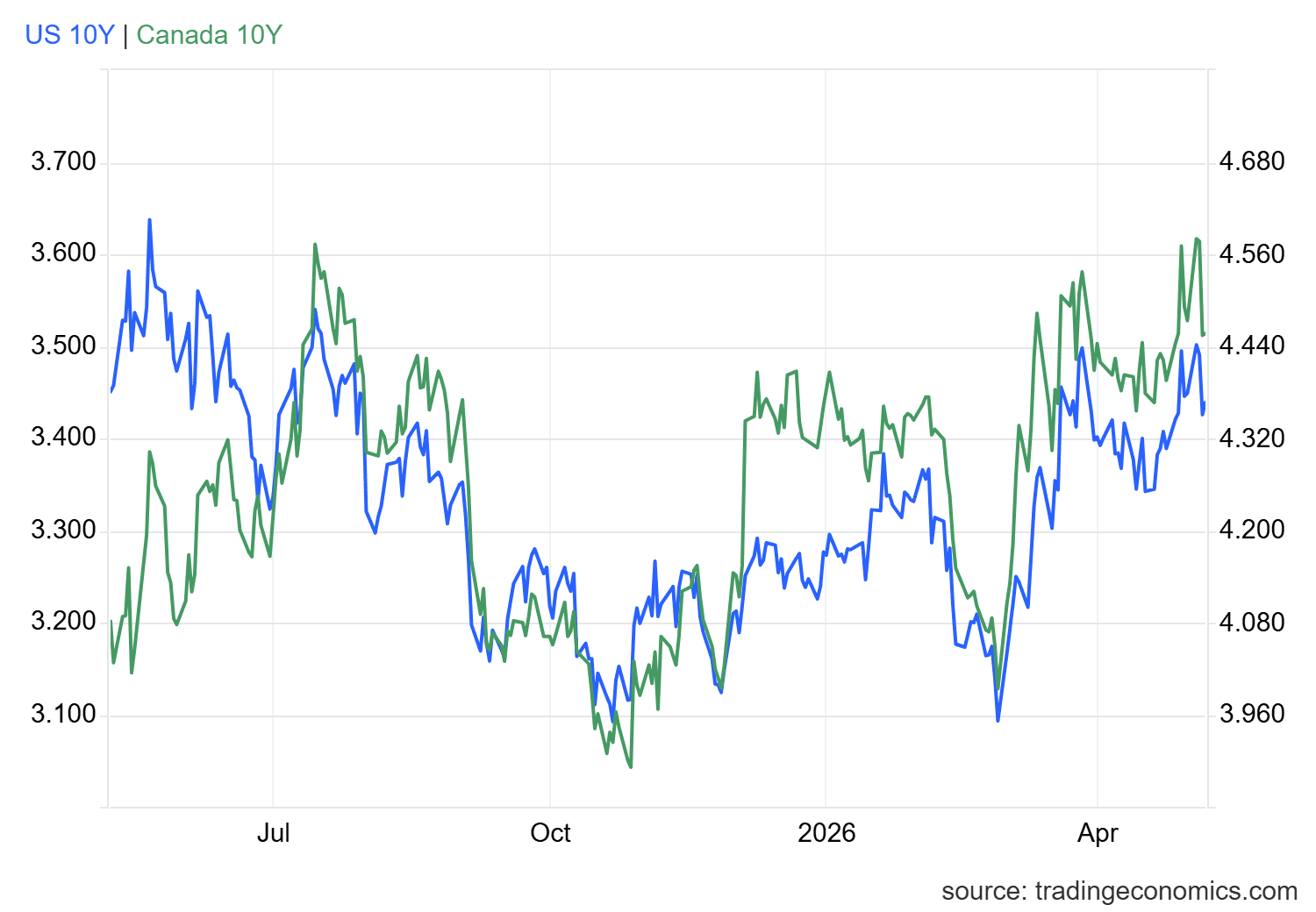
This differential is also reflected in the bond market. While both markets show similar trends, it stands out that US 10-year Treasury yields remain near 4.4%, while Canadian yields are around 3.5%, reinforcing the difference in returns between the two countries.
Source: TradingEconomics
This gap is key, as higher yields in US bonds increase their attractiveness to international capital. This can translate into stronger demand for US dollars relative to the Canadian dollar, limiting the CAD’s ability to strengthen consistently.
In this context, if this differential remains in place, it is likely to continue favoring the USD, making it more difficult for the Canadian dollar to establish a sustained bullish trend in the short term.
Taking all of this into account, the combination of stable monetary policy and a rate differential in favor of the United States could continue to generate a phase of indecision or mild buying pressure in USD/CAD in the coming sessions.
Technical outlook for USD/CAD
Source: StoneX, Tradingview
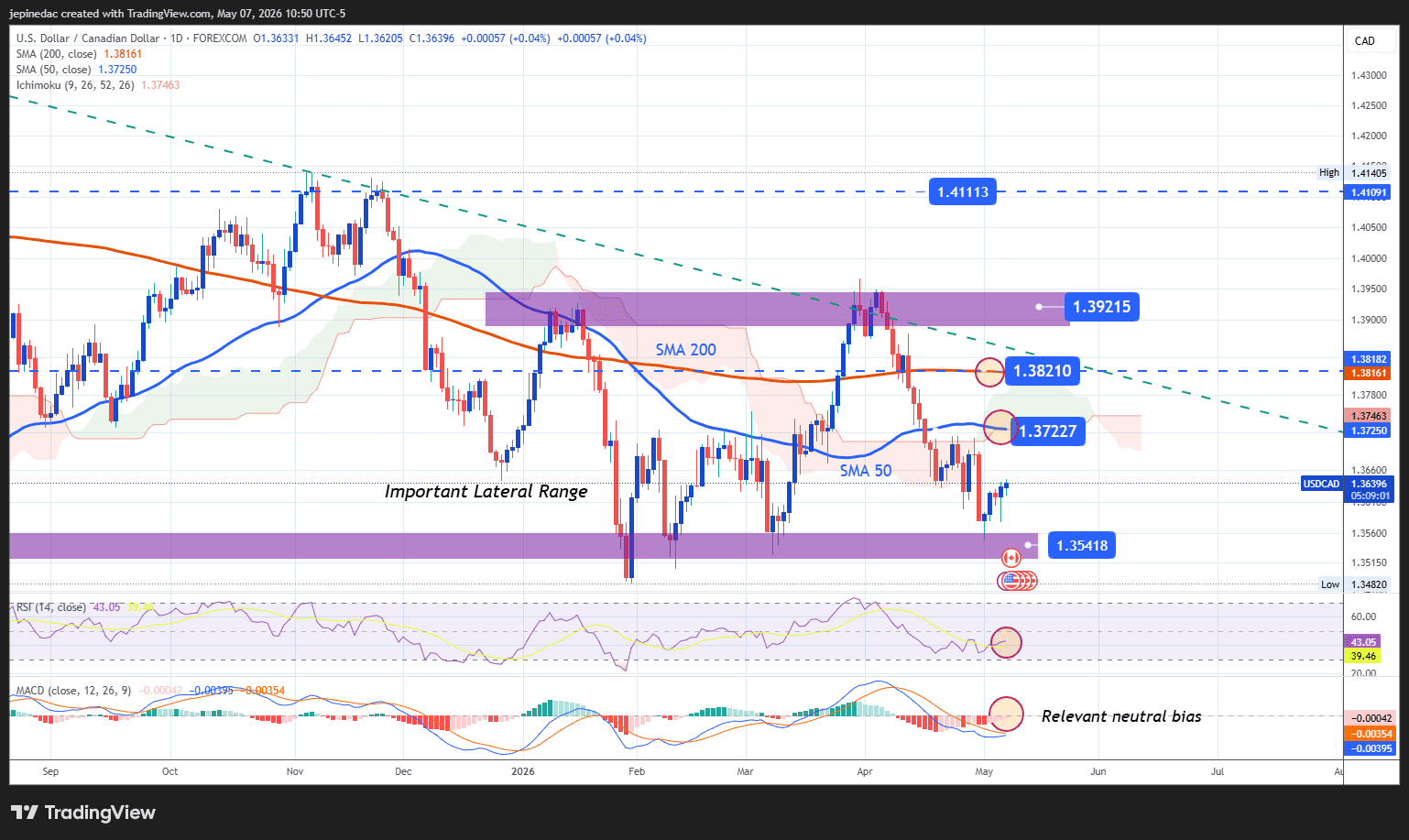
- Sideways movement becomes increasingly evident: Although long-term price action in USD/CAD still reflects a relevant bearish trendline, recent weeks have shown the formation of a more consistent range-bound structure, bounded by resistance near 1.39215 and support around 1.35418. If price fails to break clearly beyond these levels, it may be difficult to see a more consistent directional move, leaving this range as the dominant technical structure in the coming weeks.
- RSI: The RSI has moved closer to the neutral 50 level, indicating that short-term bearish pressure is losing traction, while also suggesting that the market is entering a balance between buying and selling forces. This reinforces the idea that a phase of indecision is becoming increasingly relevant in USD/CAD price action.
- MACD: The MACD shows a similar pattern, with the histogram hovering around the zero level, reflecting neutrality in short-term moving average strength. This behavior also suggests that an indecisive bias is becoming more relevant in recent price movements.
Key levels:
- 1.38210 – Key resistance: A level of recent highs aligned with the 200-period moving average. A break above this level would not only challenge the longer-term bearish trendline but also test the current neutral structure, potentially opening the door to a more relevant bullish bias.
- 1.37227 – Near-term barrier: A neutral zone aligned with the 50-period moving average. Price action near this level could continue to reinforce the current indecision phase and extend the sideways range.
- 1.35418 – Key support: A level corresponding to the 2026 lows and the main downside barrier. A break below this zone could reaffirm the bearish bias and support the continuation of the long-term downtrend as the dominant structure.
Written by Julian Pineda, CFA, CMT – Market Analyst
Follow him on: @julianpineda25
Latest market news




The complete CFD trading experience
Award-winning platforms, competitive spreads, low commissions and dedicated support.
We live and breathe the markets and are dedicated to helping traders realise their ambitions as we continue to set the industry bar.
Economic calendar
Web Trader platform
Our sophisticated web-based platform is packed with features.
Related articles
EUR/USD, USD/JPY Outlook: Oil, yields and an FX identity crisis
Crude oil is setting the tone across rates and FX, leaving EUR/USD vulnerable and USD/JPY caught between higher Treasury yields and the growing threat of intervention
AUD/USD Analysis: What's Next for the Australian Dollar After the RBA Decision?
Recent trading sessions have reflected a more neutral tone around the Australian dollar. This can be seen in AUD/USD price action, which has posted moves of roughly 0.2% over the last two sessions without establishing a clear direction. Much of this lack of momentum is linked to expectations surrounding the next policy moves from both the Reserve Bank of Australia (RBA) and the Federal Reserve.
USD into a Massive Week as Yields Fly and Gold Breaks
It’s a huge week with PCE and NFP, but it’s what’s happening off of the calendar that demands attention with US yields flying to fresh multi-decade highs.

StoneX Europe Ltd may make third party material available on this website which may contain information included but not limited to the conditions of financial markets. The material is for information purposes only and does not contain, and should not be construed as containing, investment advice and/or investment recommendation and/or an investment research and/or an offer of or solicitation for any transactions in financial instruments; any decision to enter into a specific transaction shall be made by the client following an assessment by him/her of their situation.
StoneX Europe Ltd makes no representation or warranty and assumes no liability as to the accuracy or completeness of the information provided, nor any loss arising from any investment based on a recommendation, forecast or other information supplied. You should always seek independent advice as to your suitability to speculate in any related markets and your ability to assume the associated risks, if you are at all unsure. We are not under any obligation to update any such material. Any opinion made may be personal to the author and may not reflect the opinion of StoneX Europe Ltd.