



EUR USD pulls back ahead of key Eurozone US data
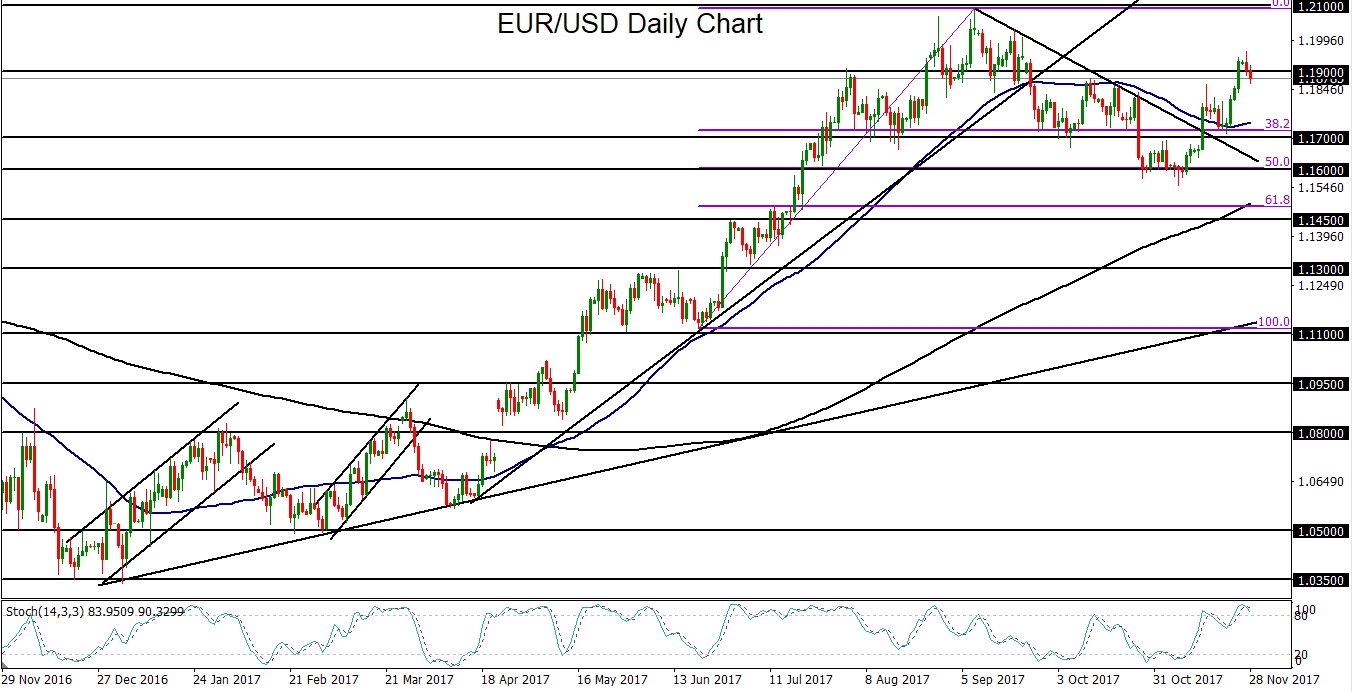
On Tuesday, as the US dollar continued its bounce from the previous day after having slid sharply against a basket of other major currencies for the past three weeks, EUR/USD has made a modest pullback within a bullish run that began in early November.
Share this:

On Tuesday, as the US dollar continued its bounce from the previous day after having slid sharply against a basket of other major currencies for the past three weeks, EUR/USD has made a modest pullback within a bullish run that began in early November.
While this recent rise for the currency pair has been driven more by dollar weakness rather than euro strength, the euro has remained resilient in the face of recent political drama in Germany involving Chancellor Angela Merkel’s failure to form a coalition government. Merkel’s CDU party is currently in talks to form a potential “grand coalition” with the Social Democrats (SPD), which, if successful, should lend further support to the euro.
Meanwhile, the US dollar has generally been pressured for the past few weeks as increasing uncertainties surrounding the timing, content, and viability of US tax reform plans from Republican lawmakers have weighed heavily on the dollar. The US Senate is preparing for a potential floor vote on its new tax reform plan this week.
Also contributing to dollar uncertainty this week has been the prospect of a new Federal Reserve Chair to replace current Chair Janet Yellen after her term expires in February. On Tuesday, the Senate Banking Committee began its hearing to confirm current Fed Governor Jerome Powell as the next Fed Chair. While Powell has been seen as the candidate with monetary policy leanings most similar to Yellen’s, and has even been considered slightly more hawkish than Yellen, there are still many unknowns as to the Fed’s future trajectory under Powell. This is especially the case after last week’s FOMC minutes, which displayed Fed members’ clear concerns about persistently low inflation and the possibility of a financial market reversal. Although markets continue to see a December rate hike almost as a foregone conclusion, there is much less confidence about the pace of monetary policy tightening in 2018 given the Fed’s ongoing concerns.
Aside from the likely Senate vote on the tax bill and some important speeches from Fed officials, key data points from the Eurozone and US this week could also impact EUR/USD. Wednesday brings preliminary US GDP data for the 3rd quarter (expected at 3.3%, annualized). Also on Wednesday, CPI inflation data will be released from key Eurozone countries – Germany and Spain. Preliminary year-over-year CPI data for the Eurozone as a whole will be released on Thursday (expected to have increased by 1.6% in November). Finally, Friday brings US ISM Manufacturing PMI data for November (58.4 expected).
From a technical perspective, EUR/USD has pulled back in the last two days as a dollar rebound has dragged the currency pair down. The technical bias, however, currently remains bullish, as EUR/USD is still trading within both a short-term and long-term uptrend, and above both its 50-day and 200-day moving averages. Overall support for the euro remains strong, despite various political risks in Europe, and uncertainties surrounding US tax reform and the Fed’s monetary policy path may continue to weigh on the dollar. With any resumption of the short-term EUR/USD uptrend after the current pullback, a move above the last high around 1.1960 should open a path back up towards the 1.2100-area multi-year highs.
Latest market news




Open an account in minutes
Experience award-winning platforms with fast and secure execution.
Economic calendar
Web Trader platform
Our sophisticated web-based platform is packed with features.
Related articles
NZD/USD Forecast: Kiwi faces historic breakdown as RBNZ survey looms
NZD/USD is teetering above support that held through the pandemic and Liberation Day turmoil. With RBNZ hawks repeatedly disappointed, today's inflation expectations survey could open the door to a slide towards the GFC lows.
USD/JPY, AUD/JPY: Central Bank Divergence Creates Two-Way Risk
USD/JPY eyes a breakout above 160, while AUD/JPY faces further losses as Fed, RBA and BoJ interest rate expectations diverge.

DXY, GBP/USD, AUD/USD, USD/CAD, USD/JPY, Gold Weekly Technical Outlook 11 16 2026
Sr. Technical Strategist Michael Boutros highlights the levels that matter on the USD Majors, commodities, and equity indices charts this week.

StoneX Financial Ltd (trading as "FOREX.com") is an execution-only service provider. This material, whether or not it states any opinions, is for general information purposes only and it does not take into account your personal circumstances or objectives. This material has been prepared using the thoughts and opinions of the author and these may change. However, FOREX.com does not plan to provide further updates to any material once published and it is not under any obligation to keep this material up to date.
This material is short term in nature and may only relate to facts and circumstances existing at a specific time or day. Nothing in this material is (or should be considered to be) financial, investment, legal, tax or other advice and no reliance should be placed on it. No opinion given in this material constitutes a recommendation by FOREX.com or the author that any particular investment, security, transaction or investment strategy is suitable for any specific person.
The material has not been prepared in accordance with legal requirements designed to promote the independence of investment research. Although FOREX.com is not specifically prevented from dealing before providing this material, FOREX.com does not seek to take advantage of the material prior to its dissemination. This material is not intended for distribution to, or use by, any person in any country or jurisdiction where such distribution or use would be contrary to local law or regulation. For further details see our full non-independent research disclaimer and quarterly summary.