



NFP preview: No signs of a major slowdown in jobs yet!
Are the expectations for NFP justified? We dive into the key leading indicators for Friday’s critical jobs report below!
Share this:

NFP insight
Last month’s NFP report came in roughly in-line with expectations, underscoring the US labor market’s resilience and doing little to call the Fed’s aggressive interest rates hikes into question. Policymakers at the world’s most important central bank have repeatedly implied that they intend to raise interest rates until the unemployment starts to rise, at minimum, as they can so as long as we continue to see solid job growth and low unemployment, the dominant trend of monetary policy tightening across the globe remains intact.
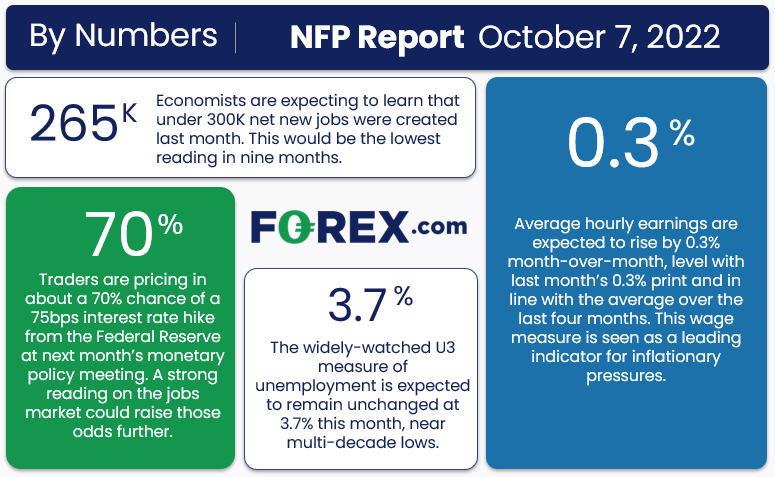
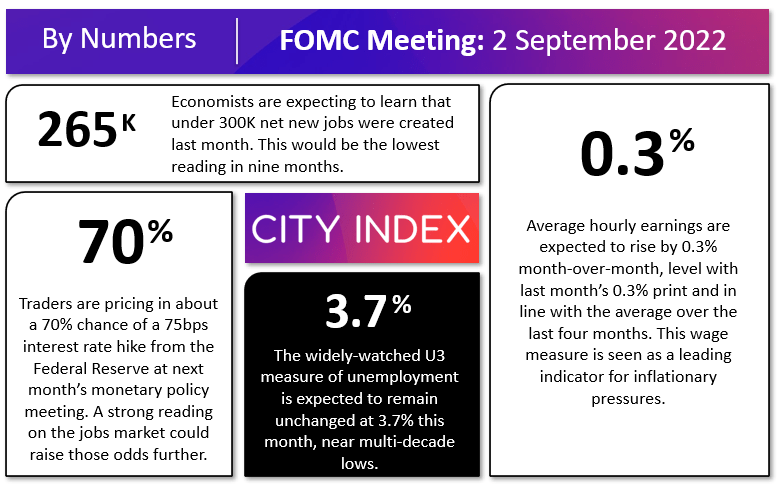
That said, there is a hint of uncertainty about the Fed’s next interest rate decision, with the CME’s FedWatch tool showing that Fed Funds futures traders are pricing in about a 70% chance of another 75bps rate hike next month, so we’re likely to see some market volatility regardless of how this month’s jobs report prints. To put it lightly, the stakes are high for traders, regardless of their favored market. For the September NFP report, consensus expectations are for 265K net new jobs and average hourly earnings projected to rise by 0.3% month-over-month:
Source: StoneX
Are the expectations for NFP justified? We dive into the key leading indicators for Friday’s critical jobs report below!
NFP forecast
As regular readers know, we focus on four historically reliable leading indicators to help handicap each month’s NFP report:
- The ISM Services PMI Employment component rose to 53.0 up from last month’s 50.2 reading.
- The ISM Manufacturing PMI Employment component fell to 48.7, down from last month’s 54.2 reading and back into contractionary territory.
- The newly revised ADP Employment report printed at 208K, up slightly from last month’s upwardly-revised 185K print.
- Finally, the 4-week moving average of initial unemployment claims ticked down to 207K, down sharply from last month’s 246K reading and back near multi-decade lows.
As a reminder, the state of the US labor market remains more uncertain and volatile than usual as it emerges from the unprecedented disruption of the COVID pandemic. That said, weighing the data and our internal models, the leading indicators point to a roughly as-expected reading in this month’s NFP report, with headline job growth potentially coming in somewhere in the 200-300K range, albeit with a bigger band of uncertainty than ever given the current global backdrop.
Regardless, the month-to-month fluctuations in this report are notoriously difficult to predict, so we wouldn’t put too much stock into any forecasts (including ours). As always, the other aspects of the release, prominently including the closely-watched average hourly earnings figure which came in at 0.3% m/m in the most recent NFP report.
Potential NFP market reaction
|
| Wages < 0.2% m/m | Wages 0.2%-0.4% m/m | Wages > 0.4% m/m |
| < 150K jobs | Bearish USD | Neutral USD | Slightly Bullish USD |
| 150K-350K jobs | Slightly Bearish USD | Slightly Bullish USD | Bullish USD |
| > 350K jobs | Neutral USD | Bullish USD | Strongly Bullish USD |
The US dollar index has pulled back over the last few weeks after reaching a 20+ year high near 115.00 in late September. The recent pullback has alleviated the overbought condition on the world’s reserve currency, potentially clearing the way for another leg higher as the underlying outperformance of the US economy remains the dominant trend.
As for potential trade setups, readers may want to consider sell opportunities on EUR/USD on a strong NFP reading. The world’s most-widely traded currency pair has recently retraced to its 50-day EMA, an indicator that has reliably provided resistance throughout the year. The psychologically-significant parity (1.00) would also serve as a logical area for the counter-trend bounce to stall.
On the other hand, a soft jobs report could present a short-term sell opportunity in USD/CAD. While the broader trend favors the greenback, USD/CAD is currently holding below last week’s highs and the loonie could be a big beneficiary of the larger-than-expected production cut from OPEC as oil remains Canada’s most important export.
How to trade with City Index
You can trade with City Index by following these four easy steps:
- Open an account, or log in if you’re already a customer
• Open an account in the UK
• Open an account in Australia
• Open an account in Singapore
- Search for the market you want to trade in our award-winning platform
- Choose your position and size, and your stop and limit levels
- Place the trade
Related tags:




Open an account in minutes
Experience award-winning platforms with fast and secure execution.
Economic calendar
Web Trader platform
Our sophisticated web-based platform is packed with features.
Related articles

AUD/USD Outlook: Historic yield squeeze leaves Aussie bears in control
Australian bond yields have fallen below their US equivalents as the Fed's hawkish repricing gathers momentum. With the Aussie weakening broadly, technical signals suggest sellers remain in control.

GBP/USD approaches breaking point as US yields surge
A historic repricing of US interest rate expectations has propelled the dollar higher, leaving GBP/USD testing a crucial support level ahead of UK GDP.

EUR/USD, DXY, Silver Price Outlook: Bullish Rebounds on Hold?
EUR/USD, DXY, Silver Price Outlook: Bullish rebounds across currency markets, precious metals, and risk assets are facing renewed pressure as U.S. CPI comes in above expectations and oil-tanker attacks persist in the Strait of Hormuz.

StoneX Financial Ltd (trading as "FOREX.com") is an execution-only service provider. This material, whether or not it states any opinions, is for general information purposes only and it does not take into account your personal circumstances or objectives. This material has been prepared using the thoughts and opinions of the author and these may change. However, FOREX.com does not plan to provide further updates to any material once published and it is not under any obligation to keep this material up to date.
This material is short term in nature and may only relate to facts and circumstances existing at a specific time or day. Nothing in this material is (or should be considered to be) financial, investment, legal, tax or other advice and no reliance should be placed on it. No opinion given in this material constitutes a recommendation by FOREX.com or the author that any particular investment, security, transaction or investment strategy is suitable for any specific person.
The material has not been prepared in accordance with legal requirements designed to promote the independence of investment research. Although FOREX.com is not specifically prevented from dealing before providing this material, FOREX.com does not seek to take advantage of the material prior to its dissemination. This material is not intended for distribution to, or use by, any person in any country or jurisdiction where such distribution or use would be contrary to local law or regulation. For further details see our full non-independent research disclaimer and quarterly summary.