
Gold was higher first thing this morning, extending its gains made on Friday when softer US retail sales data undermined the dollar. But with the US-Iran situation continuing to drag on, oil prices are remaining elevated, and this is helping to keep inflationary pressures intact and supporting bond yields. For that reason, my gold forecast remains cautious for now and expect the metal to potentially ease back after staging a decent rally in the couple of weeks. For now, though, it was holding steady, awaiting direction from bond and oil markets.
Crude oil remains on front-foot amid US-Iran stalemate
At the time of writing, oil prices were bouncing back after Reuters reported that a senior Iranian official has told the new agency that Iran has decided to shift its policy from defensive to a 'fully offensive' one. This comes after Donald Trump warned Americans to prepare for higher fuel prices during the weekend. While there were some reports that there may be some extension to the ceasefire agreement, this is not the first time we have heard such headlines before they were subsequently denied by Iran.
For now, oil prices remain firmly elevated, in a wait-and-see mode. Any fresh escalation could easily send prices sharply higher, and that in turn could send gold and other zero and low-yielding assets lower. Conversely, signs of a return to negotiations could ease supply, and therefore inflation, concerns.
Bond yields among key hurdles for gold forecast
While one can argue that the macro backdrop for gold may have become a bit more constructive in recent weeks as weaker data weighed on the dollar, elevated bond yields remain a notable constraint for the metal. Today saw the US 30-year bond yield climb to its highest level since 2007, almost reaching 5.30%.
Ultimately, if bond yields don’t turn lower, it is difficult for investors to justify holding onto a zero-yielding asset, which also carries storage and insurance costs. Unlike the past few years, there is not much in the way of clear bullish momentum either for traders to speculate on rapid price increases. All this should help limit gold’s upside potential from here.
The recent release of a disappointing US jobs report was followed by broadly in-line inflation data, weaker retail sales and softer consumer sentiment. Taken together, the figures point to some loss of momentum in the US economy and have reinforced expectations that the Federal Reserve may opt to keep interest rates unchanged in September.
That has helped weaken the dollar, normally a positive development for gold. Yet the move has been less supportive than it might otherwise have been because Treasury yields have remained elevated. This is becoming an increasingly important headwind to our gold forecast, while also creating a more challenging environment for risk assets.
Gold faces a key technical test
From a technical analysis point of view, the precious metal remains at a key technical juncture. It spent much of last week testing the $4,365-$4,455 resistance area but couldn’t secure a break above it. The zone is technically important, combining a previous swing low with an area where former support has turned into resistance. For me to turn tactically bullish on gold again, it will need to clear this hurdle and fast.
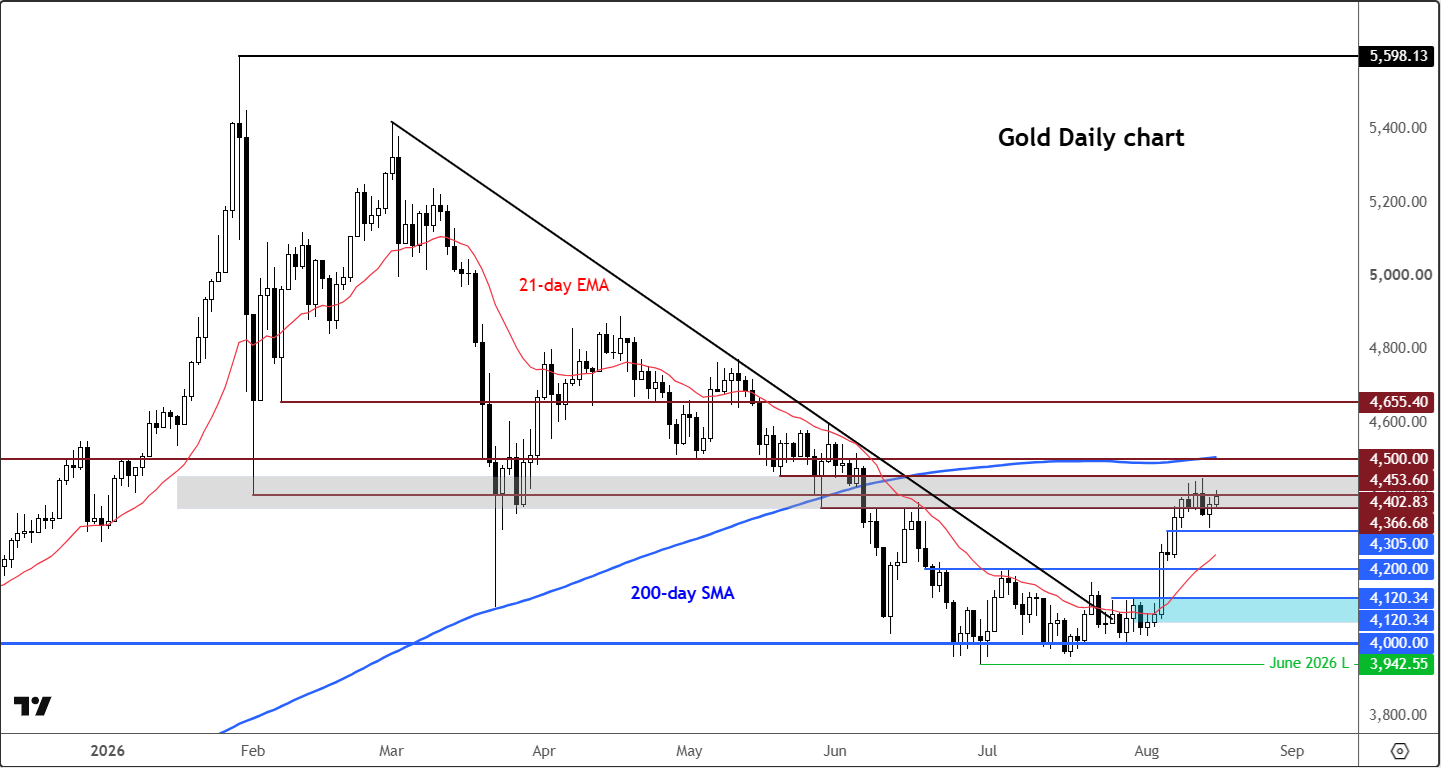
On the downside, initial support is located around $4,300-$4,305 on XAUUSD, followed by the $4,200 area. Below that, $4,100-$4,120 is likely to be more significant, as it represents the base of the recent breakout.
A decisive move above $4,365-$4,455 would improve the technical outlook and suggest that the broader bullish trend is beginning to reassert itself. Conversely, another failure at resistance, particularly alongside a stronger dollar and higher oil prices, would leave gold vulnerable to a deeper consolidation.
All told, for the recent rally to develop into something more durable, gold probably needs a combination of further evidence that US inflation is not accelerating and a meaningful retreat in Treasury yields. Until that happens, the metal may continue to struggle to gain further ground, leaving the next decisive move dependent as much on bonds and oil prices.

-- Written by Fawad Razaqzada, Market Analyst
Follow Fawad on Twitter @Trader_F_R