- USD/JPY biased lower, but countertrend rallies remain a risk
- Interest rate differentials, risk aversion key drivers
- U.S. inflation report looms as key volatility event
- Tariff headlines continue to add risk, often weighing on the pair
- Support at 147.20, resistance 148.65
Summary
Interest rate differentials have been joined by risk appetite as key drivers of USD/JPY movements, putting greater focus on economic data, bond auctions, and the performance of riskier asset classes this week in the absence of central bank activity. Price action and momentum remain with the bears, but as seen on Friday, abrupt countertrend rallies remain a possibility given how far USD/JPY has unwound recently.
Play on Rates and Risk Aversion
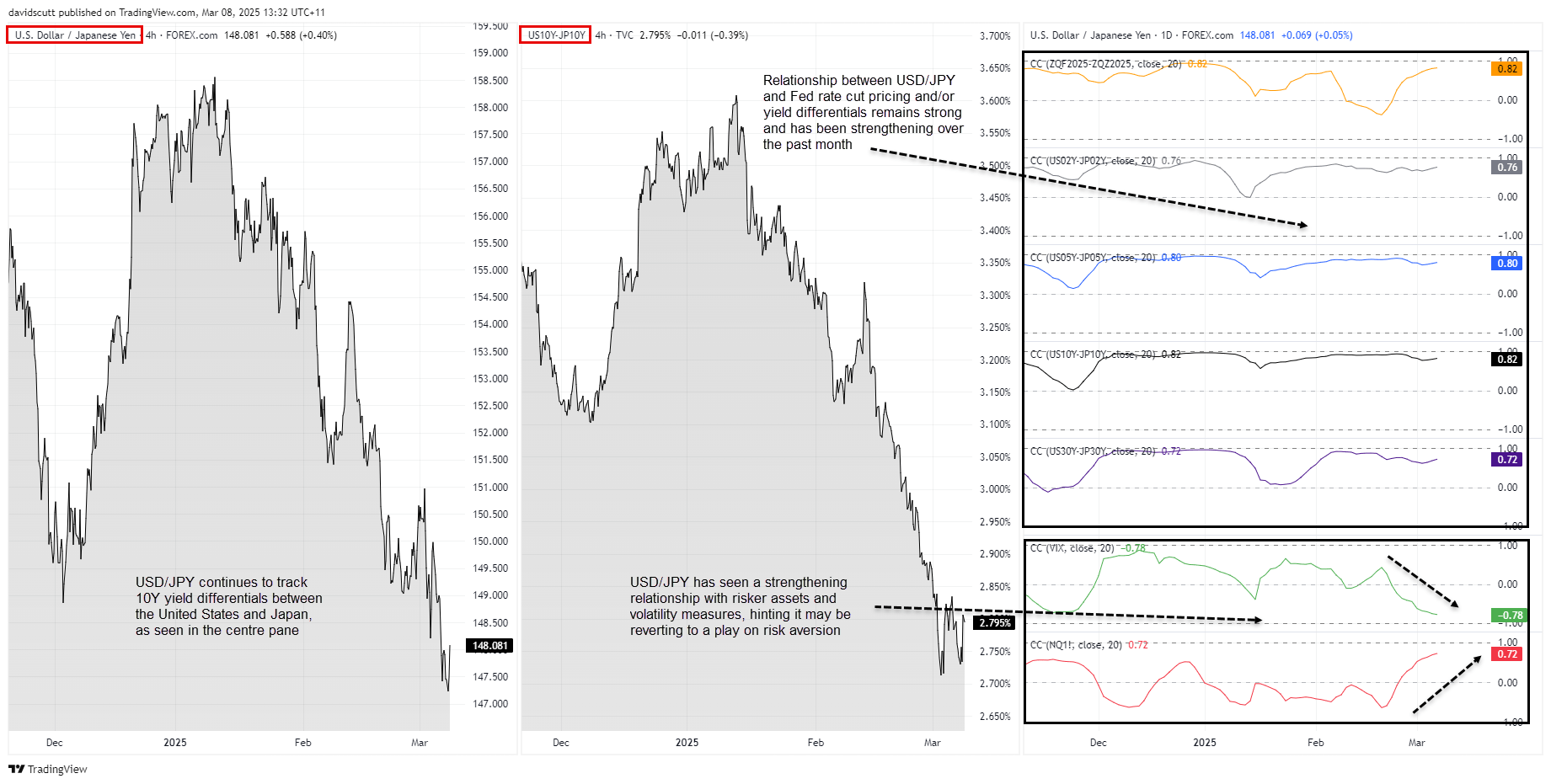
The link between USD/JPY and interest rate differentials remains strong in early March, as shown in the chart below.
Source: TradingView
Over the past 20 days, USD/JPY has logged correlation coefficients with yield spreads between U.S. and Japanese bonds—ranging from two to 10-year maturities—of between 0.76 and 0.82. While that’s similar to earlier this year, what stands out now is that it’s not just rate differentials USD/JPY has been closely tracking. Its correlation with market pricing for Fed rate cuts this year has strengthened to 0.82 over the same period.
Combined with stronger relationships with riskier asset classes—such as Nasdaq 100 futures—and measures of expected market volatility like VIX futures, this suggests USD/JPY has increasingly become a play on risk aversion over the past month, coinciding with softening U.S. economic data and wobbles in U.S. stocks.
For those unfamiliar with the term, a correlation coefficient measures the strength and direction of the relationship between two variables. A reading near 1 signals a strong positive correlation—meaning they tend to move together—while a reading closer to -1 suggests they typically move in opposite directions.

Inflation Data, Tariff Headlines Top Event Risk
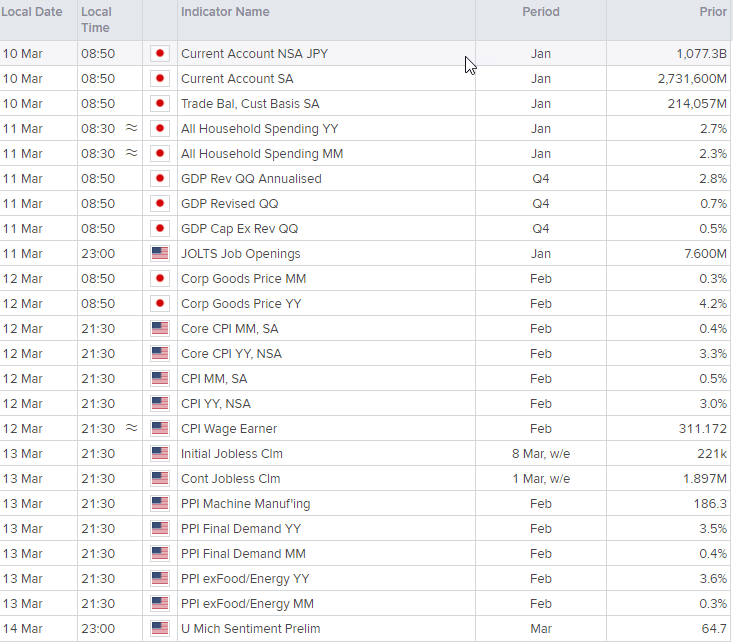
While it’s difficult to predict how investor risk appetite may evolve in uncertain times like these, identifying potential events that could shift rates markets—and hence USD/JPY—is a bit easier this week. The Federal Reserve has entered its media blackout period ahead of the March interest rate decision, meaning no official speeches. Barring leaks to known Fed mouthpieces in the media, that puts economic data and bond auctions front and centre for traders assessing potential setups.
Source: Refinitiv (JST)
The headline event is the U.S. consumer price inflation (CPI) report for February, released late Wednesday evening in Tokyo. While not the Fed’s preferred inflation gauge, it’s the one markets react to most each month, ensuring it will likely deliver volatility in USD/JPY. The key core reading is expected to rise 0.3%, down from 0.4% in January, leaving the annual increase at 3.2%, compared to 3.3% previously.
Beyond CPI, the PPI and JOLTS reports are also worth watching—the former for clues on the Fed’s preferred PCE inflation measure, the latter for signs of further softening in the U.S. labour market, in line with last Friday’s payrolls report. The University of Michigan consumer survey will also attract more attention than usual, given the recent spike in inflation expectations.
In Japan, while the economic calendar is constant, the only reports with the potential to move USD/JPY are household spending data on Tuesday and producer price inflation on Wednesday.
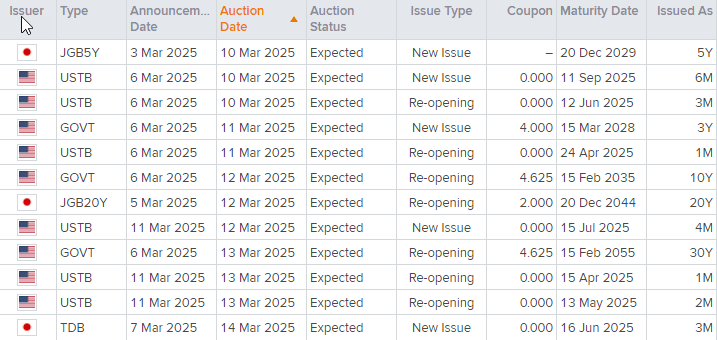
After the pronounced rally in U.S. bonds in recent weeks, traders should keep an eye on upcoming Treasury auctions for three, 10, and 30-year debt. Will lower yields sap demand from investors, creating the potential for an upward shift that boosts USD/JPY? That’s an obvious risk.
Source: Refinitiv
Beyond scheduled events, headline risk from the Trump administration’s abrupt tariff policy shifts remains a constant challenge for traders. While it’s impossible to predict when these headlines will drop, what stood out last week was that instead of tariffs supporting the U.S. dollar, the resulting increase in risk aversion often weighed on USD/JPY. That aligns with the correlation analysis discussed earlier.

USD/JPY Biased Lower
Source: TradingView
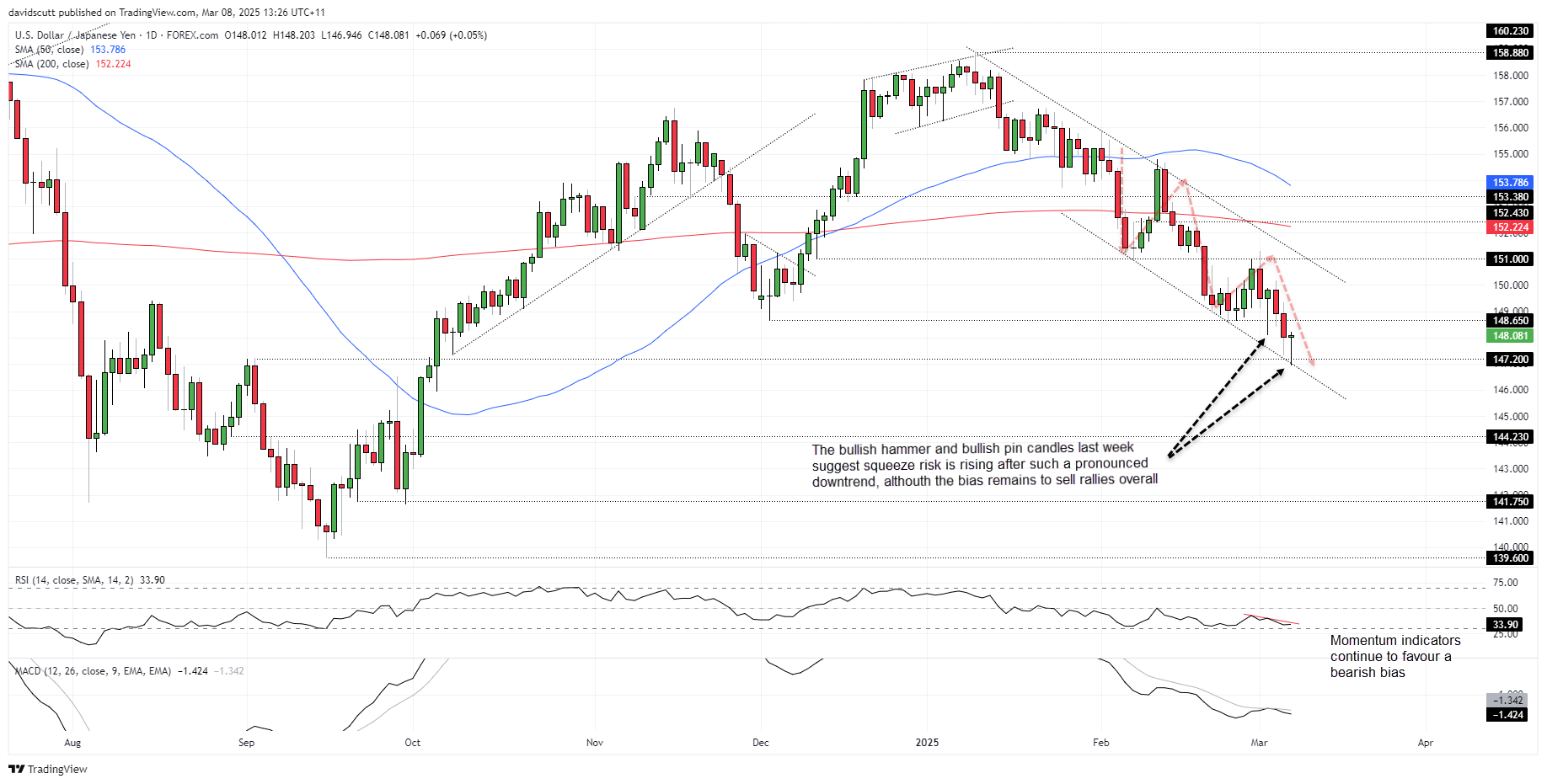
USD/JPY continues to trend lower within a descending channel, reinforcing the bearish bias that favours selling rallies. Signals from momentum indicators like RSI (14) and MACD further support this view. However, after falling more than ten big figures from recent highs, traders should be mindful of the risk of sudden countertrend rallies—illustrated by last Friday’s bullish pin bar, which points to near-term upside risks. That reinforces the need to factor in known levels when assessing setups.
Support is found at the intersection of channel and horizontal support at 147.20. A break below could see bears target 146 and 144.23. On the topside, resistance is located at 148.65 and 151.00.
-- Written by David Scutt
Follow David on Twitter @scutty