



Chinese Yuan Forecast: How, and Why, Beijing is Quietly Devaluing the Yuan
Traders may be able to use USD/CNH as a potential signal into the CCP’s outlook toward the ongoing trade tensions - see how!
Share this:

Chinese Yuan Key Points
- USD/CNH has remained remarkably stable near 7.30 since President Trump launched a trade war against China.
- However, with the US Dollar Index falling by nearly 10% so far this year, that means that the Chinese yuan has depreciated sharply against other major currencies, making its exports more competitive to non-US partners.
- Traders may be able to use USD/CNH as a potential signal into the CCP’s outlook toward the ongoing trade tensions.
For a government that has never shied away from taking an active role in markets, China’s ruling party has seemingly taken a laissez faire approach to its currency despite the Trump Administration’s crippling tariffs on the country.
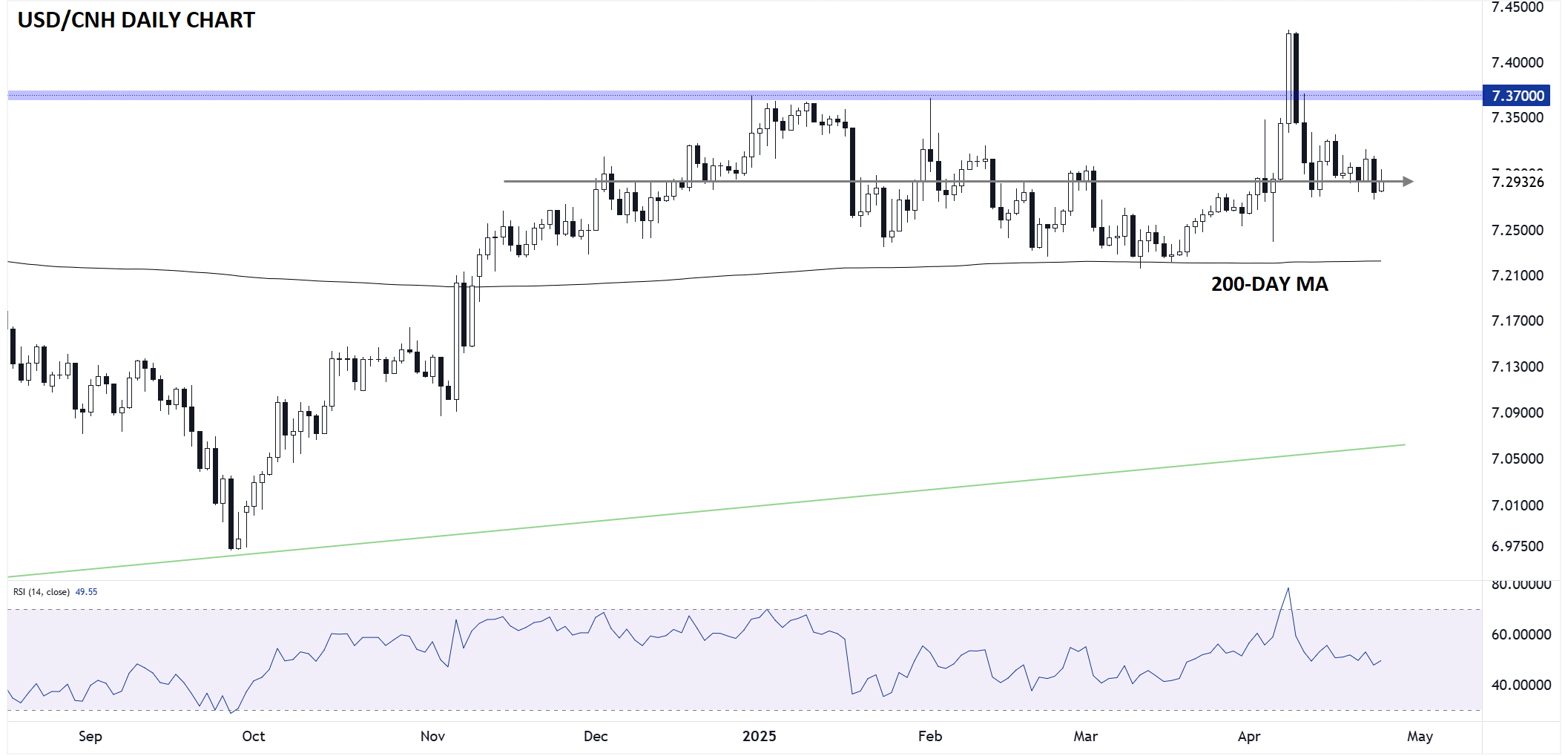
Using the “offshore” (Hong Kong) version of the currency pair, the USD/CNH chart below shows that the Chinese yuan is essentially unchanged at 7.30 against the US dollar since the week after the US election:
Source: StoneX, TradingView
Since then, USD/CNH has bounced around between about 7.20 and 7.40, and the 200-day MA remains flat near 7.22, confirming a (geopolitically surprising) lack of a clear trend.
With the US clearly acting as the aggressor in the current stage of the trade war between the world’s two largest economies, why WOULDN’T China devalue its currency to try to soften the blow from US tariffs?
The answer is that China has, unequivocally, allowed the yuan to depreciate… just not relative to the US dollar. With the US Dollar Index trading down nearly -10% in 2025 alone, holding steady against the greenback implies that the Chinese yuan has depreciated meaningfully against other major currencies, making its exports more competitive with everyone besides the US. To wit, the yuan is trading at 10-year lows against the euro, 9-year lows against the British pound, 2-year lows against the Japanese yen, and just tested 3-year lows against the Australian dollar earlier this month.
By allowing the yuan to fall in value against other global currencies, China can seek to strike trade deals with non-US counterparts at more favorable terms. Ultimately, 100%+ tariffs between the US and China serve as an effective trade embargo between the two superpowers far beyond the scale of what a currency devaluation can offset, especially for a less volatile pair like USD/CNH, which has moved in a range of about 20% total since the start of the Great Financial Crisis in late 2007.
Moving forward, traders may be able to use USD/CNH as a potential signal into the CCP’s outlook toward the ongoing trade tensions. While the Chinese yuan has not significantly budged against the US dollar in recent months, that very stability may be the message.
Traders should view USD/CNH not just as a reflection of market forces, but as a barometer of Beijing’s tolerance for economic pressure. A sharp move lower in USD/CNH (i.e. yuan strength) could signal a willingness from Chinese authorities to stabilize external relationships or reduce import costs—perhaps ahead of a major diplomatic overture. Conversely, any sudden yuan weakness against the dollar might suggest China is preparing to absorb more pain in the trade war, opting to bolster competitiveness elsewhere as it battens down the hatches for a prolonged battle.
In a world where capital controls, state influence, and geopolitical posturing blur the usual rules of forex markets, USD/CNH remains one of the clearest windows into the Chinese Communist Party’s near-term strategic mindset. Keep a close eye on not just on the level, but on the velocity and direction of moves in the Chinese yuan to decode where the next shift in global trade dynamics may emerge.
-- Written by Matt Weller, Global Head of Research
Check out Matt’s Daily Market Update videos on YouTube and be sure to follow Matt on Twitter: @MWellerFX
Latest market news



The complete CFD trading experience
Award-winning platforms, competitive spreads, low commissions and dedicated support.
We live and breathe the markets and are dedicated to helping traders realise their ambitions as we continue to set the industry bar.
Economic calendar
Web Trader platform
Our sophisticated web-based platform is packed with features.
Related articles
Canadian Dollar Short-term Outlook: USD/CAD Five-Week Rally Hits a Wall at Major Resistance 10 14 2026
USD/CAD is holding near fresh yearly highs, but bearish divergence and a well-defined October range raise the stakes at major resistance.

EUR/USD Analysis: Euro Loses Ground After a Stronger-Than-Expected U.S. CPI Report
The trading week continues to unfold and weakness around the euro has once again become increasingly evident in the short term. This can be seen in the recent performance of EUR/USD, which has declined roughly 0.3% over the last three trading sessions, highlighting renewed strength in the U.S. dollar.

USD/JPY forecast: hot US CPI lifts the pair above its 200-day average
Hotter-than-expected US inflation has pushed USD/JPY above its 200-day moving average, putting 160 and the risk of Bank of Japan intervention back in focus. The breakout still needs to hold, and a failure could send the pair sharply lower.

StoneX Europe Ltd may make third party material available on this website which may contain information included but not limited to the conditions of financial markets. The material is for information purposes only and does not contain, and should not be construed as containing, investment advice and/or investment recommendation and/or an investment research and/or an offer of or solicitation for any transactions in financial instruments; any decision to enter into a specific transaction shall be made by the client following an assessment by him/her of their situation.
StoneX Europe Ltd makes no representation or warranty and assumes no liability as to the accuracy or completeness of the information provided, nor any loss arising from any investment based on a recommendation, forecast or other information supplied. You should always seek independent advice as to your suitability to speculate in any related markets and your ability to assume the associated risks, if you are at all unsure. We are not under any obligation to update any such material. Any opinion made may be personal to the author and may not reflect the opinion of StoneX Europe Ltd.