



Surge in AU inflation heightens RBA rate hike expectations but is not a game changer for the AUDUSD
This morning's release of March quarter Australian inflation data smashed already elevated expectations. The stunning beat firms up the chances that the RBA will raise interest rates at its monthly board meeting next week for the first time since 2010.
Share this:

This morning's release of March quarter Australian inflation data smashed already elevated expectations. The stunning beat firms up the chances that the RBA will raise interest rates at its monthly board meeting next week for the first time since 2010.
Headline CPI rose by 2.1% QoQ and 5.1% YoY, shattering the median consensus for a rise of 1.7%qoq or 4.6%yoy. The RBA's preferred measure of inflation, the trimmed mean, increased by 1.4% QoQ and 3.7% YoY, well above the market's expectations of 1.2%qoq and 3.4%yoy.
Core inflation is now 70bp above the RBA's 2-3% target band, and the quarterly gain is the strongest movement since the series began in 2002. The annual trimmed mean was the highest since 2009.
The stunning beat increases the chances that the RBA will raise interest rates by 15bp at its monthly board meeting next week for the first time since 2010, just three weeks before a Federal Election.
The RBA last lifted rates during an election campaign in 2007, and the incumbent Howard government promptly lost the election three weeks later.
While the acceleration was broad-based, the most notable rises were across food (a result of recent floods in Northern NSW and Southern QLD), transport, housing and fuel.
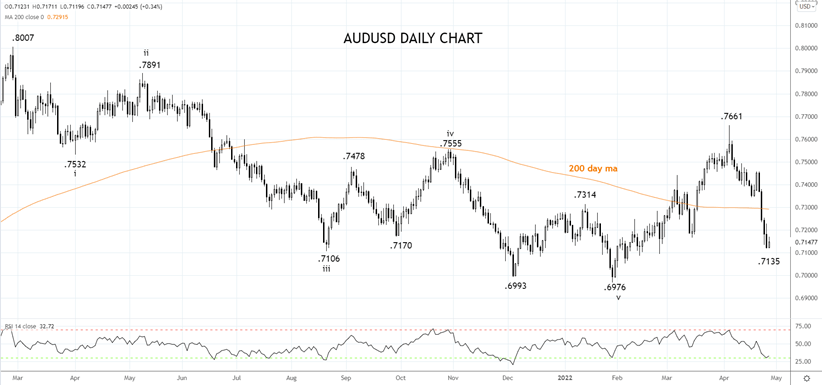
After the release, the AUDUSD bounced from .7150 to a high near .7170 before sliding back to .7150. This is because the driver of the AUDUSD in recent sessions has been the rapid depreciation of the CNY.
The Chinese currency has fallen almost 3.5% over the past seven days on growth concerns emanating from China as the lockdown in Shanghai enters the fourth week and looks set to spread to Beijing.
USDCNY had a more sedate date yesterday, settling around 6.55 after the PBoC's FX RRR cut by 1%, viewed as an effort to slow down the depreciation rather than draw a line in the sand.
USDCNY is expected to continue higher towards 6.65 in the coming weeks. This should see the AUDUSD test support between .7050 and .6950, providing a medium-term buying opportunity for the AUDUSD.
Source Tradingview. The figures stated are as of April 27th 2022. Past performance is not a reliable indicator of future performance. This report does not contain and is not to be taken as containing any financial product advice or financial product recommendation
How to trade with City Index
You can trade with City Index by following these four easy steps:
- Open an account, or log in if you’re already a customer
• Open an account in the UK
• Open an account in Australia
• Open an account in Singapore
- Search for the company you want to trade in our award-winning platform
- Choose your position and size, and your stop and limit levels
- Place the trade
This morning's release of March quarter Australian inflation data smashed already elevated expectations. The stunning beat firms up the chances that the RBA will raise interest rates at its monthly board meeting next week for the first time since 2010.
Headline CPI rose by 2.1% QoQ and 5.1% YoY, shattering the median consensus for a rise of 1.7%qoq or 4.6%yoy. The RBA's preferred measure of inflation, the trimmed mean, increased by 1.4% QoQ and 3.7% YoY, well above the market's expectations of 1.2%qoq and 3.4%yoy.
Core inflation is now 70bp above the RBA's 2-3% target band, and the quarterly gain is the strongest movement since the series began in 2002. The annual trimmed mean was the highest since 2009.
The stunning beat increases the chances that the RBA will raise interest rates by 15bp at its monthly board meeting next week for the first time since 2010, just three weeks before a Federal Election.
The RBA last lifted rates during an election campaign in 2007, and the incumbent Howard government promptly lost the election three weeks later.
While the acceleration was broad-based, the most notable rises were across food (a result of recent floods in Northern NSW and Southern QLD), transport, housing and fuel.
After the release, the AUDUSD bounced from .7150 to a high near .7170 before sliding back to .7150. This is because the driver of the AUDUSD in recent sessions has been the rapid depreciation of the CNY.
The Chinese currency has fallen almost 3.5% over the past seven days on growth concerns emanating from China as the lockdown in Shanghai enters the fourth week and looks set to spread to Beijing.
USDCNY had a more sedate date yesterday, settling around 6.55 after the PBoC's FX RRR cut by 1%, viewed as an effort to slow down the depreciation rather than draw a line in the sand.
USDCNY is expected to continue higher towards 6.65 in the coming weeks. This should see the AUDUSD test support between .7050 and .6950, providing a medium-term buying opportunity for the AUDUSD.
SourceTradingview.ThefiguresstatedareasofApril 27th2022.Pastperformanceisnotareliableindicatoroffutureperformance.Thisreportdoesnotcontain and is not to be taken as containing any financial product advice or financial product recommendation
Related tags:
Latest market news




The complete CFD trading experience
Award-winning platforms, competitive spreads, low commissions and dedicated support.
We live and breathe the markets and are dedicated to helping traders realise their ambitions as we continue to set the industry bar.
Economic calendar
Web Trader platform
Our sophisticated web-based platform is packed with features.
Related articles

RBA rate hike bets surge as Australian inflation heats up
Australia's inflation problem extends well beyond energy, with markets now pricing further RBA hikes into 2027. So why has AUD/USD reversed sharply after its initial surge?

AUD/USD Analysis: Australian Dollar Holds Steady Ahead of Inflation Data and the Fed
As the trading week progresses, a cautious tone is becoming increasingly evident around the Australian dollar. This can be observed in the recent performance of AUD/USD, where price action has remained largely unchanged over the last three trading sessions, recording a move of barely 0.1%. This behavior highlights a clear lack of direction within the market.


AUD/USD, NZD/USD face explosive CPI, RBNZ doubleheader
Aussie and Kiwi have gone remarkably quiet ahead of Australian inflation data and RBNZ decision. With substantial tightening priced and both events capable of generating major FX swings, Wednesday could deliver a volatility eruption in the antipodes.
StoneX Europe Ltd may make third party material available on this website which may contain information included but not limited to the conditions of financial markets. The material is for information purposes only and does not contain, and should not be construed as containing, investment advice and/or investment recommendation and/or an investment research and/or an offer of or solicitation for any transactions in financial instruments; any decision to enter into a specific transaction shall be made by the client following an assessment by him/her of their situation.
StoneX Europe Ltd makes no representation or warranty and assumes no liability as to the accuracy or completeness of the information provided, nor any loss arising from any investment based on a recommendation, forecast or other information supplied. You should always seek independent advice as to your suitability to speculate in any related markets and your ability to assume the associated risks, if you are at all unsure. We are not under any obligation to update any such material. Any opinion made may be personal to the author and may not reflect the opinion of StoneX Europe Ltd.