

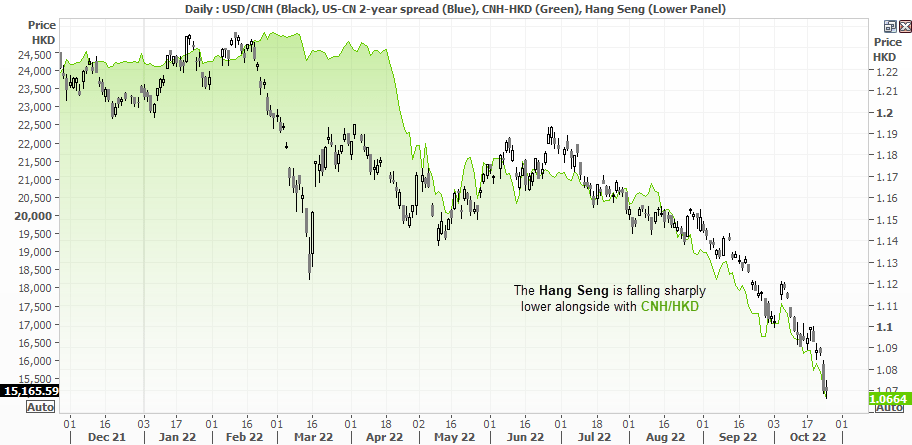


The Chinese yuan and the Hang Seng are in freefall
Whilst the yuan has continued to decline against the US dollar, its weakness can be noted against several currencies as China let’s their currency slide.
Share this:

With President Xi securing a third term and refusing to back away from the COVID-zero strategy, it has further fanned fears of a global recession as China’s growth is likely to suffer as a consequence. This has seen the Chinese currency continue to move lower against the US dollar and propelled USD/CNH to a record higher. And not wanting to miss out on the action, the Hang Seng touched a fresh 13-year low yesterday.
Whilst the yuan has fallen sharply against the US dollar, its depreciation is broad based. This month alone the yuan has lower against the Korean Won, Indian and Indonesian Rupee, Australian dollar and Hong Kong dollars (to name a few). The power that be in China are presumably happy to let their currency slide to boost exports and therefore growth. The trouble is that they are not alone with that idea, with the Bank of Japan (BOJ) being more than vocal with their desire for a weaker currency. But, for now, their intentions seem clear; China wants a weaker currency.
The Hang Seng has become collateral damage as it gets dragged lower with the CNY/HKD exchange rate. But fear not, as China’s ‘plunge protection team’ (PPT) were rumoured to be at work yesterday by purchasing securities to stimmy the stock market decline. The market may have closed below 15,000 for the first time since 2009, but downside volatility was notably lower than the days preceding it. I wouldn’t want to be a buyer at these lows, but with PPT at work I would be wary of shorts around current levels without a retracement higher.
It’s hard to construct a bearish case for USD/CNH, given the current drivers
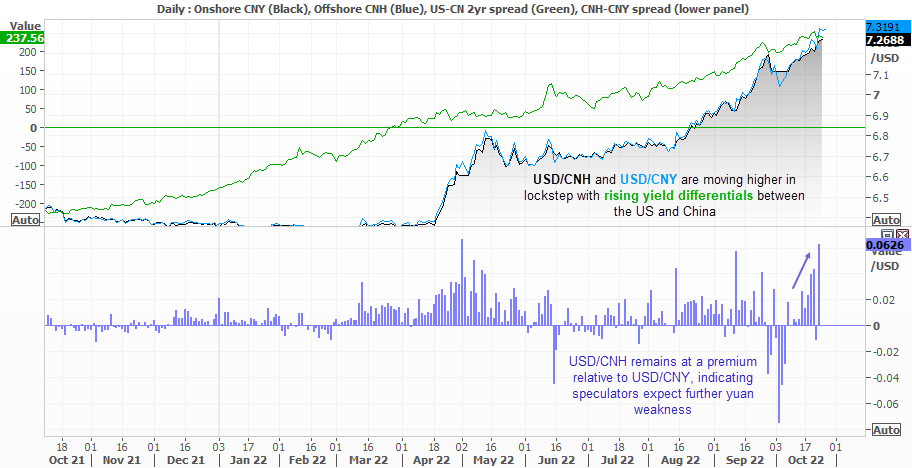
Overall, it appears that the yuan is more likely to weaken against the US dollar than reverse its trend. Markets rarely move in a straight line, even though USD/CNH has most certainly tried to in recent months. Offshore yuan (CNH) is trading below onshore yuan (CNY) which shows speculators continue to expect the onshore yuan to depreciate against the US dollar. Furthermore, rising yield differentials between US and CN are moving higher in lockstep with USD/CNH as the Fed remains on an aggressive tightening cycle and the dollar screams higher. Therefore, whilst these drivers remain in place and China are happy to let their currency slide, the bias for USD/CNH remains bullish.
Still, no trend lasts forever
A development worth keeping tabs on is the excitement that the Fed may step off the gas and hike at a slower pace, which brings us closer to this famous ‘Fed Pivot’. The US dollar and yields were lower yesterday following weak consumer sentiment, manufacturing and house data – which means there’s less pressure for the Fed to hike in 75bp chunks.
As we head into 2023 the odds of the US dollar topping out seem higher, given the Fed can’t hike forever and the dollar has had broad-based rally this year. And as noted two weeks ago, the US dollar index annual rate is over +2 standard deviations – a level which tends to lead to some mean reversion.
So if or when we get the Fed pivot, the dollar could become the currency of choice to ‘throw overboard’ as bulls book profits and bears trade against it. And if China were to reverse their zero-COVID policy, a bearish case for USD/CNH becomes compelling.
1-week implied volatility for the yuan is on the rise
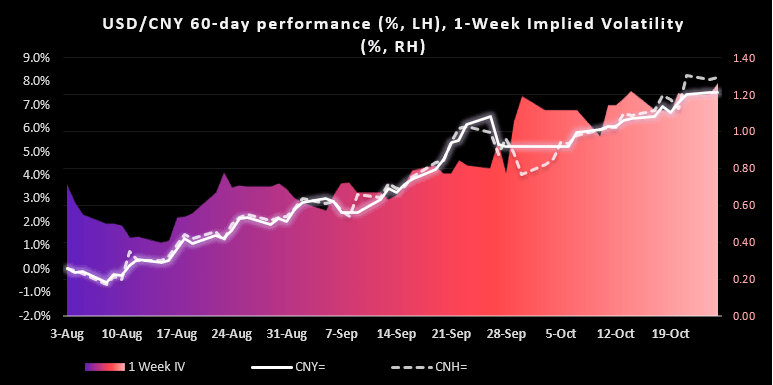
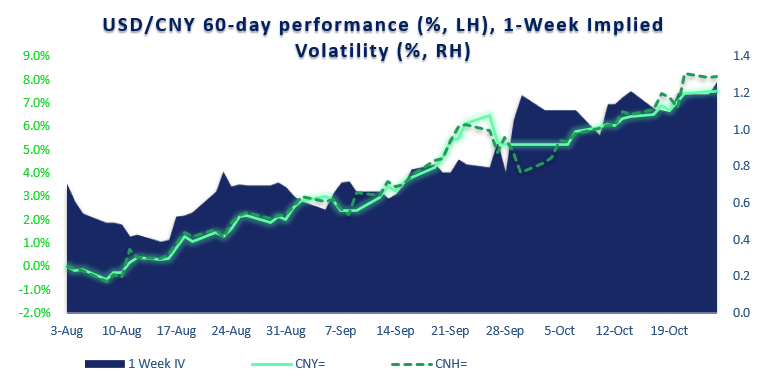
However, 1-week implied volatility (IV) has spiked higher and trades at a premium to the 2-week IV and beyond. Clearly, options traders are concerned over the near-term and that leaves the potential for larger swings than usually expected, in either direction.
USD/CNH daily chart
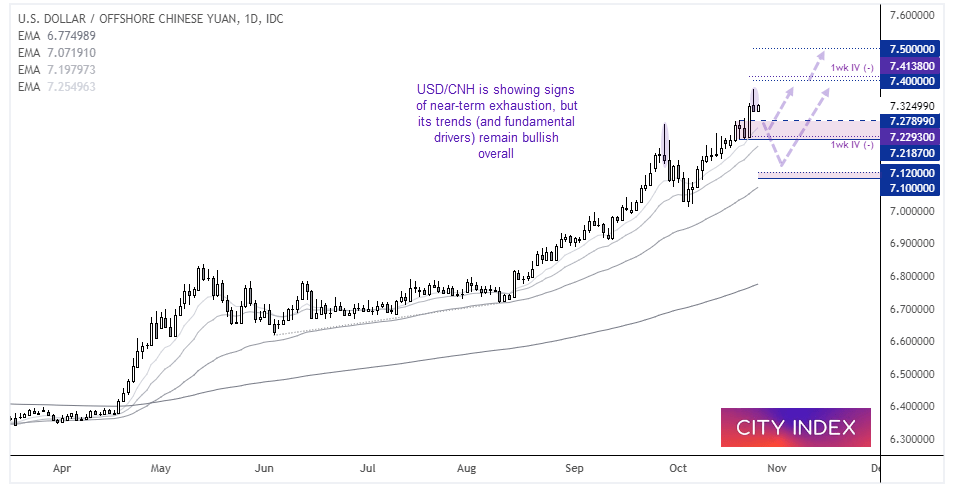
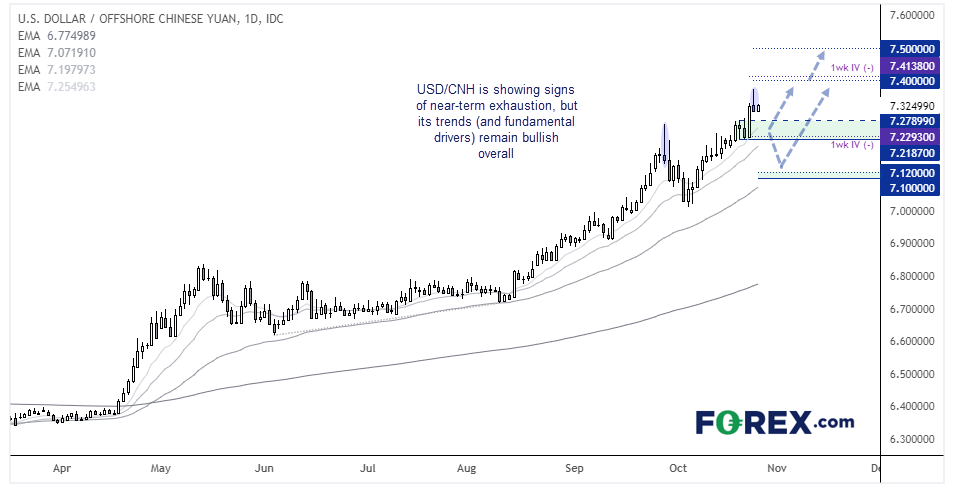
A bearish hammer formed on the USD/CNH daily chart yesterday – a pattern which last seen on the 28th of September marked the beginning of a retracement. That correction lasted a whole five days and retraced around 3.5% which, if repeated, could see the pair pull back to the 7.1200 area.
Using a more conservative approach, perhaps prices pull back towards the 7.218 low which is near the 1-week implied volatility downside estimate. A break below this support level likely marks a deeper correction, but for now I suspect bulls would be interested in buying dips above it.
7.4000 is the next key level for bulls to focus on, which sits near the 1-week implied volatility upside estimate.
How to trade with City Index
You can easily trade with City Index by using these four easy steps:
- Open an account, or log in if you’re already a customer
• Open an account in the UK
• Open an account in Australia
• Open an account in Singapore
- Search for the company you want to trade in our award-winning platform
- Choose your position and size, and your stop and limit levels
- Place the trade
How to trade with FOREX.com
Follow these easy steps to start trading with FOREX.com today:
- Open a Forex.com account, or log in if you’re already a customer.
- Search for the pair you want to trade in our award-winning platform.
- Choose your position and size, and your stop and limit levels.
- Place the trade.
Latest market news




The complete CFD trading experience
Award-winning platforms, competitive spreads, low commissions and dedicated support.
We live and breathe the markets and are dedicated to helping traders realise their ambitions as we continue to set the industry bar.
Economic calendar
Web Trader platform
Our sophisticated web-based platform is packed with features.
Related articles
Canadian Dollar Short-term Outlook: USD/CAD Plunge Stalls at Pivotal Support—Range Break in Focus 11 5 2026
Friday’s U.S. and Canadian employment reports could trigger a decisive USD/CAD move as bulls and bears battle for control at critical support.


US Dollar Technical Outlook: DXY Bulls Fight to Hold Critical Support Ahead of NFP 11 5 2026
DXY bulls are attempting to defend a pivotal technical threshold, with the next reaction likely to determine whether the broader recovery survives.

Nasdaq 100 forecast: Tech stocks remain under pressure despite mid terms rally
The Democratic sweep in the US midterms delivered the negative dollar reaction I had anticipated, but that upsurge in stocks was not something I or many others had anticipated. Fears that a Democrat-controlled Congress would trigger a broader sell-off in technology stocks proved premature. Nevertheless, the sector remains under pressure. The political outcome may help explain the Nasdaq’s relative underperformance with futures falling 0.8% today. Sharp falls in shares of Arm and Qualcomm following their results are certainly not helping. While the removal of midterm uncertainty provided a broad-based boost to risk appetite yesterday, investors may be starting to price in the prospect of tighter regulatory scrutiny of Big Tech, particularly around AI, under greater Democratic influence in Congress. This could become a headwind for technology valuations, even if the immediate impact on corporate earnings remains unclear.

StoneX Europe Ltd may make third party material available on this website which may contain information included but not limited to the conditions of financial markets. The material is for information purposes only and does not contain, and should not be construed as containing, investment advice and/or investment recommendation and/or an investment research and/or an offer of or solicitation for any transactions in financial instruments; any decision to enter into a specific transaction shall be made by the client following an assessment by him/her of their situation.
StoneX Europe Ltd makes no representation or warranty and assumes no liability as to the accuracy or completeness of the information provided, nor any loss arising from any investment based on a recommendation, forecast or other information supplied. You should always seek independent advice as to your suitability to speculate in any related markets and your ability to assume the associated risks, if you are at all unsure. We are not under any obligation to update any such material. Any opinion made may be personal to the author and may not reflect the opinion of StoneX Europe Ltd.