


Bank of England meeting
What is the Bank of England meeting – and how can you trade it? Learn everything you need to know here, or open your FOREX.com account to trade the next meeting now.
- How to trade the BoE meeting
- What is the Bank of England?
- What is the Bank of England base rate?
- What is the Bank of England MPC?
- The structure of the MPC
- Bank of England FAQ
How to trade the BoE meeting
The BoE can drive significant volatility across currency pairs, indices, stocks, bonds and other securities. Most traders will attempt to predict what the Bank will decide to do ahead of time, so they can minimise risk and even plan for profit.
For example, if the Bank’s Monetary Policy Committee (MPC) decides to increase interest rates, this could cause the value of the pound to rise and reduce the value of stocks, bonds, indices and other securities. And if they decide to lower interest rates, GBP could fall in value and cause other asset classes to rise.
Most traders will monitor forex pairs such as EUR/GBP and GBP/USD, UK stock indices including the FTSE 100 and FTSE 250, as well as any UK based banking stocks such as Barclays, Lloyds and HSBC.
Ready for your first opportunity?
Open a FOREX.com account now and start trading in minutes.
What is the Bank of England?
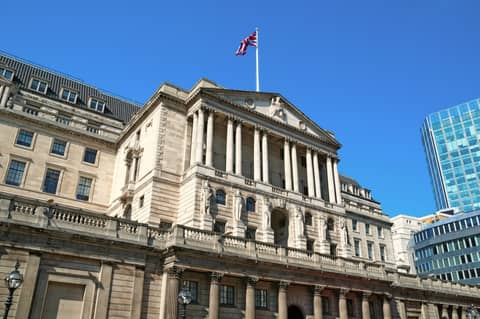
The Bank of England (BoE) is the United Kingdom’s central bank. The BoE is tasked with setting monetary policy and issuing currency, as well as regulating banks and being the lender of last resort – meaning it provides loans to banks and other institutions that are in financial difficulty.
The Bank of England is just one of many central banks; other famous examples include the Federal Reserve System in the US and European Central Bank. The BoE is one of the oldest banks in the world, so it has been used as a model for central banks globally.
What is the Bank of England base rate?
The Bank of England base rate is the interest that the Bank of England pays to any commercial bank that holds money with them. This rate will have a direct impact on the interest rates that banks charge or pay to consumers – so it will impact what you’d pay if you take out a loan, or you’d receive from your savings account.
Monitoring and changing the base rate is a core part of the monetary policy responsibilities of the BoE. Every year, an inflation target is set by the government that aims to keep inflation low and stable and the BoE will change the bank rate to meet this inflation target. Currently, the target is 2%.
How does the base rate affect inflation?
The base rate affects inflation by encouraging or discouraging spending. When spending is high, goods become more expensive and inflation should rise. When spending is low, on the other hand, prices and inflation should fall.
When the base rate is low, it makes interest payments on loans cheaper, but also decreases the amount of interest earned from savings accounts, which makes it less rewarding to save.
Cheap loans and poor returns from saving encourages people and businesses to spend. With higher demand for goods, property and services, prices should rise. This makes the pound worth less (as you can buy less with a single pound), meaning inflation is on the rise.
With high rates, on the other hand, the opposite happens. Spending is discouraged, lowering demand and seeing the value of the pound rise.
What is the latest BoE bank rate?
The current Bank of England base rate is 4.5%. The rate was raised by 0.50bps in December 2022, marking the ninth consecutive rate rise from the MPC. The increase was part of the continued efforts of the BoE to curb inflation in the UK and reduce the length of the forecasted recession.
Practise trading with a free demo
Our trading demo account gives you $20,000 virtual funds to trade 6,000+ live markets. It’s the perfect place to hone your skills.
What is the Bank of England MPC?
The Bank of England’s Monetary Policy Committee (MPC) is the body in charge of setting monetary policy – including the base rate. It has a goal of meeting the government’s 2% inflation target to sustain growth and employment.
The MPC sets and announces monetary policy eight times a year – roughly every six weeks – usually at noon on a Thursday. It’s estimated that the decisions made by the MPC will take two years to fully take effect – which means all announcements have to consider future events as well as historic and current economic circumstances.
As well as their base rate announcements, the BoE also releases quarterly monetary policy reports, which set out their economic analysis and inflation projections. These reports are useful for traders as they explain the decisions behind interest rates in more detail.
The structure of the MPC
The Committee is made up of nine members: The Governor of the Bank of England, three Deputy Governors, a Chief Economist and four external members appointed directly by the Chancellor of the Exchequer. Each member will have previous expertise in the field of economics and monetary policy – the external members of the MPC ensure that the Committee’s knowledge pool is diversified beyond the Bank of England.
Name | Position |
|---|---|
Andrew Bailey | Governor of the Bank of England |
Ben Broadbent | Deputy Governor, Monetary Policy |
Sir Jon Cunliffe | Deputy Governor, Financial Stability |
Sir Dave Ramsden | Deputy Governor, Markets and Banking |
Andy Haldane | Chief Economist and Executive Director |
Jonathan Haskel | External member |
Michael Saunders | External member |
Silvana Tenreyo | External member |
Who is the Bank of England governor?
The governor of the Bank of England is Andrew Bailey, whose term runs from 16 March 2020 to 15 March 2028. The governor is responsible for overseeing the Bank’s three main goals: keeping inflation in check, monitoring the financial system and regulating banks.
Previously, Bailey served as the Chief Executive Officer of the Financial Conduct Authority (FCA) and was a member of the Bank of England’s Prudential Regulation Committee and Financial Policy Committee.
Latest BoE news

A better trading experience
Discover how FOREX.com's platforms can give you an edge.
Learn to trade with confidence
Head over to the FOREX.com Academy for curated courses designed to get you started on the markets.
Economic calendar
Why trade with FOREX.com?
Proudly supporting traders worldwide, we are committed to offering cutting-edge platforms, education, insights and opportunities for market success.
That's why over one million traders* have chosen us as their trusted partner.
Elite products, value, and execution
Choose from thousands of CFD markets across a variety of asset classes, including EUR/USD, US SP 500, Tesla and Nvidia.
Enjoy consistently low trading costs and fast, quality execution.
Tools designed for your edge
Choose from a variety of platforms and refine your trading with exclusive data tools like Performance Analytics.
Take full command of your analysis with industry-leading TradingView charts and in-platform news feeds.
A superior customer experience
Access knowledgeable customer support by phone, email or chat and, enjoy convenient online account management tools.
FOREX.com VIP traders can experience a personalised service and exclusive benefits.
A trusted global leader
We're a wholly-owned subsidiary of StoneX Group, a Nasdaq-listed, Fortune 50 financial giant with an operating revenue of $4.1 billion.†
Fully MAS-regulated and financially stable, FOREX.com has proudly been providing trading services to clients since 2001.
*
Based on demo and active live trading accounts globally since 2023.
† StoneX Annual Report 2026
Bank of England FAQ
If you have more questions visit the FAQ section or start a Chat with our support.