
Key Events
- Nations within the BRICS alliance face heightened sanction risks due to their perceived threat to the US Dollar's dominance.
- OPEC’s gradual increase in production may help cushion the impact of tariffs on import costs and labor market pressures—especially when viewed in tandem with evolving Fed rate expectations.
Amid increasing political tension, headlines suggest pressure on the Federal Reserve to change its leadership and pressure on the Bureau of Labor Statistics to align with Trump’s rate-cut agenda. These developments come alongside concerning labor market reports and the re-emergence of tariff threats. A partial counterbalance may come from a moderation in oil prices due to increased supply.
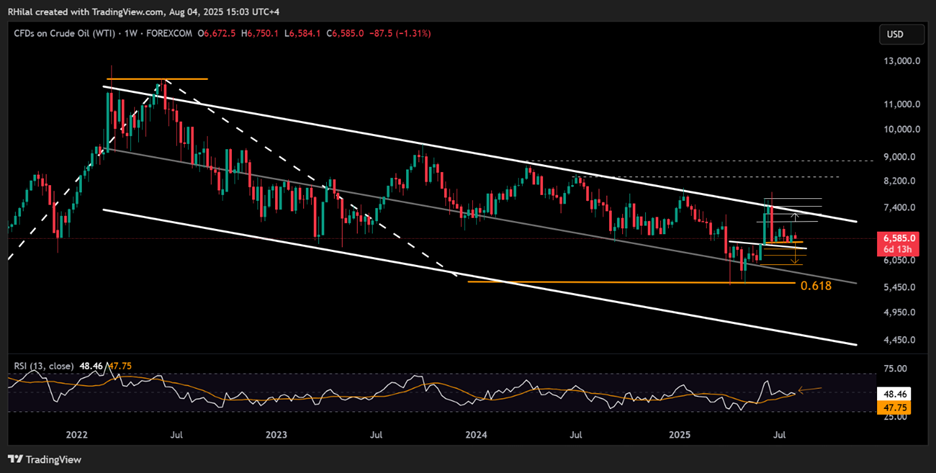
Crude prices remain capped within a 3-year downward channel, while the US Dollar struggles to break above the 100.20 resistance. This reflects mounting economic uncertainty—particularly as tariff threats loom over the tech sector, a key driver of global growth due to the deep integration of AI and technology in national economic agendas.
In terms of market share, OPEC appears determined to reclaim what it lost since initiating production cuts in 2023. The current unwind has so far been associated with a more than $10 per barrel increase in oil prices . Meanwhile, U.S. geopolitical strategies continue to place pressure on India (for reducing Russian oil imports) and China (for Iranian oil purchases). The U.S. is eager to expand its oil export market toward the world's largest importers, but these nations are increasingly pursuing their own diversified energy strategies—regardless of pressure from Trump.
A rise in OPEC supply, alongside declining prices, may help cushion inflation and economic growth risks tied to aggressive tariff policies—though this would depend on how those price levels align with oil-producing countries’ fiscal budgets.
The key question is whether OPEC will proceed to unwind the remaining 1.66 million barrels per day to defend market share—especially if new U.S. sanctions hit Russian oil and tariffs escalate tensions in global tech supply chains.
Technical Analysis: Quantifying Uncertainties
Crude Oil: Weekly Time Frame – Log Scale
Source: Tradingview
Crude oil remains above the key $64 support from June, with resistance below $70. Prices are range-bound, caught between rate cut hopes and demand concerns tied to labor weakness and tariffs—all under a 3-year downtrend from 2022 highs.
A firm break above $70 could extend the rebound from $64.40, with RSI holding above 50, targeting $72.40, $74.40, and possibly $77. A breakout above $77–78 would signal a shift away from bearish dominance, opening the door to a longer-term rally.
Conversely, a drop below $64 may push prices toward $63.20, $61.80, and $59.70 within the channel's mid-range.
Written by Razan Hilal, CMT
Follow on X: @Rh_waves