
- EUR/USD forecast stays bullish above 1.1500 support, with room towards 1.20 in coming months
- Eurozone PMI data shows manufacturing momentum returning, adding support for the single currency
- All eyes on Powell’s Jackson Hole speech as Fed policy path remains the key driver
The choppy trend in FX continued this morning, with the EUR/USD pair rebounding from early weakness, while the USD/JPY turned higher as bond yields rebounded, something which also hurt gold prices. Slightly stronger European PMIs helped both the pound and the euro, although traders were largely sitting on their hands ahead of Powell’s speech on Friday. The EUR/USD forecast remains bullish despite the recent side-ways chop.
EUR/USD forecast: Underlying trend still constructive
Although the EUR/USD has been largely range-bound in recent weeks, the broader trend retains a bullish bias while the pair holds above the key 1.1500 support zone. From here, we see scope for a move into the 1.20s over the coming months, particularly as the Fed edges closer to cutting rates. The caveat remains US inflation. If it proves too sticky, the Fed could be forced to hold back, slowing momentum for the pair. But as things stand, the EUR/USD forecast stays positive.
Euro remains supported by strong fundamentals
The euro has found mild support from improving economic data. August’s eurozone composite PMI ticked up from 50.9 to 51.1, signalling resilience despite global headwinds. Manufacturing provided the real surprise, with output hitting its highest level in over three years at 52.3. While services lagged slightly, slipping to 50.7, gains in new orders and hiring suggest momentum could be building. These healthier data points should add to the euro’s constructive backdrop.
Indeed, investor sentiment towards the eurozone has improved markedly in recent years. European equities have seen renewed foreign demand, with overseas investors purchasing around €236 billion of eurozone debt and equities across May and June alone, according to the ECB’s Balance of Payments data. That appetite supports the single currency, particularly as Germany prepares to step up fiscal spending to boost the bloc’s largest economy.
Even with one more ECB rate cut expected this year, the central bank is closer to a neutral policy stance, while it is the Fed that appears more likely to loosen further. This narrowing of yield differentials between the US and the eurozone provides a supportive backdrop for the EUR/USD forecast.
The main risk to the euro narrative remains geopolitics. For example, should the conflict in Ukraine escalate and energy prices spike once more, sentiment could turn quickly. But with peace discussions advancing, such risks have eased somewhat in recent weeks.
Powell the key event risk
Attention now shifts to the Jackson Hole Symposium, where Chair Jerome Powell’s Friday speech will be pivotal. Market expectations lean towards a neutral-to-dovish tilt, particularly after softer payroll revisions and falling consumer confidence. Inflation linked to tariffs may yet prove less damaging than feared.
If Powell signals the Fed is willing to cut by 25 basis points in September—and potentially follow up in October and December—the dollar could weaken further, giving the EUR/USD forecast a boost. A hawkish tone, however, risks sparking renewed dollar strength in the near term.
Technical EUR/USD forecast: Levels to watch
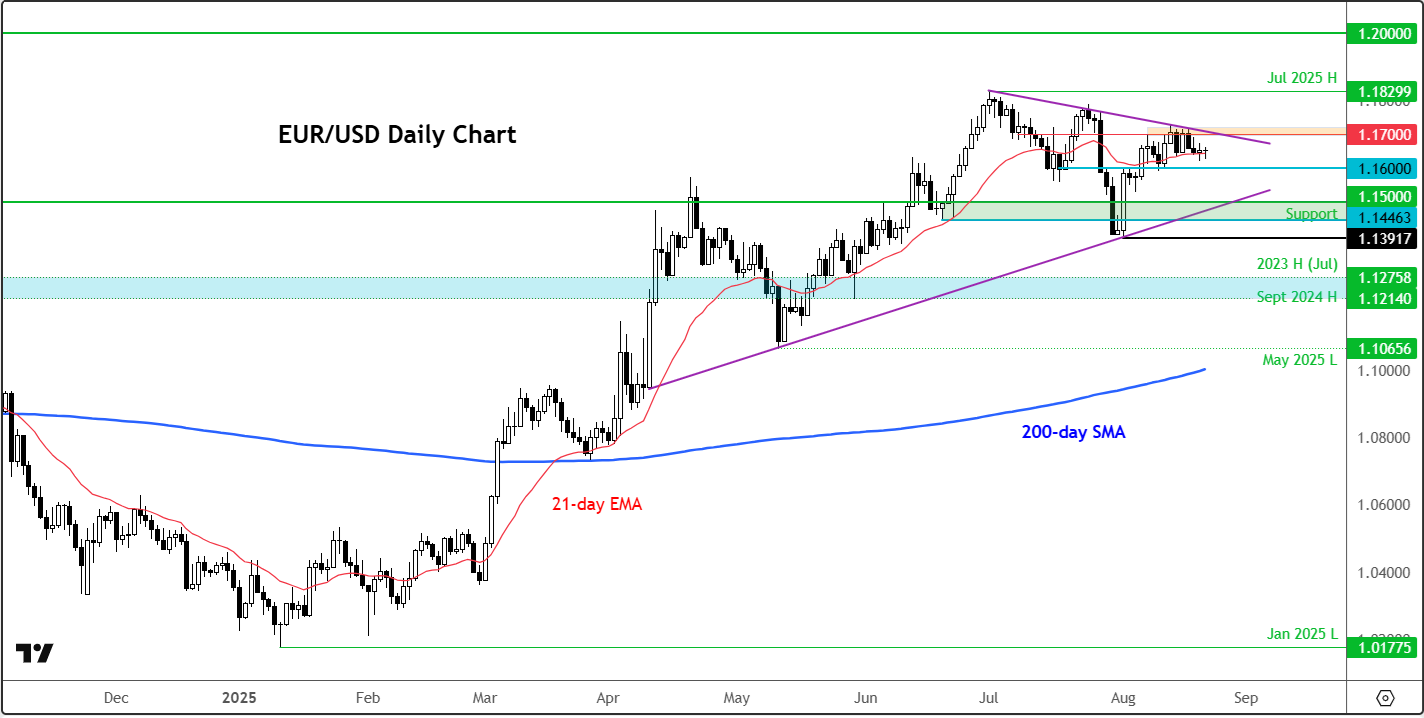
The recent consolidation in the EUR/USD chart should not be mistaken for weakness. Price action remains clustered near the resistance of a triangle pattern, with the pair holding above its 21-day EMA. Support lies around 1.1600 and then 1.1500, a critical level for near-term structure. On the topside, 1.1700 remains stubborn resistance; a break there would open the path towards July’s high of 1.1830, and ultimately a move into the 1.20 handle.
-- Written by Fawad Razaqzada, Market Analyst
Follow Fawad on Twitter @Trader_F_R