
Following the CPI-related drop yesterday, Nasdaq 100 futures have fallen further following a weak handover from Asian markets overnight. US stocks came under intense pressure after a hotter-than-expected inflation report revived bets on further Federal Reserve rate hikes and sent Treasury yields and the dollar higher. While both the dollar and yields subsequently dropped back to pre-CPI levels and more in the case of yields, the Nasdaq has failed to respond positively as concerns over AI trade remained. As things stand, more losses look increasingly likely in the near-term, especially with the major indices all created bearish reversal signs. Against this backdrop, and as before, we will maintain a cautious Nasdaq 100 forecast in the near-term.
We will discuss the macro factors influencing the markets later but first let me draw your attention to the chart of the Nasdaq 100, which has started to break lower.
Nasdaq 100 breaks trend line
A bullish trend line going back to March has now been taken out on the Nasdaq 100.
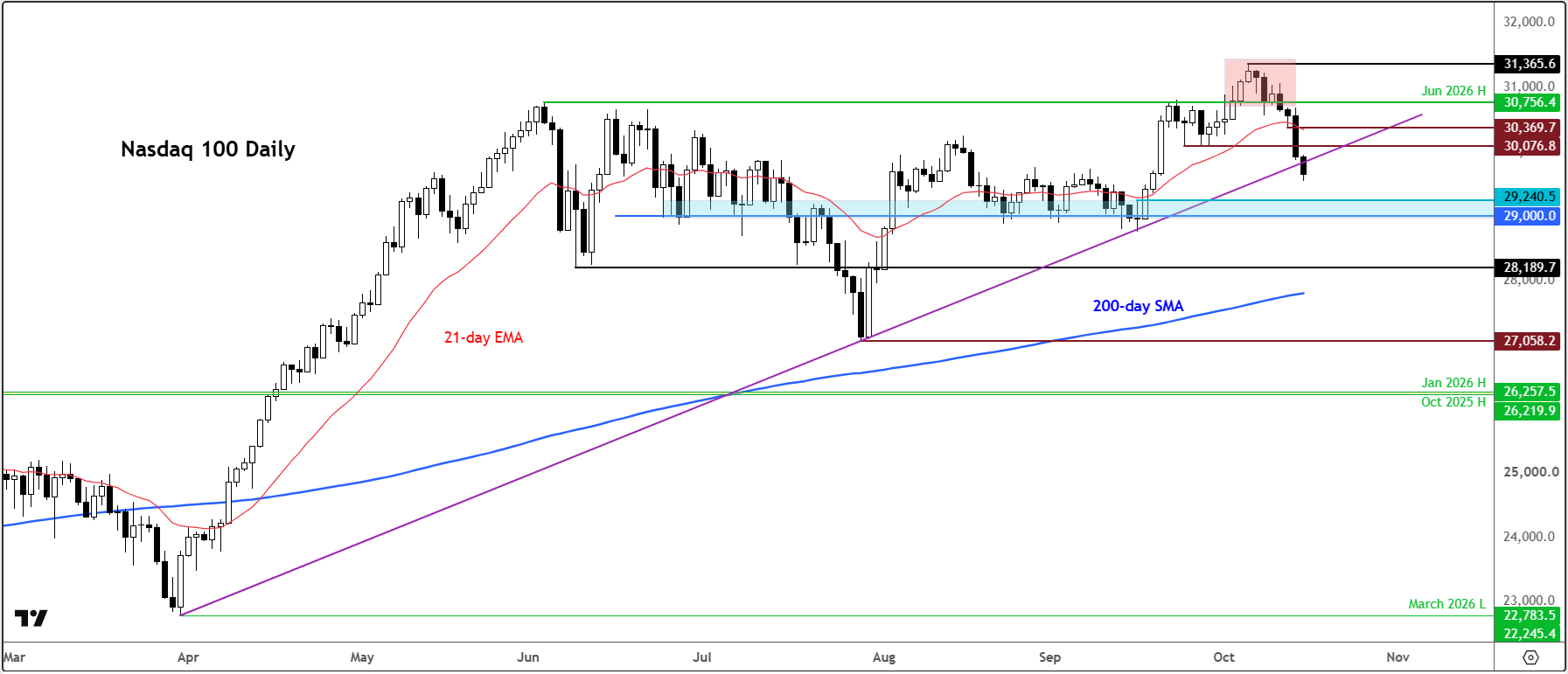
The above is our US Tech 100 daily chart, which is derived from the Nasdaq 100 futures. The index has been printing bearish price action after it failed to hold above the June's record high a few days ago.
Still, a daily close below this trend line is needed today to confirm the bearish reversal. Next key support is seen around 29,000-29,240, marking the base of the previous breakout. Below that, there is now much in the way of obvious near-term levels until perhaps 29,190. Meanwhile, key resistance is now seen between 30,000 to 30,370. Above that, the June high of 30,755 would come into focus next.
AI trade faces growing pressure
The latest sell-off in technology stocks looks increasingly like more than a reaction to higher bond yields. Investors appear to be questioning whether the enormous capital spending behind the AI boom can generate returns quickly enough to justify current valuations and rising financing costs.
That concern is becoming visible in credit markets, where the cost of insuring against default among US technology companies has reached record levels. The signal is particularly relevant for data-centre operators and other capital-intensive businesses whose investment cases depend heavily on future revenue growth.
The problem is that higher-for-longer interest rates make that future cash flow less valuable today. Hotter-than-expected US inflation has therefore added more pressure, raising the hurdle rate for an investment cycle that already requires vast amounts of capital.
Nasdaq 100 forecast: Good AI news is no longer enough
The reaction to TSMC’s latest outlook is telling. The chipmaker delivered an exceptionally strong revenue forecast, yet the news failed to lift the broader technology sector. Ordinarily, such developments would reinforce the bullish AI narrative. Instead, the market largely looked through them.
That suggests the debate is shifting from how big AI can become to how profitable the investment cycle will ultimately be. Strong demand for chips is one thing; generating adequate returns on the infrastructure being built around that demand is another.
The weakness has been particularly pronounced in Asia, where the tech-heavy KOSPI suffered a sharp sell-off and triggered circuit breakers after falling as much as 8%. European technology stocks have also weakened, while Nasdaq 100 futures underperformed the Dow in early European trade, with the latter even posting a gain.
Bonds offer a revealing contrast
There is an important divergence elsewhere in markets. Treasuries have led a broader global bond rally as investors seek haven assets, pushing yields lower after the initial inflation-driven spike.
Yet lower yields have not been enough to revive technology stocks. If the sell-off were purely about interest rates, falling Treasury yields should provide some relief for long-duration growth stocks. The fact that they have continued to struggle points instead to growing concerns around valuation, leverage and the economics of the AI investment cycle itself.
Markets price a more hawkish Fed after the CPI surprise; PPI up next
Following Tuesday, hotter CPI data, the probability of an October rate hike has jumped to around 45%, from just 20% before the data, while a December hike is now priced at roughly 85%. Investors are also pricing at least three 25-basis-point hikes over the next 12 months.
That is considerably more hawkish than the Federal Reserve itself has been signalling. New York Fed President John Williams said he expects only one further rate hike this year and none in 2027. The problem for the Fed is that elevated oil prices and an US economy that is doing okay could keep upward pressure on inflation. If that continues, markets may have to price a more aggressive rate path, particularly with several Fed speakers still to come, including Chair Kevin Warsh.
Up next, we have PPI measure of inflation. This is due for release shortly and is expected to print +0.3% m/m on the core front and +0.6% on the headline front. Another hotter inflation reading could further exacerbate the Nasdaq 100 forecast.