
- Yen strength builds, but fiscal year-end flows muddy the signal
- USD/JPY prints key reversal after extended run higher
- GBP/JPY tests major trend support after sharp unwind
- EUR/JPY rolls over with bearish engulfing, momentum fading
Yen strength returns as intervention risk builds
USD/JPY has printed a clean key reversal after another extended push higher, aided by a series of hawkish policy remarks from leading Japanese policymakers. However, while the yen was the top performer on the session, the timing raises a question mark, arriving on March 30, a day before quarter-end and the end of Japan’s fiscal year, leaving open whether the move reflects a genuine shift in direction or is being distorted by calendar-driven flows. With energy prices still pushing higher and no clear end to the Iran conflict amid conflicting updates from both sides, it likely carries an asterisk for now until follow-through confirms the signal.
Atsushi Mimura, Japan’s top currency diplomat and the one who actually oversees FX intervention, kicked things off on Monday, warning authorities may need to take “decisive measures” if speculative moves persist, pointing specifically to increased activity in FX and crude markets. His choice of wording matters. It’s the first time he’s used it in the role, and it’s typically the last step in the playbook before intervention, at least based on his predecessors.
Then Japanese Finance Minister Satsuki Katayama reinforced Mimura's message later in the session, telling her G7 counterparts that Japan is watching markets with a “very high sense of urgency.” While she didn't convey publicly that Japan has been given a green light to intervene, it clearly signals she’s not comfortable with the pace of yen weakness.
Adding to yen tailwinds, BOJ Governor Kazuo Ueda explicitly linked weakness in the yen to the monetary policy outlook. He said the bank will closely monitor FX moves given their impact on growth and inflation, keeping the door open to rate hikes. That lines up with the BOJ paper released alongside his remarks, which flagged that yen weakness and higher oil may now feed more persistently into underlying inflation than in the past, with firms more willing to pass on costs to customers.
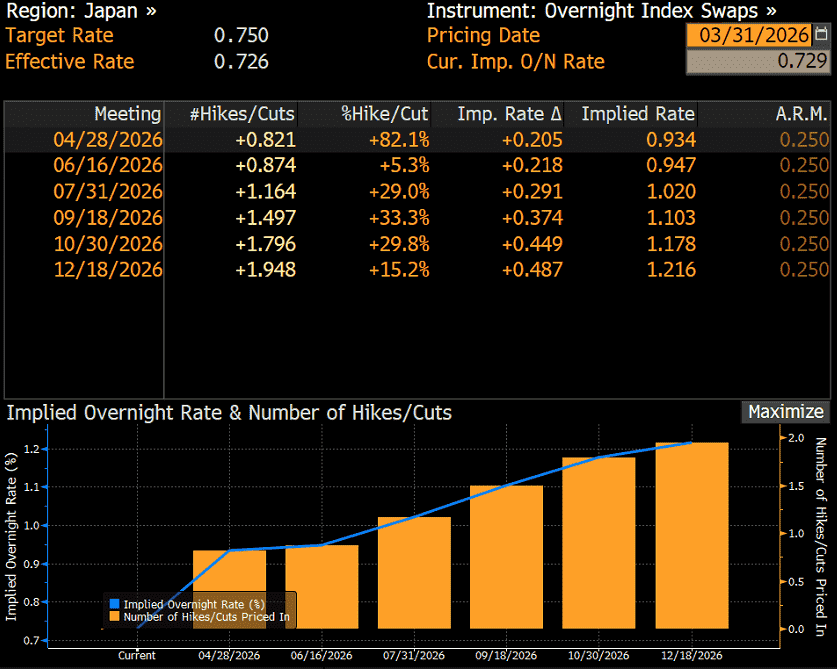
Source: Bloomberg
Markets reacted to the triple hit of hawkish commentary, lifting pricing for an April rate hike to 82%, up from roughly 68% prior to Ueda’s remarks. That helped drive yen outperformance during the session, aided by the intervention threat, and not just against the US dollar but also the euro and pound.
USD/JPY: Key reversal warns of shift in trend
Source: TradingView
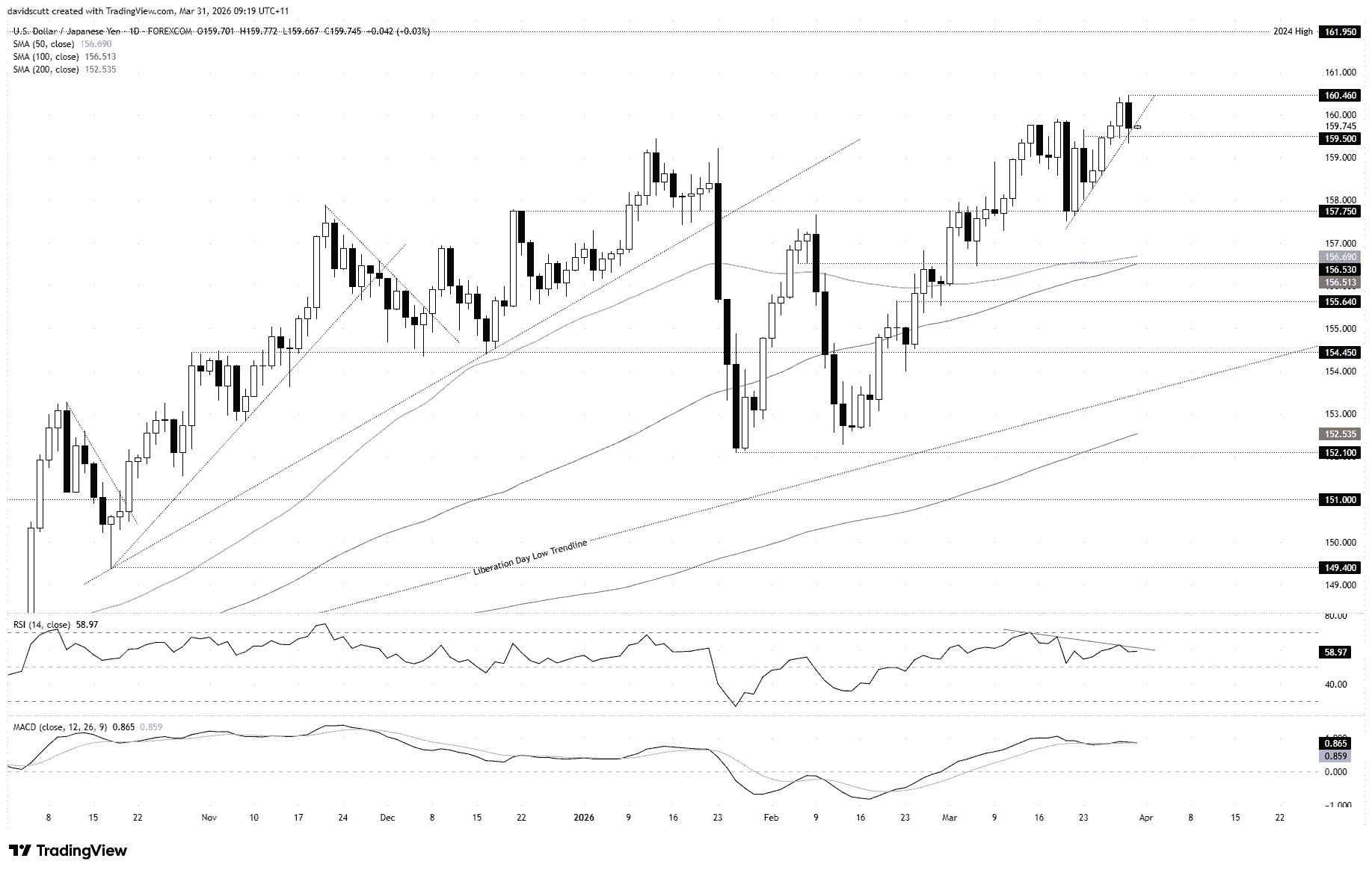
You can see the bearish key reversal as clear as day, with the price opening above Friday's close, setting a higher high, before closing beneath Friday's open after trading below Friday’s low earlier in the session. The move also saw the price break the minor uptrend that had been in place since the middle of March. It suggests downside risks are growing, but can it be trusted a day before the turn of Japan's fiscal year?
The message from the oscillators complements the signal, with RSI (14) diverging from the price in setting lower highs. MACD is also rolling and looks set to cross the signal line while remaining in positive territory, adding to the cautionary signals for bulls. But follow-up bearish price action over the coming days will likely be required to get more traders playing the pair from the short side.
159.50 is a level to watch given the price has tested it often over the past week but only crossed it sustainably once. If it were to be broken convincingly, 157.75 has also seen a lot of work either side of it in recent months. Should the signal prove false, levels overhead to monitor include Monday's high of 160.45 and the 2024 high of 161.95.
GBP/JPY: Major support under pressure
Source: TradingView
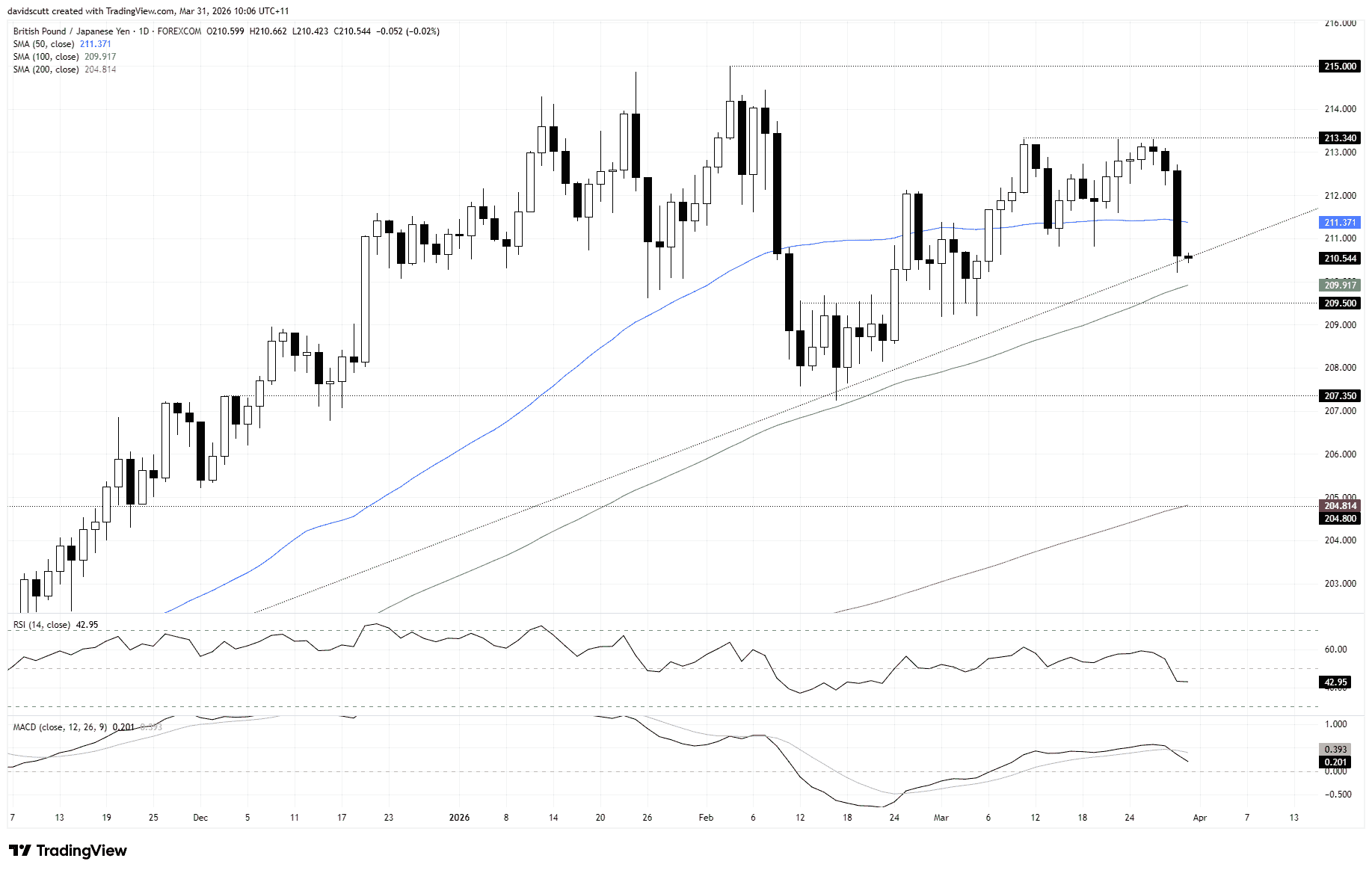
GBP/JPY finds itself testing a major support following its latest unwind, sitting right on the uptrend that’s been tested and held on multiple occasions since the Liberation Day tariff lows set in April last year.
Having tried and failed to break above resistance at 213.34 earlier in the month, we’ve seen a sizeable bearish unwind over the past two sessions, taking the price through the 50dma. The price action looks heavy, a view backed up by RSI (14) which has flipped beneath 50, breaking the uptrend that had been in place since early February. MACD has also crossed the signal line from above and is pushing sharply lower, providing another cautionary message for bulls without outright confirming the bearish signal.
If the Liberation Day uptrend were to be broken cleanly, downside levels to watch include the influential 100dma, where the price bounced from twice on the last two tests, along with 209.50 support and 207.35. If the uptrend holds again, the 50dma and 213.34 are the immediate levels overhead to focus on.
EUR/JPY: Bull run losing steam
Source: TradingView
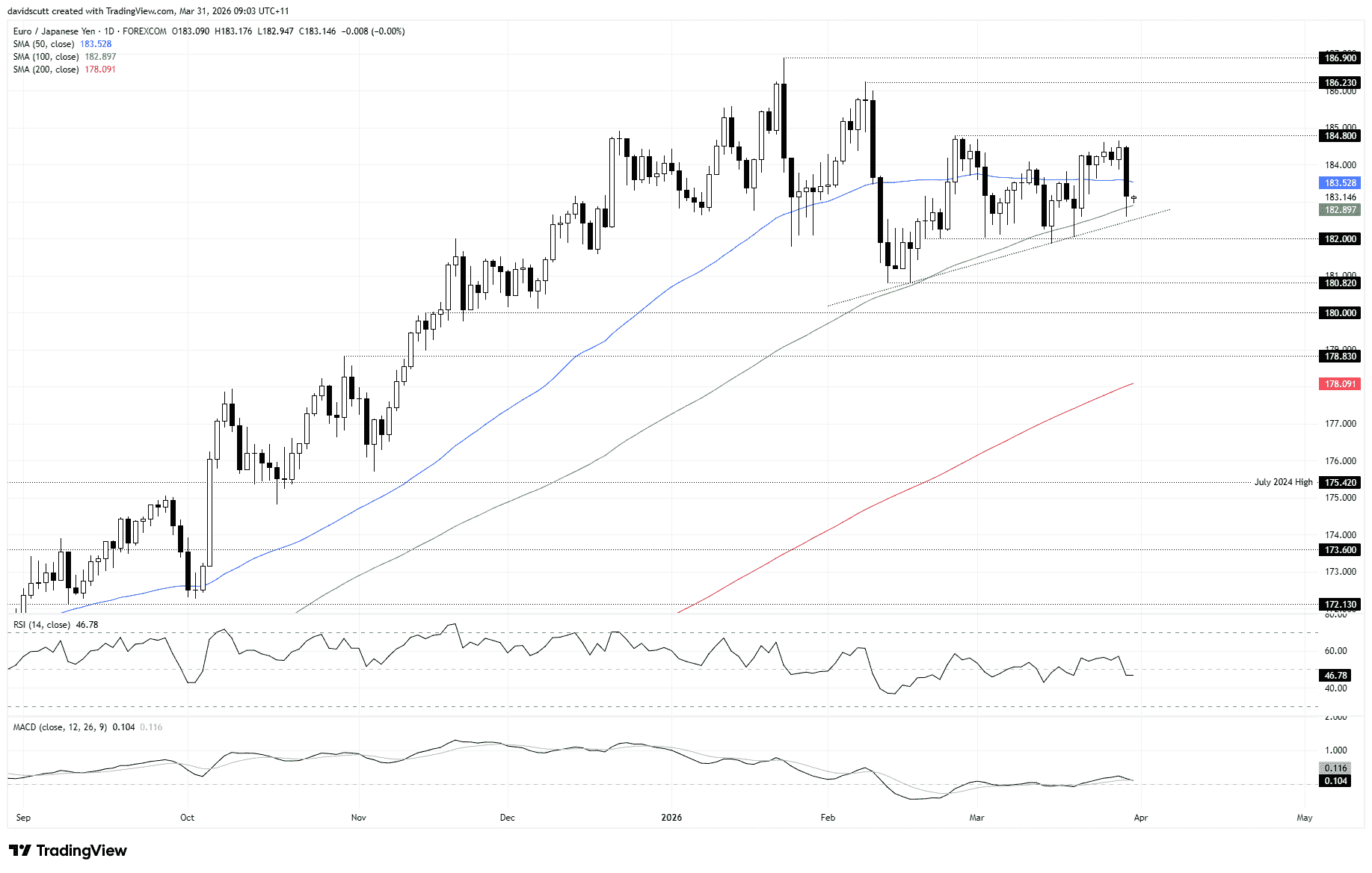
For EUR/JPY, we have a bearish engulfing candle on the daily, warning directional risks may be skewing lower after the pair struggled to even test the late February high of 184.80 over the past week. With a string of lower highs, and with the 50dma now starting to roll over, what’s been a spectacular bullish move over the past year is looking fairly tired.
RSI (14) and MACD are providing a complementary message, sitting around neutral levels without delivering a definitive momentum signal in either direction. Like with GBP/JPY, the 100dma is an important level located underneath where the pair trades, having held on Monday after being tested. Below, minor uptrend support running from the February lows is the other nearby level to watch, along with horizontal support at 182.00.
If those three levels were to be taken out, 180.82 and 180.00 loom as targets for shorts. Above the 100dma, levels overhead to consider for setups include the 50dma and 184.80. A break of the latter would snap the sequence of lower highs, tilting directional risks higher if it were to eventuate.
Calendar poses limited event risk
There is a raft of data out in Japan on Tuesday morning, including key Tokyo CPI for March. While it may pick up some of the increase in energy prices seen as a result of the Iran war, key second-round inflationary effects are unlikely to show up until April at the earliest. Unemployment and industrial production figures will also be released, although they’ve rarely moved the dial for yen pairs in the past.
In Europe, we’ll get a smattering of top-tier data, including flash inflation for March, although, as with Japan, the elements policymakers are really focused on are unlikely to be evident in this release.
In reality, the release most likely to move broader FX markets today is the US JOLTS report for February, given the Fed’s tendency to react more quickly to weakness in the labour market than to strong inflation prints.
More broadly, developments in the Middle East remain the key driver of market movements overall.