

The USD/CAD has posted two consecutive bullish sessions, with a short-term gain of around 0.5%, strengthened after comments from Federal Reserve Chairman Jerome Powell. Buying pressure has become more consistent, although still insufficient to establish a decisive path for the U.S. dollar. In this context, the market continues to show indecisive movements, without a clear short-term direction.

What Updates Has the Fed Provided?
Today, Powell highlighted that the central bank faces a delicate balance between persistent inflation and a weaker labor market, which has begun to show signs of slowdown in recent months.
He emphasized that the new cycle of rate cuts cannot progress too quickly, as this could reignite inflationary pressures. At the same time, he underscored that the Fed’s short-term goal is to sustain a recovery in employment.
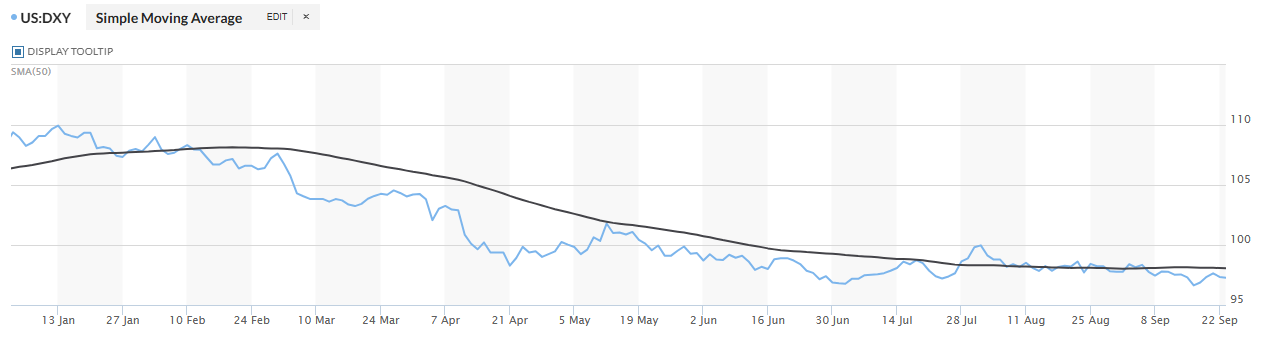
These remarks were interpreted as a signal that the Fed is not leaning toward overly aggressive cuts, which gave the U.S. dollar some temporary relief after trending lower for much of 2025. In fact, the DXY index, which measures the dollar’s strength against a basket of currencies, has halted its recent declines and is holding above 97 points, reflecting a degree of recovery in recent sessions.
Source: MarketWatch
As a result, this rebound in confidence in the dollar could cause the Canadian dollar to lose further ground in the short term. However, this appears to be a temporary development, particularly after last week’s rate decisions from both the Fed and the Bank of Canada. If the Fed continues with a cycle of steady rate cuts and the Bank of Canada does not confirm additional reductions this year, the selling pressure that previously characterized USD/CAD could return in the medium term, especially given that the pair has yet to establish a clear directional move.
New Plans for Canada?
On September 18, a meeting took place between the Canadian Prime Minister and the President of Mexico, where both countries agreed to deepen cooperation in trade and security ahead of the scheduled USMCA review in 2026. During the meeting, it was noted that Canada seeks to expand its bilateral trade with Mexico, which reached nearly $56 billion in 2024, with expectations of further growth in the coming years.
These initiatives are part of Canada’s broader strategy to diversify its economic policy, in response to the risk that trade relations with the U.S. could put pressure on its economy. At the same time, the government remains committed to its “Buy Canadian” policy, designed to boost domestic production and consumption as a way to mitigate potential risks to growth.
In this context, Canada’s current measures aim to diversify the economy and reduce its dependence on the U.S. If these efforts succeed, they could stabilize confidence in the Canadian dollar and enhance its attractiveness as an investment asset. In such a scenario, renewed selling pressure on USD/CAD could emerge, becoming a key factor for the pair’s movements in upcoming sessions.
USD/CAD Technical Forecast
Source: StoneX, Tradingview
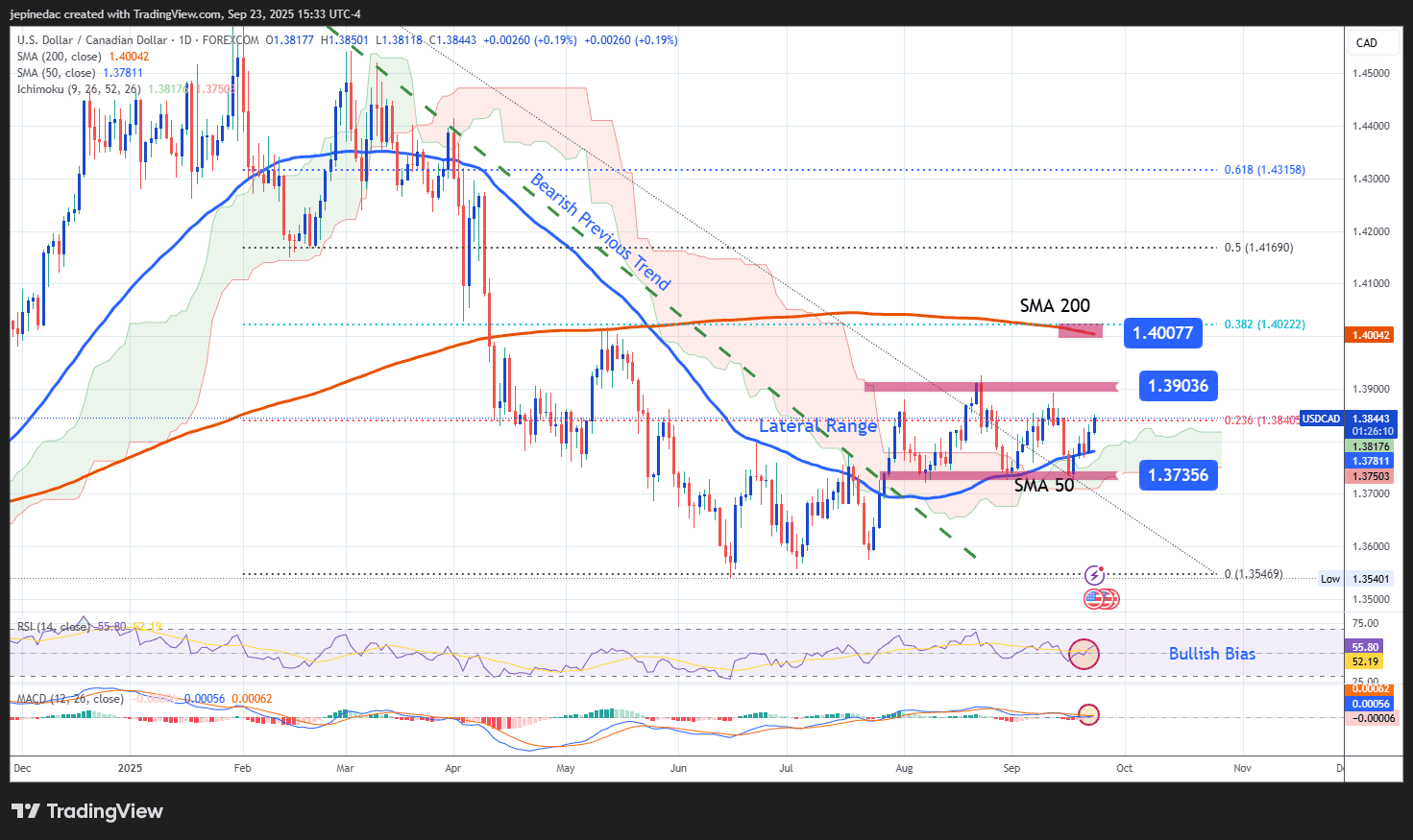
- Short-Term Sideways Range: Since late July, USD/CAD has been moving within a lateral channel, with resistance at 1.39036 and support at 1.37356. Recent moves have not been strong enough to break this formation, which remains the main technical reference in the short term. As long as the range holds, the market will likely continue in a state of indecision.
- RSI: The RSI line continues to rise above the neutral 50 level, indicating that buying momentum has gained strength in the average of the last 14 sessions. If this trend continues, it could reinforce a short-term bullish bias.
- MACD: The MACD histogram oscillates around the neutral zero line, signaling indecision in short-term moving averages. Unless a clearer direction emerges, the lateral range is likely to prevail.
Key Levels:
- 1.37356 – Crucial Support: Coincides with recent declines and the Ichimoku cloud. A break below could revive the bearish trend that was in place until recent weeks.
- 1.39036 – Immediate Resistance: Represents recent highs. A break above this level would trigger an exit from the lateral channel and open the door to a stronger bullish bias.
- 1.40077 – Key Resistance: Aligned with the 200-period simple moving average and the 38.2% Fibonacci retracement, this level is crucial to watch for potential bullish continuation. A sustained breakout above could confirm a stronger uptrend.
Written by Julian Pineda, CFA – Market Analyst
Follow him: @julianpineda25