




AUDJPY may be Ready for Next Leg Lower
Markets will get their first look at how Australian consumers feel about the US-China trade deal.
Share this:

Later, markets will get their first look at how Australian consumers feel about the US-China trade deal. What is good for China is good for Australia as the economies are inherently tied through China’s demand for Australian goods. The Westpac Consumer Confidence Change for January will be released with -0.4% expected vs -1.9% last. In addition, the Westpac Consumer Confidence Index will be released with and expectation of 94.7 vs 95.1 last. A reading of 92.8 in October 2019 tested lows not seen since 2015. It will be interesting to see if the US-China trade deal increased optimism or if the devastating wildfires will have taken a toll on consumer expectations.
Although not factored into the consumer confidence data for January, one must consider how markets will react to the ongoing Coronavirus, as a small number of cases have been discovered in different counties in Southeast Asia, 1 in Australia, and 1 in the US. The CDC in the United States said they expect to find more cases in the US.
If the consumer confidence data is worse and if the number of cases of Coronavirus continue to rise, what will be the impact on AUD/JPY? The Australian Dollar would likely selloff on bad data and the Japanese Yen will benefit from a flight to safety if more cases of Coronavirus are discovered.
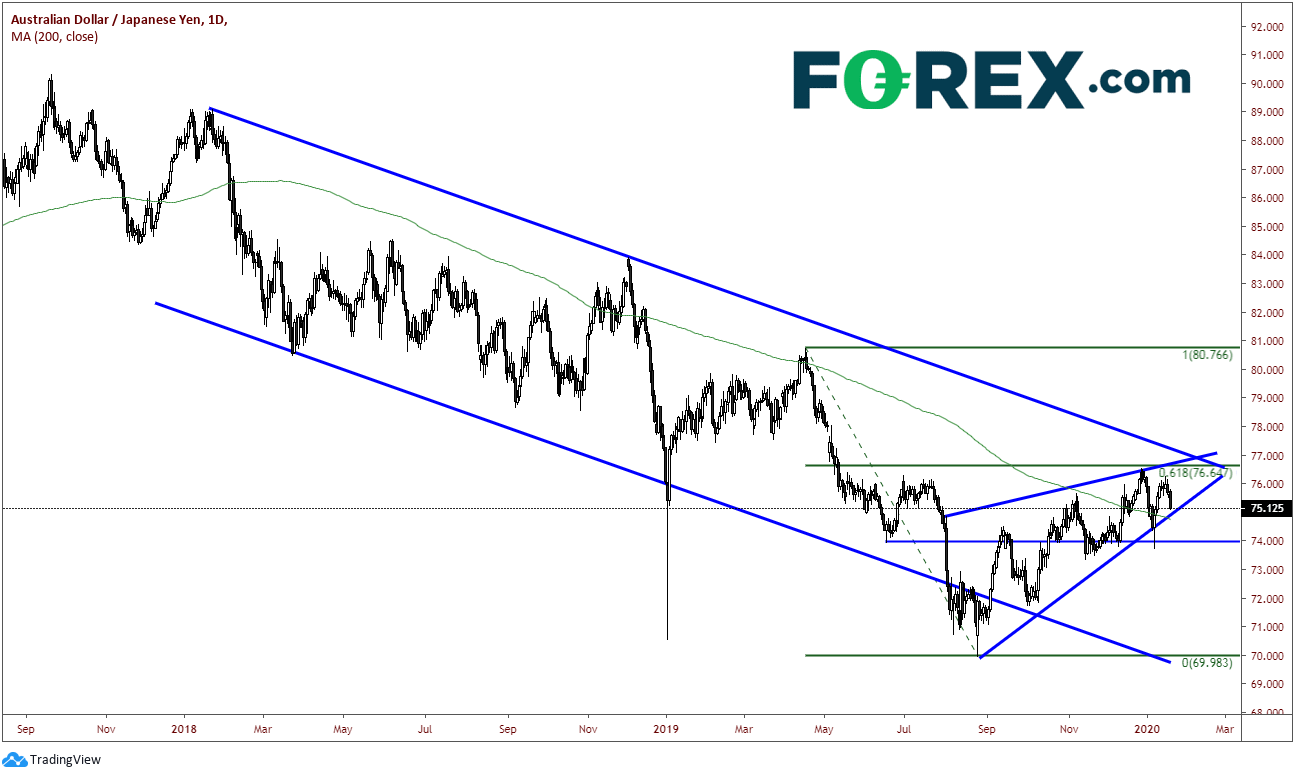
AUD/JPY has already been in a downward sloping channel since early 2018. In August 2019, there was a failed break lower out of the channel that has since formed a rising wedge (which is corrective) back to the top trendline of the channel near 76.65. In addition, this is the 61.8% Fibonacci retracement level of the from the highs in mid-April to the lows on August 23rd. The pair is already down .8% today and is forming a long bearish candle into the bottom trendline of the rising wedge near 75.00. The 200 Day Moving Average also comes across near 74.80.
Source: Tradingview, City Index
If AUD/JPY breaks through the 200 Day Moving Average, there is horizontal support near 74.00. However, the target for a rising wedge is a 100% retracement of the wedge, which can be considered the next level of support down near 70.00. There is a confluence of resistance near the 76.65/77.00 area, which is the previously mentioned 61.8% retracement level, the top trendline of the downward sloping LT channel, and the upper trendline of the rising wedge.
Note that on Thursday Australia will release December Employment data. Expectations are for +16,000 vs a strong print of +39,900 last. This has potential to add more downside risk if the data is weak. If the wedge doesn’t break on the consumer confidence data or the coronavirus news, it may break on the Employment Change.
Later, markets will get their first look at how Australian consumers feel about the US-China trade deal. What is good for China is good for Australia as the economies are inherently tied through China’s demand for Australian goods. The Westpac Consumer Confidence Change for January will be released with -0.4% expected vs -1.9% last. In addition, the Westpac Consumer Confidence Index will be released with and expectation of 94.7 vs 95.1 last. A reading of 92.8 in October 2019 tested lows not seen since 2015. It will be interesting to see if the US-China trade deal increased optimism or if the devastating wildfires will have taken a toll on consumer expectations.
Although not factored into the consumer confidence data for January, one must consider how markets will react to the ongoing Coronavirus, as a small number of cases have been discovered in different counties in Southeast Asia, 1 in Australia, and 1 in the US. The CDC in the United States said they expect to find more cases in the US.
If the consumer confidence data is worse and if the number of cases of Coronavirus continue to rise, what will be the impact on AUD/JPY? The Australian Dollar would likely selloff on bad data and the Japanese Yen will benefit from a flight to safety if more cases of Coronavirus are discovered.
AUD/JPY has already been in a downward sloping channel since early 2018. In August 2019, there was a failed break lower out of the channel that has since formed a rising wedge (which is corrective) back to the top trendline of the channel near 76.65. In addition, this is the 61.8% Fibonacci retracement level of the from the highs in mid-April to the lows on August 23rd. The pair is already down .8% today and is forming a long bearish candle into the bottom trendline of the rising wedge near 75.00. The 200 Day Moving Average also comes across near 74.80.
Source: Tradingview, FOREX.com
If AUD/JPY breaks through the 200 Day Moving Average, there is horizontal support near 74.00. However, the target for a rising wedge is a 100% retracement of the wedge, which can be considered the next level of support down near 70.00. There is a confluence of resistance near the 76.65/77.00 area, which is the previously mentioned 61.8% retracement level, the top trendline of the downward sloping LT channel, and the upper trendline of the rising wedge.
Note that on Thursday Australia will release December Employment data. Expectations are for +16,000 vs a strong print of +39,900 last. This has potential to add more downside risk if the data is weak. If the wedge doesn’t break on the consumer confidence data or the coronavirus news, it may break on the Employment Change.
Latest market news




The complete CFD trading experience
Award-winning platforms, competitive spreads, low commissions and dedicated support.
We live and breathe the markets and are dedicated to helping traders realise their ambitions as we continue to set the industry bar.
Economic calendar
Web Trader platform
Our sophisticated web-based platform is packed with features.
Related articles
EUR/USD Q4 2026 Outlook: Euro at a Crossroads as Fed, ECB Tighten 9 25 2026
EUR/USD enters Q4 at a pivotal inflection point as competing Fed-ECB policy paths and persistent inflation risks collide with major technical support.

USD/JPY Q4 2026 Outlook: Hawkish Fed Pricing Clashes With Intervention Risk
The year-end tug-of-war is clear: hawkish Fed pricing supports USD/JPY, while intervention risk limits the upside.


Japanese Yen Forecast: USD/JPY 4% Rally Challenges Post-Intervention Downtrend 9 24 2026
USD/JPY momentum has shifted sharply higher, putting a major resistance confluence in focus as U.S. and Japanese event risk builds.
StoneX Europe Ltd may make third party material available on this website which may contain information included but not limited to the conditions of financial markets. The material is for information purposes only and does not contain, and should not be construed as containing, investment advice and/or investment recommendation and/or an investment research and/or an offer of or solicitation for any transactions in financial instruments; any decision to enter into a specific transaction shall be made by the client following an assessment by him/her of their situation.
StoneX Europe Ltd makes no representation or warranty and assumes no liability as to the accuracy or completeness of the information provided, nor any loss arising from any investment based on a recommendation, forecast or other information supplied. You should always seek independent advice as to your suitability to speculate in any related markets and your ability to assume the associated risks, if you are at all unsure. We are not under any obligation to update any such material. Any opinion made may be personal to the author and may not reflect the opinion of StoneX Europe Ltd.