



Canadian Dollar Forecast: USD/CAD Highlights Indecision After Fed and BoC Comments
A consistent sense of neutrality has begun to dominate USD/CAD price action in the short term, as the latest session has shown only a marginal move of around 0.04%. This lack of clear direction comes after both the Federal Reserve and the Bank of Canada announced their respective interest rate decisions.
Share this:

A consistent sense of neutrality has begun to dominate USD/CAD price action in the short term, as the latest session has shown only a marginal move of around 0.04%. This lack of clear direction comes after both the Federal Reserve and the Bank of Canada announced their respective interest rate decisions.
For now, the outcome has not been strong enough to drive a clear directional move in the pair, mainly because both central banks are following similar monetary policy paths. In this context, this phase of indecision may continue to remain relevant in the coming trading sessions.


Central bank decisions take center stage
During today’s session, both the Federal Reserve and the Bank of Canada delivered their interest rate decisions, with outcomes largely in line with market expectations.
The Federal Reserve kept its rate unchanged within the 3.50%–3.75% range. In the post-meeting comments, Fed Chair Powell acknowledged that inflation has eased but is still not fully under control. He also emphasized that the Fed remains data-dependent and does not follow a fixed path, reinforcing the idea of a restrictive monetary policy for longer.
This has already been reflected in market expectations. According to CME Group data, there is a consistent outlook that no significant changes in rates are expected for several months. Currently, there is over a 90% probability that rates will remain unchanged at least until October 2026, with more than a 40% chance that this scenario could extend into October 2027.
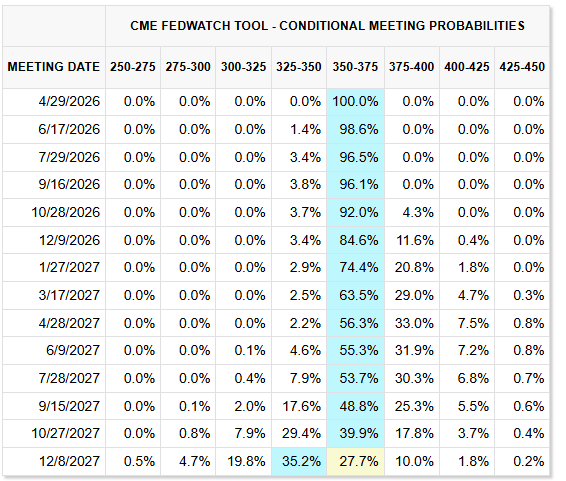
Source: CMEGROUP
On the Bank of Canada side, the picture is similar. The central bank held its policy rate at 2.25% and, in its comments, highlighted ongoing inflation risks, indicating no clear commitment to rate cuts in the short term. This reinforces the expectation of rate stability in upcoming decisions.
The key takeaway from these central bank events is that, rather than creating surprises, they have reinforced the neutral tone in USD/CAD, as both institutions are maintaining a similar policy stance.
However, an important development has been the recovery in bond yields across both economies. In the United States, 10-year Treasury yields continue to show a strong upward trend, moving above the 4.4% level, while Canadian yields have also risen toward the 3.6% area. This reflects how expectations of stable rates are supporting the bond market in both regions.
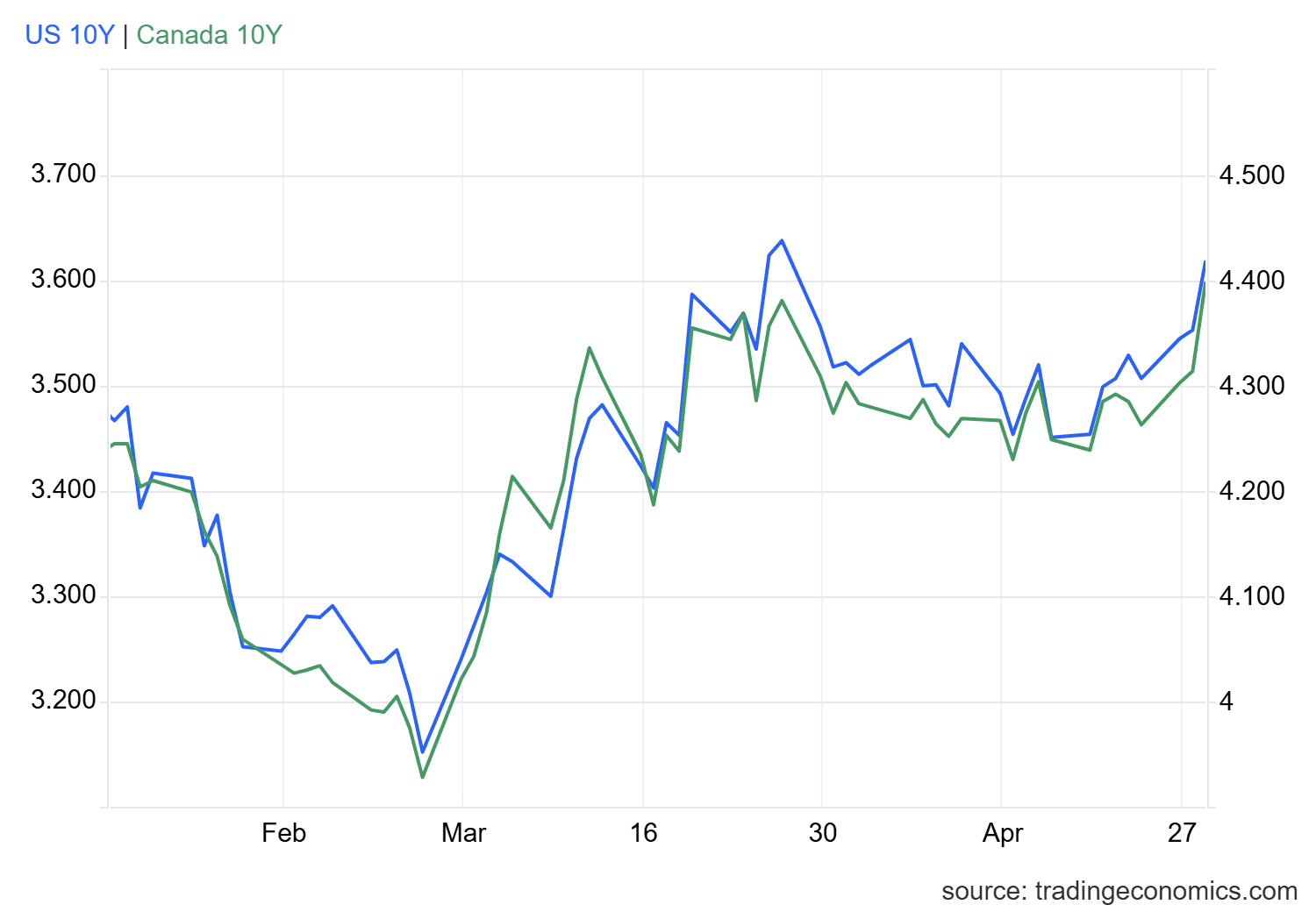
Source: TradingEconomics
That said, the key factor for the longer-term outlook remains the interest rate differential. Despite the recovery in yields in both markets, a notable gap persists between the 4.4% yield in the US and the 3.6% yield in Canada.
This differential could continue to favor US dollar-denominated assets, as they offer higher relative returns. As a result, capital flows may continue to favor the US dollar over the Canadian dollar, limiting the CAD’s ability to strengthen in a sustained manner.
If this dynamic persists, it could make it more difficult for the Canadian dollar to appreciate consistently, thereby limiting the continuation of a sustained bearish trend in USD/CAD in the coming weeks.
Technical outlook for USD/CAD
Source: StoneX, Tradingview
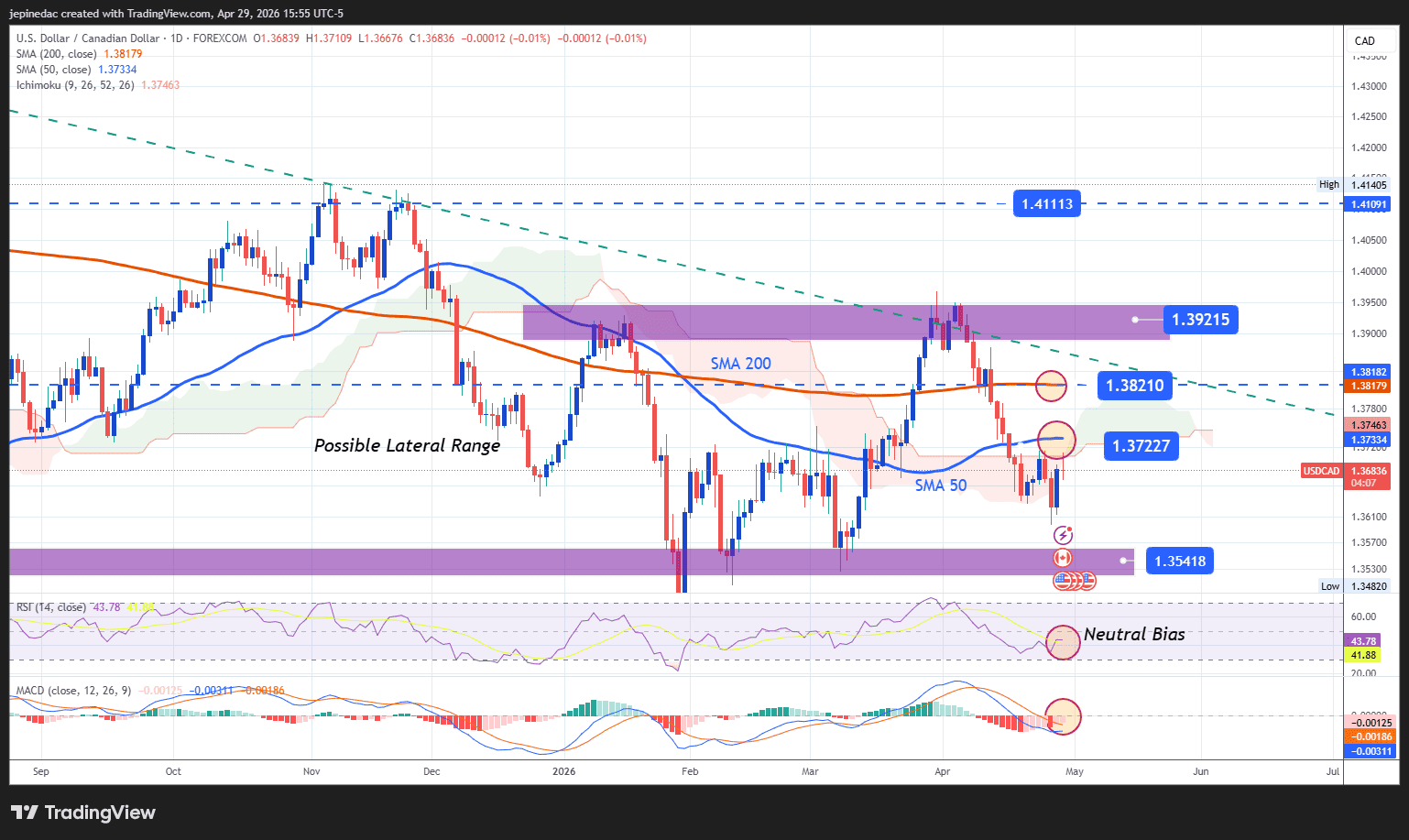
- A relevant neutral phase begins to emerge: Over the past several weeks, USD/CAD has failed to establish a clear directional trend on the daily chart, giving way to the formation of a potential sideways range. This range is defined by resistance near 1.39215 and support around 1.35418. If price action remains within these levels, a clear trend is unlikely to emerge, with the pair continuing to trade in a range-bound environment. In this sense, sideways behavior may remain the dominant structure in the short term, with price continuing to react to these key levels.
- RSI: The RSI continues to move closer to the 50 level, indicating a balance between buying and selling forces. This suggests that indecision could remain dominant in the coming sessions.
- MACD: The MACD shows a similar pattern, with the histogram approaching the zero line, reflecting a balance in short-term moving averages. This reinforces the likelihood that the current neutral phase may persist.
Key levels:
- 1.38210 – Key resistance: A level of recent highs aligned with the 200-period moving average. A strong break above this level could reinforce a consistent bullish bias, potentially challenging the current range structure and the long-term downtrend. This could pave the way for a more meaningful bullish structure in the coming weeks.
- 1.37227 – Near-term barrier: A neutral zone aligned with the 50-period moving average. Price action around this level could highlight ongoing market indecision and support the continuation of the current range-bound behavior.
- 1.35418 – Key support: A level corresponding to the 2026 lows and the main downside barrier. A break below this zone could reaffirm selling pressure and support the continuation of the long-term bearish trend as the dominant technical structure in the coming weeks.
Written by Julian Pineda, CFA, CMT – Market Analyst
Follow him on: @julianpineda25



The complete CFD trading experience
Award-winning platforms, competitive spreads, low commissions and dedicated support.
We live and breathe the markets and are dedicated to helping traders realise their ambitions as we continue to set the industry bar.
Economic calendar
Web Trader platform
Our sophisticated web-based platform is packed with features.
Related articles

USD/JPY Weekly Outlook: Yen Carry Unwind Risks Flash Red
A historic Nasdaq 100 selloff has revived fears of a disorderly yen carry trade unwind. Yet futures positioning, options pricing and Thanksgiving seasonality suggest the biggest threat to USD/JPY could come from the Fed itself.


S&P 500 Analysis: SPX Is Going Through One of Its Most Difficult Periods of 2026
Confidence around the U.S. equity market continues to face significant pressure. Over the last three trading sessions alone, the S&P 500 has fallen nearly 3.3%, highlighting a bearish bias that has become increasingly evident across the broader market.

Bitcoin's Bigger Problem Isn't AI
Bitcoin, semis and even gold are getting hammered. Our research suggests an overlooked macro force may help explain why, with Bitcoin now approaching a major support zone.
StoneX Europe Ltd may make third party material available on this website which may contain information included but not limited to the conditions of financial markets. The material is for information purposes only and does not contain, and should not be construed as containing, investment advice and/or investment recommendation and/or an investment research and/or an offer of or solicitation for any transactions in financial instruments; any decision to enter into a specific transaction shall be made by the client following an assessment by him/her of their situation.
StoneX Europe Ltd makes no representation or warranty and assumes no liability as to the accuracy or completeness of the information provided, nor any loss arising from any investment based on a recommendation, forecast or other information supplied. You should always seek independent advice as to your suitability to speculate in any related markets and your ability to assume the associated risks, if you are at all unsure. We are not under any obligation to update any such material. Any opinion made may be personal to the author and may not reflect the opinion of StoneX Europe Ltd.