





EUR/USD Analysis: The Euro Maintains a Neutral Bias Ahead of Jackson Hole
The EUR/USD has recorded a modest variation of just 0.5% over the past three trading sessions and has started to show a consistent neutral bias as the Jackson Hole symposium approaches.
Share this:

The EUR/USD has recorded a modest variation of just 0.5% over the past three trading sessions and has started to show a consistent neutral bias as the Jackson Hole symposium approaches. For now, the market remains in a state of steady neutrality, as investors cautiously await fresh signals on central bank dynamics in the short term following this important gathering. As long as monetary policy remains the key driver, it is likely that neutrality will continue to dominate the pair’s movements until central bank leaders’ remarks provide clarity on the path of interest rates.
What to Expect from Jackson Hole?
The Jackson Hole Economic Policy Symposium will take place from August 21 to 23 this year and, as always, will be a crucial event for anticipating the monetary policy outlook from both the Federal Reserve and the European Central Bank in the near term. This year’s discussions are expected to focus on the evolution of global employment trends and economic productivity, in a context still shaped by ongoing trade tensions.
For the Federal Reserve, markets hold firm expectations that an interest rate cut will be confirmed, bringing the benchmark rate down to 4.25% from the current 4.5%. This would mark a reduction of 25 basis points, the first such cut since early 2025. However, uncertainty remains as to whether Jerome Powell will stress that inflation risks are still present. If he does, the start of a prolonged rate-cutting cycle could be delayed.
On the European Central Bank’s side, Christine Lagarde is expected to address the 2% inflation target and highlight the progress the eurozone has made in managing this challenge. Her remarks may suggest the continuation of current interest rates, signaling a more neutral stance for future policy decisions.
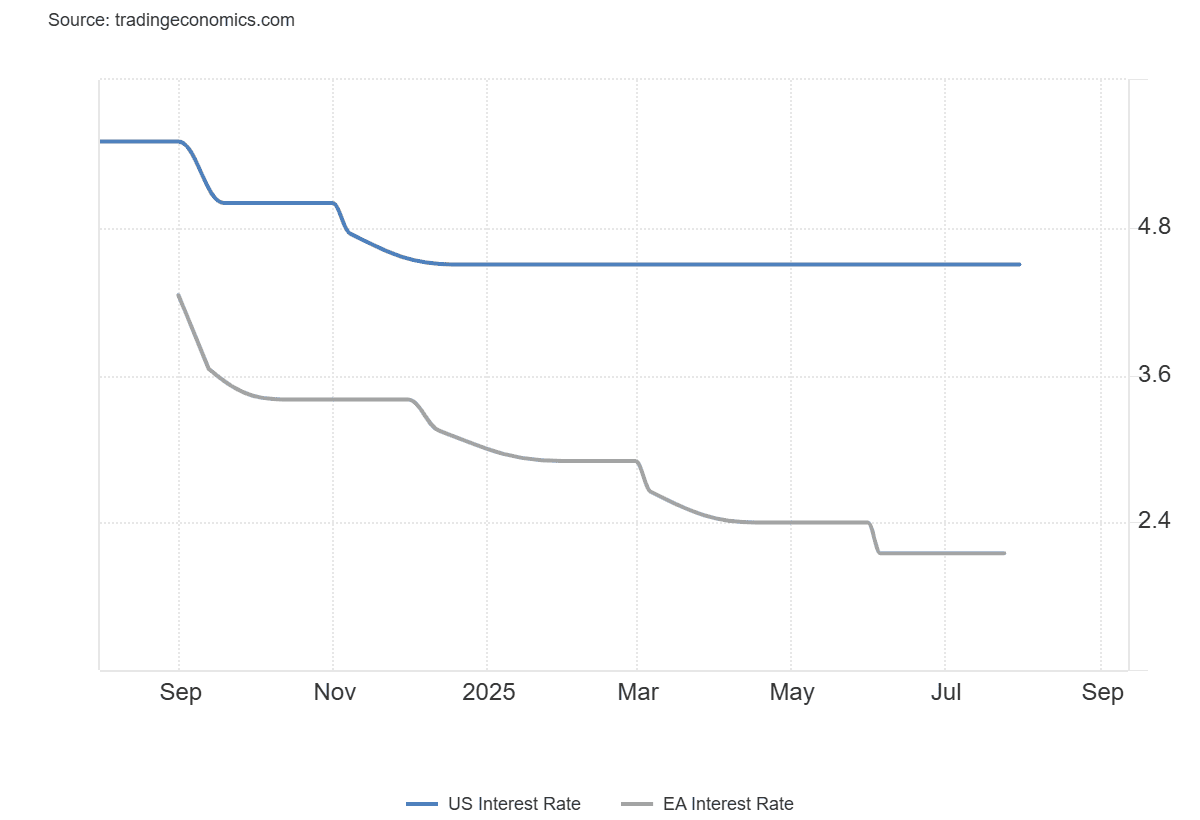
Against this backdrop, the interest rate differential remains decisive: while U.S. rates stand at 4.5%, Europe’s are at 2.15%, significantly lower. This gap has prevented the euro from consolidating a stronger upward trend against the dollar, as the higher U.S. yield continues to attract demand.
Source: TradingEconomics
Even so, the picture could shift after Jackson Hole. If the Fed confirms a more flexible stance and the ECB maintains a neutral tone, the rate differential could begin to narrow through the rest of 2025. Such a scenario would weaken the dollar’s advantage, allowing the euro to regain ground and potentially build a more sustained bullish pressure on EUR/USD in the short term.
Is the Dollar Struggling to Recover?
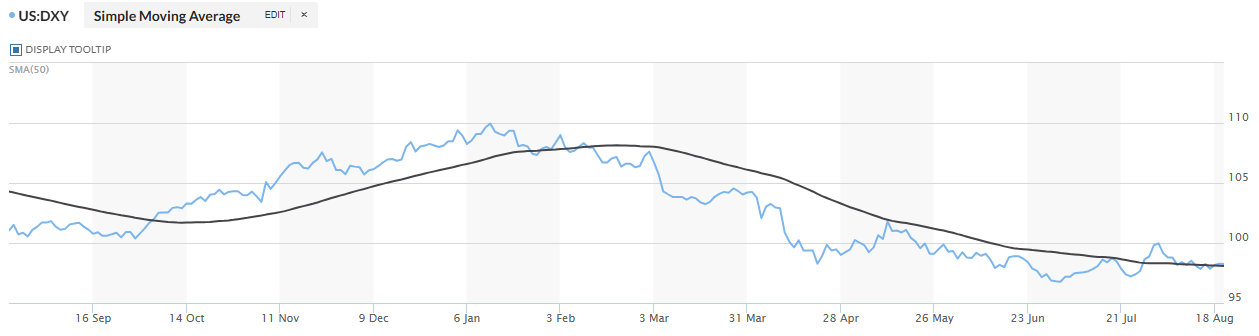
The U.S. dollar’s weakness remains evident, reflected in the performance of the DXY index, which tracks the greenback against a basket of currencies. The index has pulled back toward the 98-point area, extending a bearish correction that highlights the dollar’s inability to reclaim levels above 100 points.
Source: Marketwatch
This retreat is closely tied to expectations of a more flexible Fed in the near term. Should Powell reinforce this view at Jackson Hole, demand for the dollar could remain under pressure, giving the euro more room to advance and reinforcing a potential buying bias in EUR/USD.
EUR/USD Technical Outlook
Source: StoneX, Tradingview
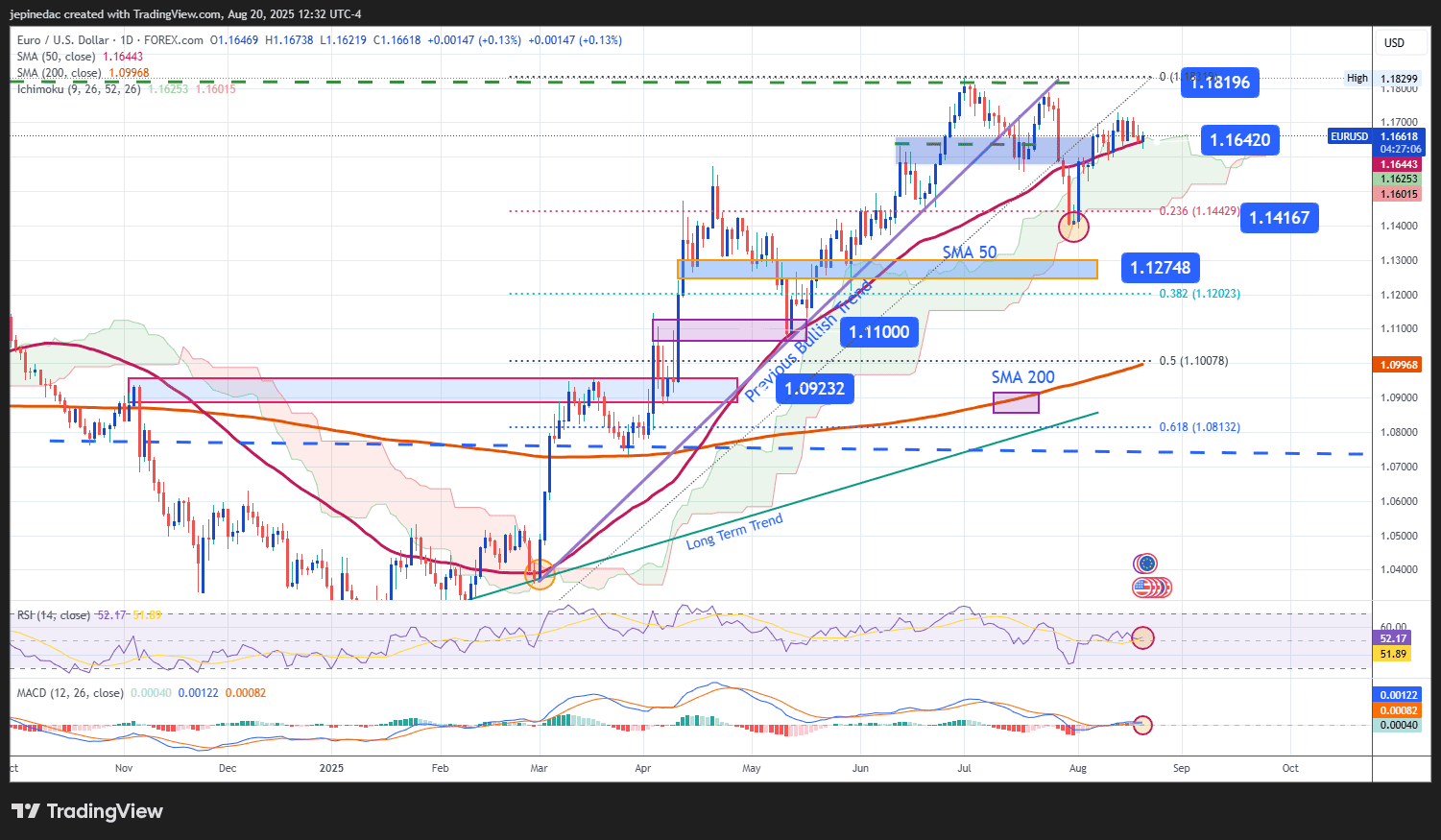
- The Uptrend Attempts a Comeback: After recent bearish corrections broke through the previous ascending trendline, the EUR/USD has begun showing signs of recovery. The pair is once again testing the year’s highs, though for now it holds a neutral stance. A stronger wave of buying pressure could allow the uptrend to regain control of the chart in the short term.
Technical Indicators:
- RSI: remains near the neutral 50 level, reflecting an equilibrium between buying and selling pressure over the last 14 sessions.
- MACD: the histogram is hovering close to the 0 line, confirming the lack of clear direction in short-term momentum.
Both indicators highlight the prevailing neutral sentiment ahead of this week’s key events. However, this calm could break, paving the way for a more decisive directional move in the coming sessions.
Key Levels:
- 1.18196 – Major Resistance: this corresponds to the year’s highs and represents the most critical barrier for buyers. A sustained breakout above this level could open the door to new highs and consolidate a stronger bullish phase.
- 1.16420 – Near-Term Support: aligned with the 50-day simple moving average, this level may serve as temporary support during corrections. Holding above this zone will be crucial to preserving the bullish bias.
- 1.14167– Critical Support: aligned with the 23.6% Fibonacci retracement, this level is the most significant from a support perspective. A drop toward this area could trigger a structural shift and pave the way for a more defined bearish trend.
Written by Julian Pineda, CFA – Market Analyst
Follow him: @julianpineda25



The complete CFD trading experience
Award-winning platforms, competitive spreads, low commissions and dedicated support.
We live and breathe the markets and are dedicated to helping traders realise their ambitions as we continue to set the industry bar.
Economic calendar
Web Trader platform
Our sophisticated web-based platform is packed with features.
Related articles

Gold Update: XAU/USD Remains Under Pressure Even After the NFP Report
As the trading week comes to an end, weakness around gold price action remains evident in the short term. This can be seen in the performance of the past two sessions, where the metal has declined by approximately 0.3%. Although the move has not been particularly aggressive, it highlights that buying pressure continues to struggle to regain control of the market.

USD Sets Fresh Yearly High as EUR/USD Drops Dramatically, USD/JPY Stable
Well, it was a week of USD strength that wasn’t entirely pushed by USD/JPY, as a strong sell-off in EUR/USD has pushed the major pair to its most oversold state in a decade.
EUR/USD forecast remains tilted lower with French bond troubles ahead of US jobs report
The EUR/USD has tagged a fresh year-to-date low as French public-finance concerns trigger a government bond sell-off. Today's US jobs report may change little, with resilient activity, elevated energy prices and hawkish Fed bets keeping the greenback supported. With the pair trapped below resistance at 1.1410, the risk to the near-term EUR/USD forecast is tilted to the downside.

StoneX Europe Ltd may make third party material available on this website which may contain information included but not limited to the conditions of financial markets. The material is for information purposes only and does not contain, and should not be construed as containing, investment advice and/or investment recommendation and/or an investment research and/or an offer of or solicitation for any transactions in financial instruments; any decision to enter into a specific transaction shall be made by the client following an assessment by him/her of their situation.
StoneX Europe Ltd makes no representation or warranty and assumes no liability as to the accuracy or completeness of the information provided, nor any loss arising from any investment based on a recommendation, forecast or other information supplied. You should always seek independent advice as to your suitability to speculate in any related markets and your ability to assume the associated risks, if you are at all unsure. We are not under any obligation to update any such material. Any opinion made may be personal to the author and may not reflect the opinion of StoneX Europe Ltd.