
- Cyclical assets driving recent Aussie and Kiwi strength
- US dollar and Treasury yield rebounds threaten gains
- Speculators heavily long AUD, short NZD, creating contrasting vulnerabilities
- AUD/USD looks heavy, NZD/USD breaks its minor uptrend
The Aussie and Kiwi have enjoyed decent bounces against the US dollar over recent days, benefiting from a recovery in risk appetite, China's latest data dump coming in marginally firmer than expected, and potentially a short-term rotation away from US tech and AI-linked stocks towards more cyclical and value-orientated areas of the market.
A reduction in hawkish Fed pricing and a decline in US Treasury yields, led by the back end of the curve, may have provided an additional tailwind, particularly for cyclical assets.
However, while both Antipodean currencies continued to rise against the greenback on Monday, the narrower US Dollar Index found its footing, helped in part by renewed concerns over France's fiscal outlook, while Treasury yields and US tech stocks pushed higher. Broader risk appetite remained firm, helping to sustain the gains, but an extension of those moves could create headwinds for both the Aussie and Kiwi today.
Cyclicals Lead the Way
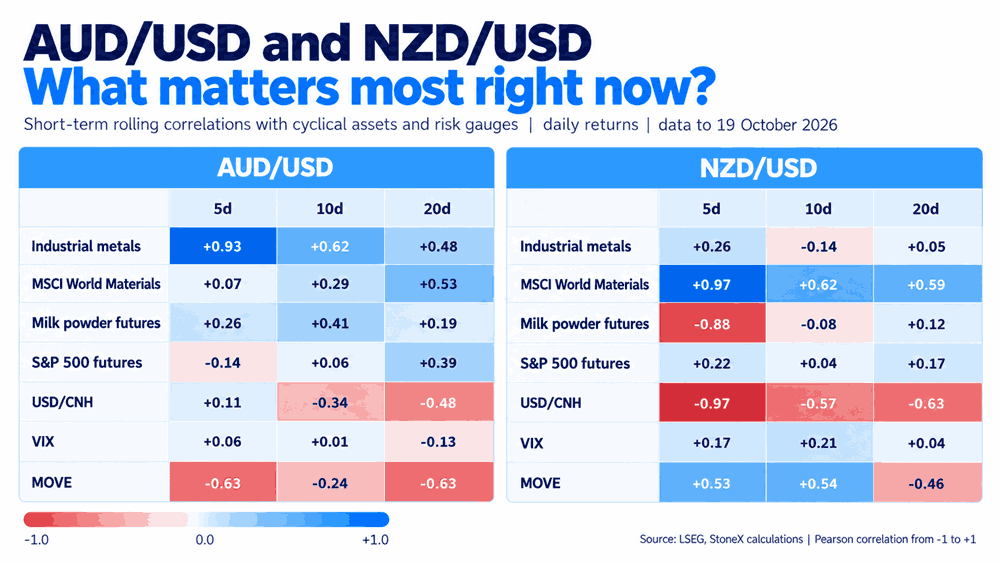
Source: LSEG
AUD/USD continues to track industrial metals prices closely, with correlations of +0.93 over five sessions and +0.62 over ten. NZD/USD, in contrast, has shown a stronger relationship with global materials equities and USD/CNH, with ten-session correlations of +0.62 and −0.57, respectively.
Interestingly, neither currency has shown much of a relationship with broader risk appetite, proxied here by S&P 500 futures, or volatility measures such as VIX futures and the MOVE index over the past ten sessions. Nor have interest rate differentials shown a particularly meaningful relationship over the near term, suggesting cyclical factors have been a more consistent influence on both currencies recently than broader risk appetite or relative interest rate movements.
Speculative Divide
Perhaps reflective of the Aussie's outperformance against the Kiwi for large portions of this year, positioning among speculative traders remains heavily skewed in the Aussie's favour, as seen in the graphic below showing the latest CFTC leveraged funds gross and net positioning.
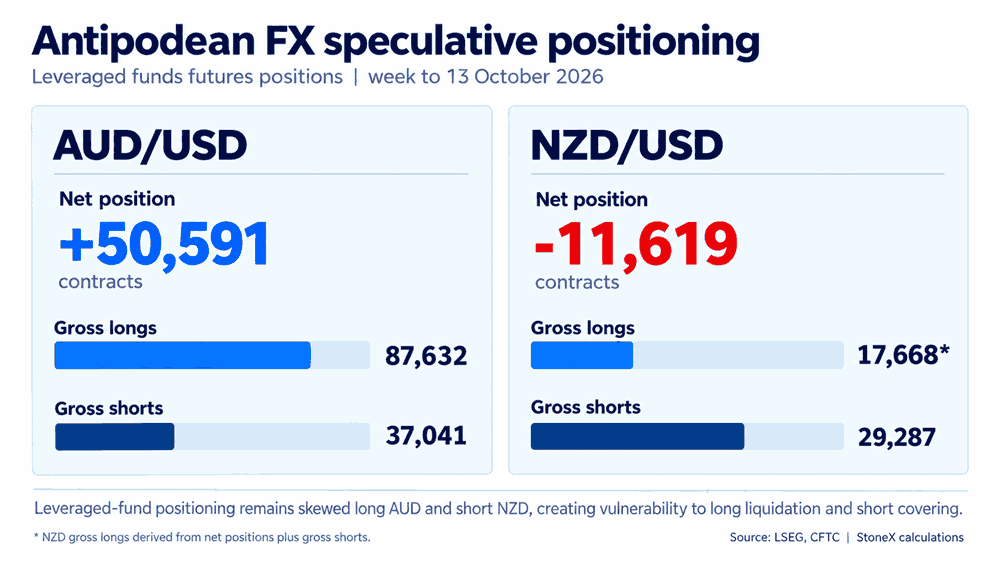
Source: LSEG
Leveraged funds hold 87,632 gross long AUD futures contracts against just 37,041 shorts, leaving them net long 50,591 contracts. It's almost the mirror image for the Kiwi, with 17,668 gross longs against 29,287 shorts, leaving speculative traders net short 11,619 contracts.
While this represents only one segment of the broader FX market, it gives a sense of how positioning may be skewed. With Aussie longs heavily outweighing shorts, there's potential vulnerability to long liquidation should sentiment deteriorate. For the Kiwi, the opposite applies, with short covering potentially providing support if the recovery continues.
Recent economic data may also explain why the Kiwi has started clawing back ground, with softer Australian labour market data last week seeing traders curtail expectations for further RBA tightening. A full 25 basis point hike is no longer priced by the end of next year.
In contrast, New Zealand's latest manufacturing and services PMIs suggest the economic recovery continues to build despite headwinds from elevated energy prices and persistent inflationary pressures, with markets continuing to price more than four full rate hikes by the second half of next year.
The divergence in economic performance may also be contributing to the shift in relative performance between the two currencies.
Aussie Looking Heavy
Source: TradingView
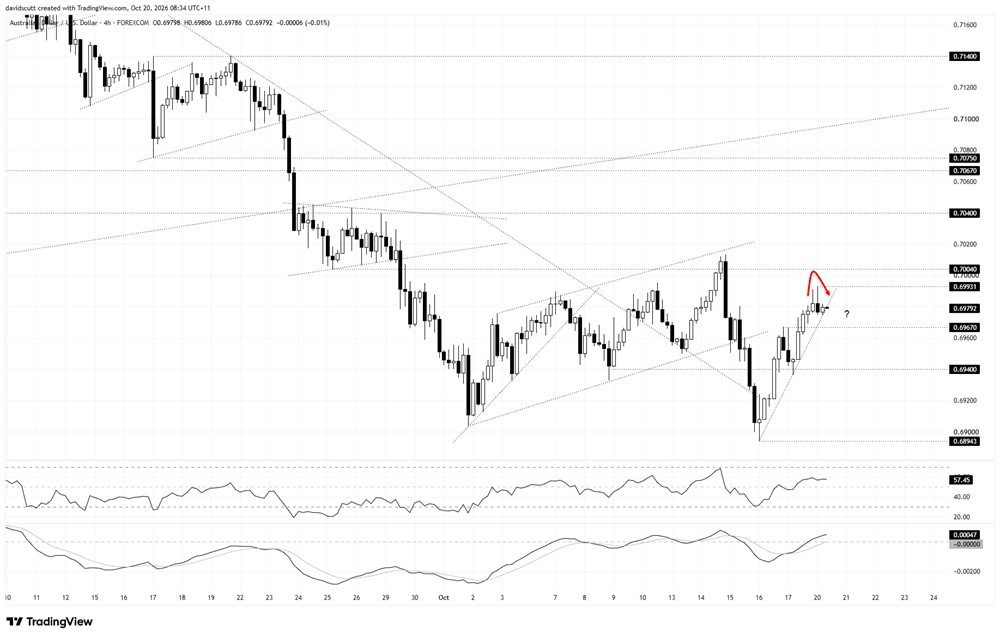
Having hit its lowest level since July last week, the latest Aussie bounce has seen the pair recover from just beneath 69 US cents to within a whisker of 70 cents on Monday.
However, looking at the four-hourly candles overnight, you can't help but notice the elongated upper wicks, resembling something akin to shooting stars. While we've yet to see follow-through selling, the pair is now resting right on the minor uptrend that's been in place from the recent lows, suggesting directional risk may be starting to skew to the downside.
RSI (14) remains above the neutral 50 level but has now flatlined, while MACD is beginning to converge towards its signal line, albeit in positive territory.
After a decent bounce, the price action looks heavy, putting downside levels such as 0.6967 and 0.6940 in focus in the near term.
Should the Aussie resume its advance, 0.69931 marks the level where the price stalled overnight, while 0.7004 has acted as both support and resistance over recent weeks. A break above 0.7015, the high set on October 14, would disrupt the sequence of lower highs and begin to skew directional risk higher again.
For now, though, the immediate price action suggests the bulls may have their work cut out extending the recovery.
Kiwi Losing Momentum
Source: TradingView
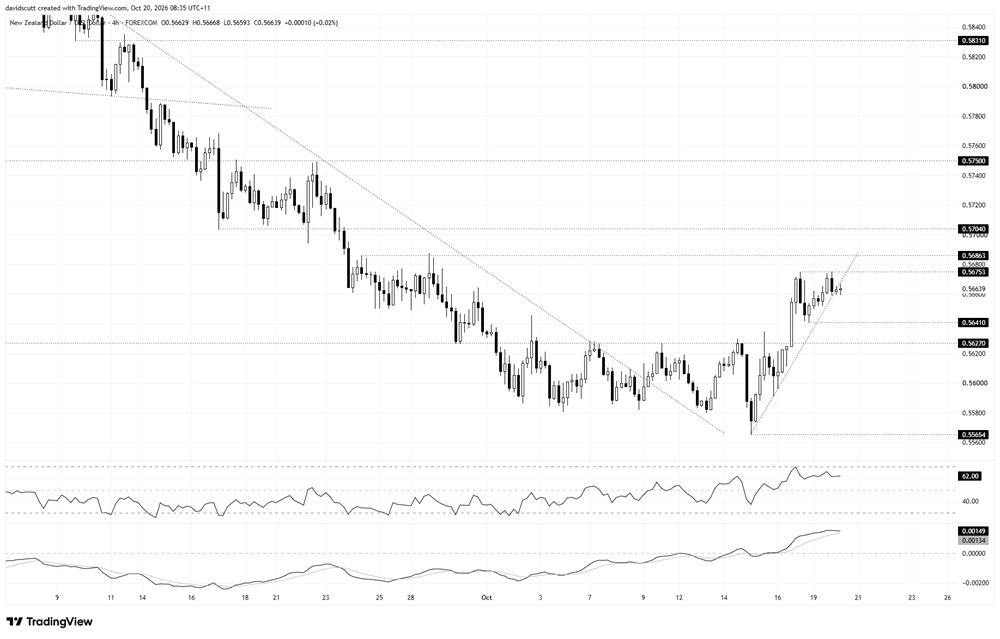
NZD/USD has followed a similar pattern to the Aussie, although the pair has already broken beneath the minor uptrend that had been in place from the lows set earlier this month. While that suggests directional risk may be shifting sideways to lower, overnight selling pressure was not as pronounced by comparison.
Looking at the last two four-hourly candles, bids have emerged around 0.5660, making that the immediate focal point for trade construction. On the downside, 0.5641 marks the low set late last week, with 0.5627 a more substantial support zone, having acted as resistance for a lengthy period earlier this month.
Overhead, 0.56753 marks the high set late last week, with 0.56863 and 0.5704 the next levels of note.
RSI (14) remains above the neutral 50 level but has yet to set a higher high, providing a cautionary message for bulls considering chasing further upside in the near term. That view is reinforced by MACD, which is now converging towards its signal line in positive territory, raising the possibility of a bearish crossover.
It's not an outright bearish message by any stretch, but it does put greater emphasis on how the price responds around these levels rather than holding a firm directional bias in the near term.