
EUR/USD, USD Talking Points:
- Last year the US Dollar ripped after the Fed started cutting rates in September, with a massive rally taking over in Q4.
- So far it’s been USD-strength since the rate cut last Wednesday and EUR/USD has opened the week with a test at an important spot on the chart, with a trendline, a Fibonacci level and prior resistance coming into play as support in an early-week bounce.
- The calendar is heavy with Fed-speak and this Friday brings the release of Core pCE, or the Fed’s preferred inflation gauge. I’ll be looking at setups around the USD in tomorrow’s webinar and you’re welcome to join. Click here to register.

Life would be much simpler if fundamentals had a perfectly direct impact on price. But that would avoid the important topic of competition in a market and it’s the very act of anticipation that can allow some market participants to develop an edge against others. And perhaps most importantly, its not data prints or rate decisions that create price movements – it’s buying and selling, supply and demand – and if everyone in a market that wants to be long already is, well, even the best news in the world will fail to drive prices-higher.
I get that this can sound discouraging. But if you think through it this can also be somewhat motivational, in that there’s something else behind the constant drive of price and it’s not going to be a perfect manifestation of what the headlines suggest that it should be.
Last year is great illustration of this fact. For pretty much all of 2024 and even going back to 2023, the Fed continued to tell markets that they wanted to cut rates. They did this via the dot plot matrix in their forecasts and it can probably even draw back to the regional banking crisis in 2023 when we can see the Fed leaning more dovish, even with inflation at very high levels. This is at least part of the reason why stocks spiked so aggressively that year, even with the Fed still in a hiking posture. Market participants were simply looking around the next corner, anticipating, and using those Fed forecasts as reasons to justify taking on more risk in equities.
Last September is when the rubber hit the road with the Fed finally cutting rates. But, at that point the US Dollar was already beaten down from a clear and decisive Q3 sell-off. The Fed even went for a ‘jumbo’ rate cut of 50 bps – even with inflation still well-elevated. And in their forecasts, they told markets that they wanted to cut more, which they did.
But for price that mattered little. The Greenback set a low on the date of that rate cut and then sellers were suddenly stalled. Much to the chagrin of the Fed, something similar happened with long rates as both the 10 and 30-year Treasury hit a low yield the day before the rate cut announcement, and only continued to jump through their Q4 cutting cycle.
This was the market anticipating, looking around the next corner, and expecting that a bank cutting rates while inflation was already elevated would lead to even more inflation down the road. So why would an investor want to hold a 10-year bond with a 3.6% yield if inflation was going to go up even more, eating away at that return? And to that point, if the Fed was going to stimulate markets even when their mandate suggests they shouldn’t, why wouldn’t they be in the very asset classes that the Fed likely wanted to see move-higher (stocks). So in turn the Fed’s rate cut boosted stock prices and capital flowed out of bonds (with lower prices and higher yields) and that theme ran through the end of the year.
This matters because the US Dollar rallied on this, as well. It mattered little that short-term overnight rates which are more pertinent to direct USD capital flows (considering rollover or swap) were going down. That move was already priced-in well ahead of the cut. And then as the Fed cut more the Dollar rallied along with US equities and higher Treasury yields.
As we came into 2025, it seemed there was nary a bear in sight; and parity calls for the Euro were aplenty. But that’s around the time that something else started to get priced in…
US Dollar Daily Price Chart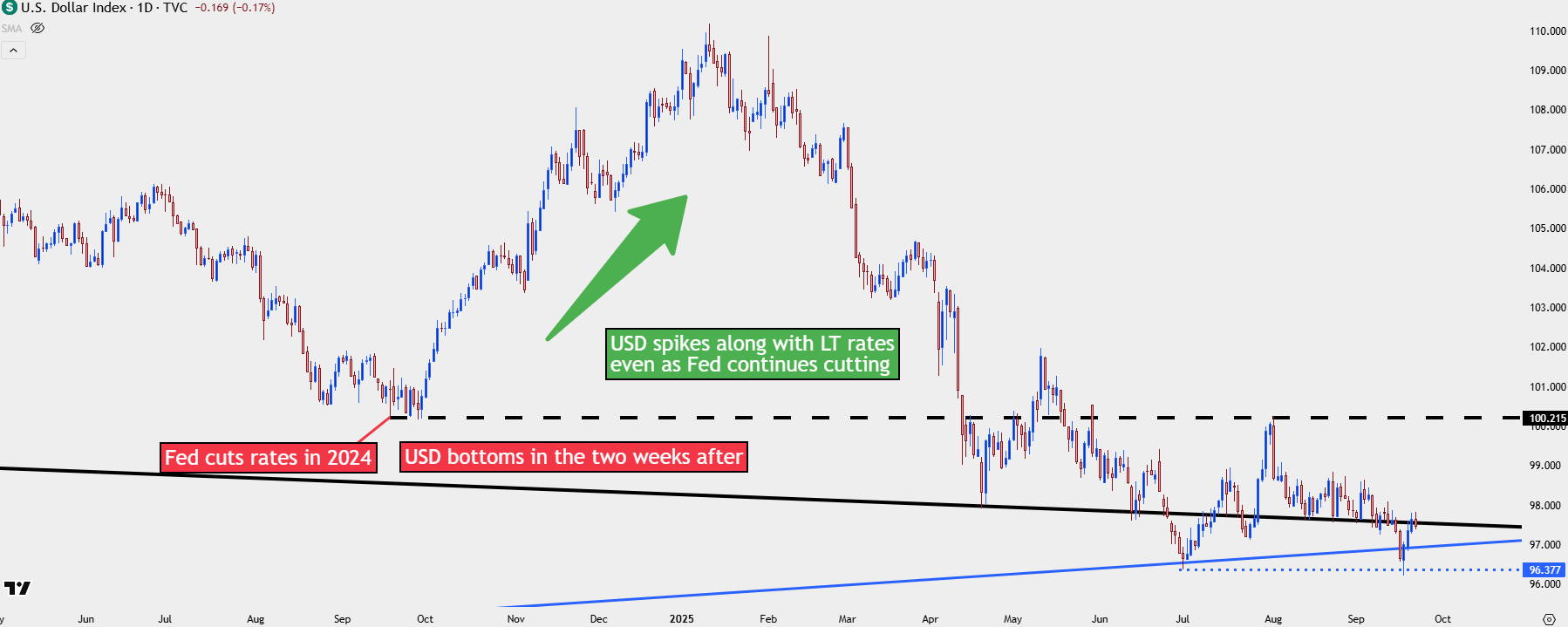
Chart prepared by James Stanley; data derived from Tradingview
At the 2025 open it seemed that EUR/USD bears were fully in-control. The pair hit a Fibonacci level a couple of weeks into the New Year and suddenly started to stall.
It wasn’t a clear reversal yet, however, as the topic of tariffs started to take-over the headlines. The month of February was largely back and forth for EUR/USD; but the pair did develop an ascending triangle formation, which is a bullish formation.
And then in March something entirely new started to get priced-in, and that was the prospect of recession in the United States which led to a deluge in the USD and, correspondingly, a strong breakout in EUR/USD.
This is the stage where normally markets start to do that anticipation thing again, looking for the Fed to respond to stress in the way that’s become commonplace since the GFC, with loose accommodation. This time, however, they seemed noticeably coy around the matter, instead saying that the prospect of tariffs meant that inflation might run higher, and they suddenly got prudent on the matter. Markets seemed to see through that, however, as the USD ramped higher and rate expectations continued to look for a cut.
Even through the July FOMC meeting, it seemed as though the Fed’s dual mandate wouldn’t allow for the bank to cut rates. But initial signs of weakness in the labor market finally allowed for the Fed to mold to market expectations, ultimately culminating in a cut last Wednesday. Even at that meeting, Powell said that it was a ‘risk management rate cut,’ as inflation remains high and the labor market, at least via the unemployment rate that the Fed follows in their forecasts, doesn’t look all too restrictive, which was the same thing that Powell said in July.
But perhaps the bigger question is whether we’re on the cusp of a redux of last year’s scenario, when the Fed’s rate cuts with high inflation simply Fed into longer-term inflation expectations, further bringing higher yields and a stronger USD.
The initial reaction, at least so far, has been even stronger for the Dollar than last year’s episode. But, the more important matter will be follow-through and this week is huge for that item.
In the USD’s largest component of EUR/USD, bulls are still holding on, and there’s a big support test going down right now as price has tested a bullish trendline that’s confluent with the 1.1748 Fibonacci level. So far, that’s held, and this keeps the door open for EUR/USD bulls and, in-turn, USD bears.
But there’s going to be a lot of motivation this week with numerous Fed-speak engagements, going along with the Friday release of Core PCE data.
EUR/USD Daily Price Chart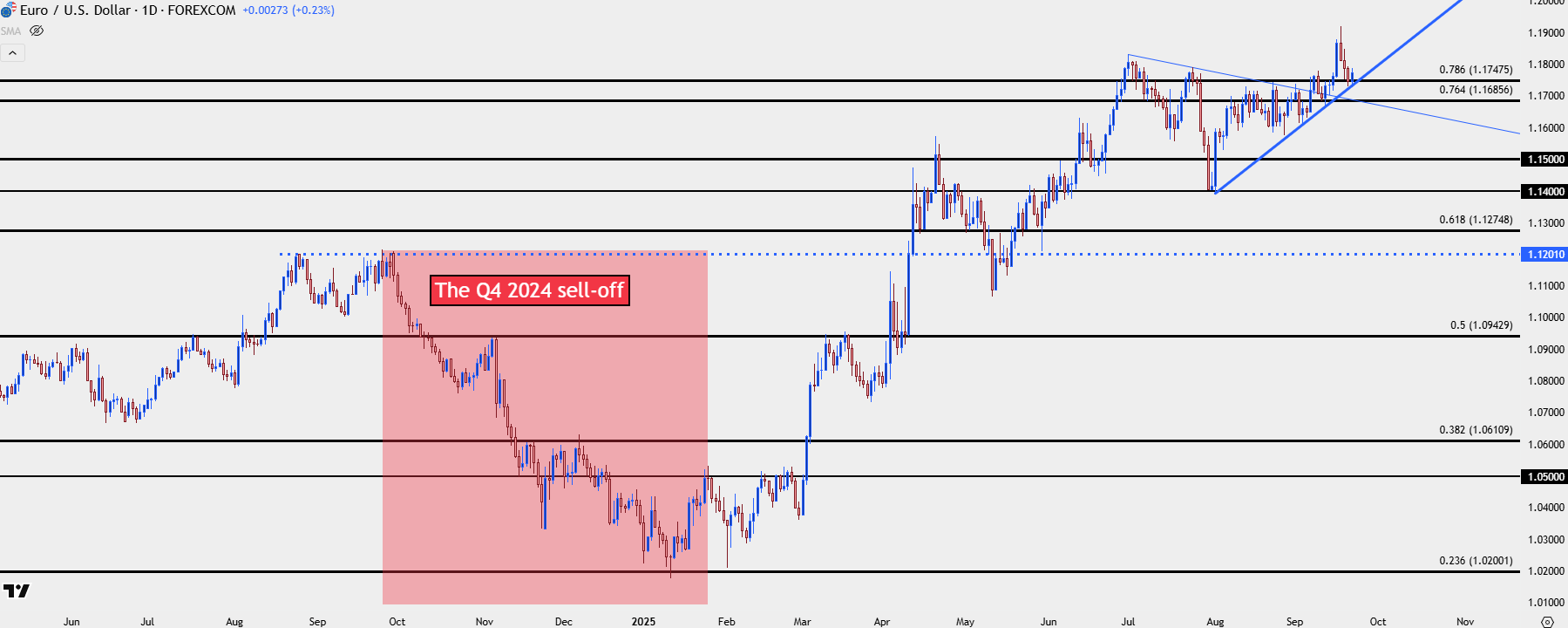
Chart prepared by James Stanley; data derived from Tradingview
--- written by James Stanley, Senior Strategist