



USD/CAD Forecast: Trade Risks Continue to Weigh on the Loonie
Over recent trading sessions, a growing sense of indecision has once again become evident around USD/CAD price action. For now, average movements over the last four trading sessions have failed to establish a clear directional bias, with daily fluctuations remaining close to 0.2%, a relatively modest figure compared to the moves above 0.6% observed last week
Share this:

Over recent trading sessions, a growing sense of indecision has once again become evident around USD/CAD price action. For now, average movements over the last four trading sessions have failed to establish a clear directional bias, with daily fluctuations remaining close to 0.2%, a relatively modest figure compared to the moves above 0.6% observed last week. This situation continues to reflect a cautious market environment, driven first by the evolution of the trade dispute between Canada and the United States and, second, by the recent behavior of bond markets in both countries. As long as these factors remain largely unchanged, they could continue supporting a phase of indecision around USD/CAD in the sessions ahead.

How Is the Tariff Situation Evolving?
Recent trading sessions have been particularly important for the ongoing trade dispute between Canada and the United States. A few hours ago, markets learned about a new escalation after the White House announced that certain Canadian products, including dairy products, motorcycles, and alcoholic beverages, will be subject to import restrictions beginning later this month. In addition, other goods will face tariffs of up to 50% starting on September 15.
These measures partly respond to Canada's retaliatory tariffs introduced on September 8, which affect roughly $20 billion worth of U.S. products and also include duties of up to 50%. This situation highlights that both countries have once again entered a cycle of trade retaliation, increasing uncertainty surrounding the future of their economic relationship.
The key issue is that this environment may not be particularly favorable for the Canadian dollar. Data from late 2025 continues to show that Canada maintains a strong trade dependence on the United States, with more than 70% of total exports directed toward the U.S. market. This represents a significant component of Canadian economic activity, meaning any deterioration in trade relations could have a meaningful impact on growth prospects.
With that in mind, the tariff situation could begin limiting confidence in Canadian dollar-denominated investments because weaker growth expectations often reduce the attractiveness of a currency. Unless meaningful progress emerges in trade negotiations, this factor could continue favoring a phase of indecision or even a stronger bullish bias around USD/CAD in the weeks ahead.
Do Bond Markets Matter?
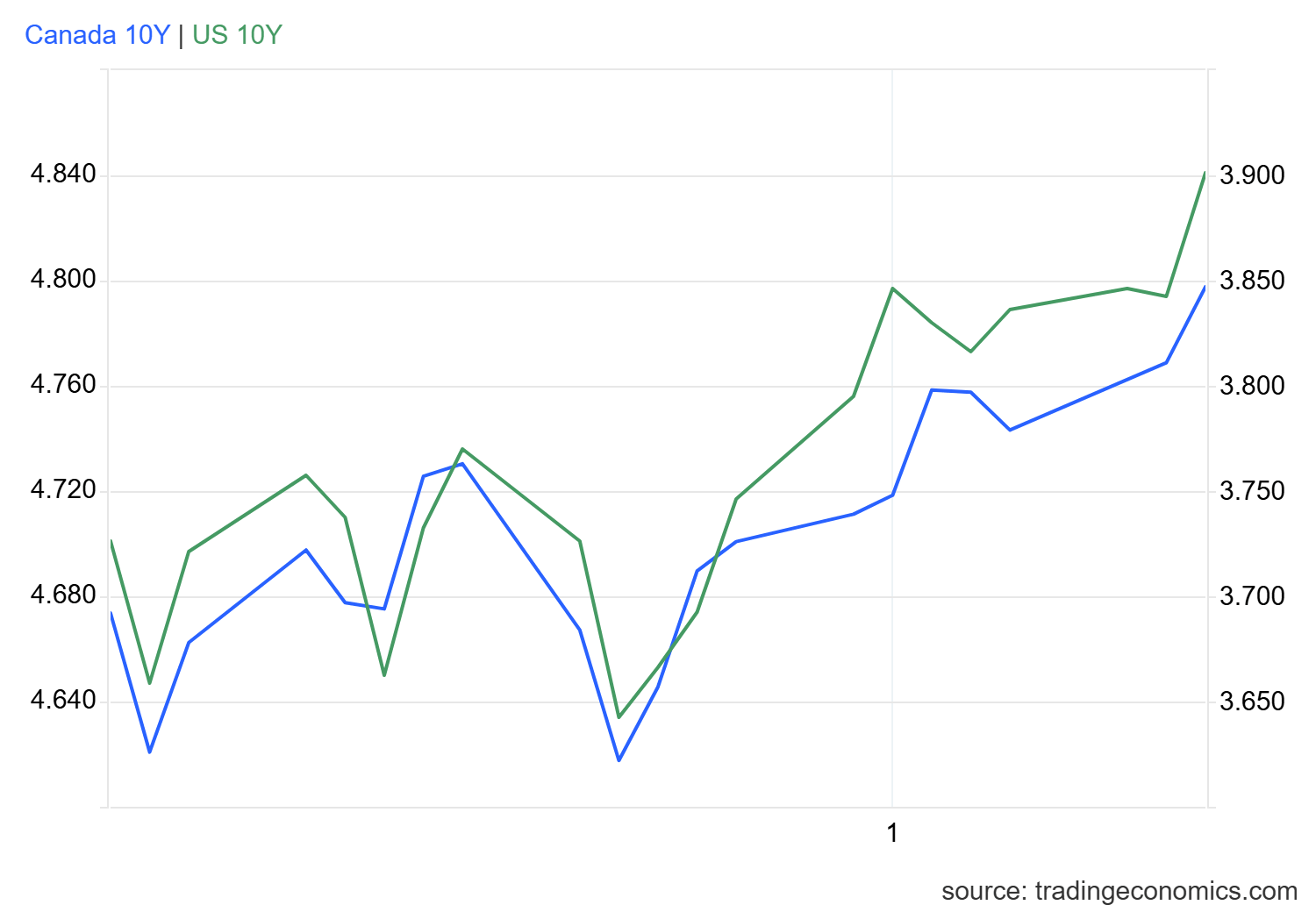
Another important factor within the dynamic of these currencies is the behavior of fixed-income markets. Currently, U.S. 10-year Treasury yields remain above the 4.8% area and continue to maintain a constructive upward trajectory.
However, a similar picture is also emerging in Canada. Canadian 10-year government bond yields continue to trend higher and have already approached the 3.85% area. This suggests that while rising U.S. yields increase the relative appeal of the dollar, Canada continues to maintain supportive conditions within its own bond market.
Source: TradingEconomics
This situation remains important because, beyond highlighting the attractiveness of both fixed-income markets, it also shows that bond market conditions in Canada and the United States continue to evolve in a relatively similar manner. This dynamic may be limiting the ability of either the Canadian dollar or the U.S. dollar to establish clear dominance within the foreign exchange market.
As long as this sense of balance remains present, the recent indecision observed around USD/CAD could continue to be relevant. However, it is also important to consider that new U.S. inflation data will be released later this week. If those figures continue supporting the idea of a Federal Reserve that is more aggressive than the Bank of Canada, stronger demand for the U.S. dollar could develop and open the door to more consistent buying pressure within USD/CAD.
USD/CAD Technical Outlook
Source: StoneX, Tradingview
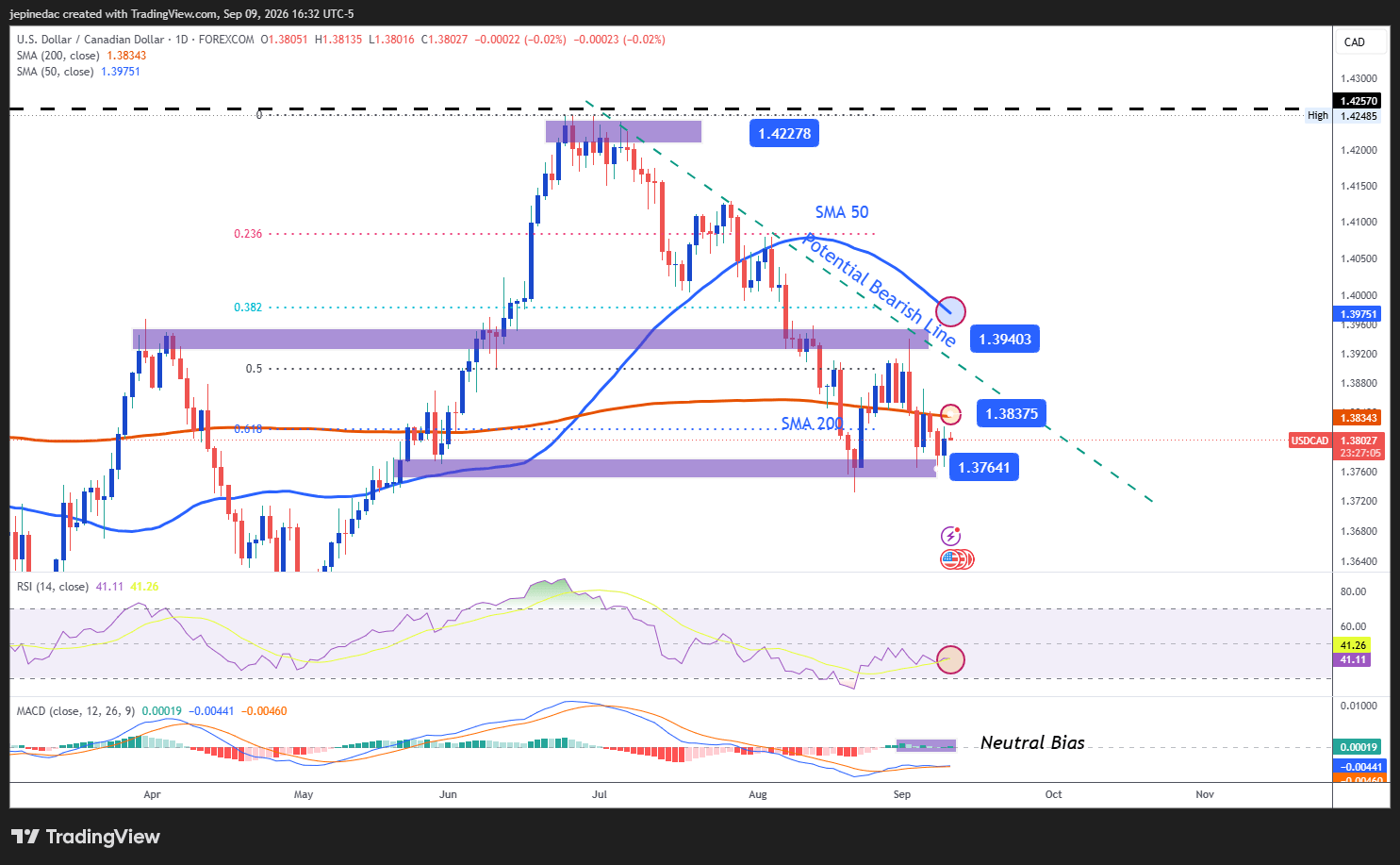
- The Downtrend Continues Attempting to Hold: Price action over recent sessions continues to respect the major bearish trendline that has been developing since July of this year. For now, this remains the most important technical structure on the chart and could continue dominating market activity unless a more significant recovery begins to emerge. At the same time, recent sessions have also highlighted a growing phase of neutrality, a situation that may favor a short-term period of sideways trading if price action continues to lack a more defined direction.
- RSI: The RSI remains close to the neutral 50 level. In addition, the indicator has begun displaying a progressively flatter slope, a development that reflects balance between buying and selling momentum and continues to support a neutral outlook on the chart.
- MACD: A similar picture can be observed in the MACD, as the histogram continues to fluctuate near the neutral 0 line. This behavior reflects balance within the average strength of short-term moving averages and continues to support the idea that a phase of indecision remains relevant within recent USD/CAD price action.
Key Levels:
- 1.39403 – Key Resistance: A recent equilibrium area that coincides with the medium-term bearish trendline and the 50-period moving average. Sustained trading above this level could challenge the dominant bearish structure and create room for a more relevant bullish bias over the coming weeks.
- 1.38375 – Nearby Barrier: A level that coincides with the 200-period Simple Moving Average and the 61.8% Fibonacci retracement. It remains the most important equilibrium area observed over recent weeks and could continue supporting a broader phase of sideways trading if price action fails to move decisively away from this zone.
- 1.37641 – Critical Support: This area corresponds to recent lows and remains the most important downside barrier on the chart. A sustained break below this level would reinforce bearish control and could favor a broader extension of the dominant downtrend over the coming weeks.
Written by Julian Pineda, CFA, CMT – Market Analyst
Follow him on: @julianpineda25



The complete CFD trading experience
Award-winning platforms, competitive spreads, low commissions and dedicated support.
We live and breathe the markets and are dedicated to helping traders realise their ambitions as we continue to set the industry bar.
Economic calendar
Web Trader platform
Our sophisticated web-based platform is packed with features.
Related articles

AUD/USD Bulls Fight Back After Australian Jobs Shock
AUD/USD has been hit by another ugly Australian employment report, sending RBA rate hike expectations sharply lower. Yet the relationships driving the currency have shifted since quarter-end, and improving risk appetite could provide the fuel for a recovery.

USD/JPY Update: Can the Japanese Yen Sustain Its Recovery?
Short-term price action around the Japanese yen has started to show some relative improvement over recent sessions. This can be seen in the recent performance of USD/JPY, which has now recorded three consecutive daily declines in favor of the Japanese currency, resulting in a depreciation of roughly 0.35% over the period.

US Dollar Technical Outlook: DXY, Treasury Yields Retreat Despite Hot CPI 10 15 2026
The US Dollar is testing major support despite hotter inflation as Fed pushback cools yields and forces markets to reassess the path for tightening.

StoneX Europe Ltd may make third party material available on this website which may contain information included but not limited to the conditions of financial markets. The material is for information purposes only and does not contain, and should not be construed as containing, investment advice and/or investment recommendation and/or an investment research and/or an offer of or solicitation for any transactions in financial instruments; any decision to enter into a specific transaction shall be made by the client following an assessment by him/her of their situation.
StoneX Europe Ltd makes no representation or warranty and assumes no liability as to the accuracy or completeness of the information provided, nor any loss arising from any investment based on a recommendation, forecast or other information supplied. You should always seek independent advice as to your suitability to speculate in any related markets and your ability to assume the associated risks, if you are at all unsure. We are not under any obligation to update any such material. Any opinion made may be personal to the author and may not reflect the opinion of StoneX Europe Ltd.